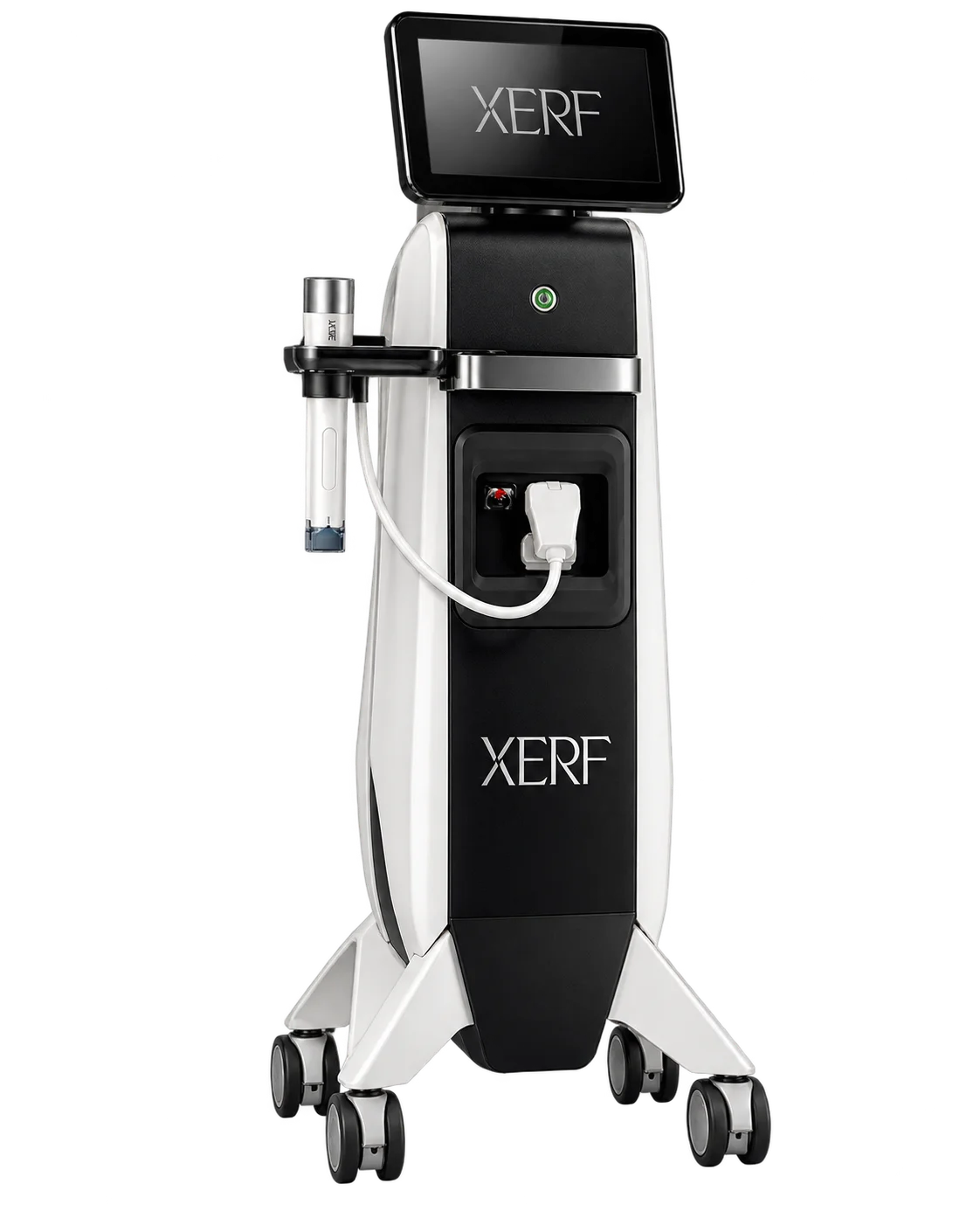
XERF Cost · Portland & Vancouver
What XERF costs, why it costs that, and how the price compares to Ultherapy, Thermage and RF microneedling once you count the number of visits each one needs.
A full XERF treatment costs $1,800 at Cosmetiq Medicine in Vancouver, WA, the clinic where Portland clients come for this treatment, since XERF is not offered at our Portland location. Nationally, published provider pricing runs roughly $1,500 to $3,000 per session. Most clients complete one or two sessions, see an immediate tightening effect the same day, reach peak result somewhere between three and six months, and hold that result for about a year.
That is the short answer, and it is more than most XERF pages will give you. The longer version is where the useful decisions live, because XERF is roughly a year old in the U.S. market, priced like a serious investment, and marketed with language that deserves a closer read.
Key takeaways
- $1,800 per full treatment at our Vancouver, WA clinic, inside the national $1,500 to $3,000 range reported by dermatologists and below the $2,500 full face and neck pricing quoted in several major markets.
- One or two sessions, not a series of six. That is the real cost story. A treatment needing three or four visits at $750 each can total more than a single XERF session.
- Searching for a XERF machine price is a different question. Device pricing runs into six figures and is a practitioner purchase. This guide covers what the treatment costs a client.
- XERF is cleared for electrocoagulation and hemostasis in dermatologic and general surgical procedures. Any provider telling you it is approved for a facelift is overstating it.
- It is a laxity treatment, not a texture treatment. If your concern is acne scarring, pores or surface roughness, RF microneedling will serve you better and cost less.
- XERF is performed on the Washington side only. Our Vancouver clinic on SE Mill Plain Blvd treats clients from across the Portland metro and Clark County.
How much does XERF cost?
Here is the number most pages bury behind a consultation form. Our published pricing also appears on the full treatment price list, and it does not change at checkout.
Pricing shown is our standard published rate. Promotional pricing changes periodically, and current offers are always listed on our specials page. Package pricing cannot be combined with other promotions.
Why XERF is priced the way it is
Three things set the number. The device is new to the U.S. market, so there are few units in any given region and no price pressure from a crowded field. The session treats multiple tissue depths in one pass, which is why a single visit replaces what other platforms spread across several. And the appointment is provider time rather than technician time, since depth and intensity are selected from an assessment rather than a fixed preset.
Whether that makes it expensive depends entirely on the comparison. Against a single visit of almost anything else, $1,800 is a lot. Against a full course of a treatment that needs three or four visits to reach a comparable result, it is often the same or less.
XERF treatment cost compared to XERF machine cost
These two searches look alike and mean completely different things. If you are a client, the treatment is what you pay: $1,800 per session here. If you are a practice owner pricing the device itself, that is a capital equipment purchase in the six-figure range, quoted directly by the manufacturer and not published openly. This guide covers the first question.
The cost math that actually matters
Per-session price is the wrong comparison. Cost per year of result is the right one, because these treatments do not require the same number of visits.
Cosmetiq Medicine published pricing as of September 2026. Actual plans are set at consultation and depend on treatment area and skin assessment.
The takeaway is not that XERF is cheap. It is that a single-session treatment at $1,800 sits in the same annual range as a three-visit RF microneedling series while doing a different job. When someone tells you XERF is expensive, ask what they are comparing it to and how many visits that alternative requires.
For clients spreading the cost, CareCredit and Cherry financing are both accepted, and our Glow and Elite memberships build monthly credits that can be applied toward XERF the same as any other service.
What XERF is, and what the FDA actually cleared
XERF is a monopolar radiofrequency device made by Cynosure Lutronic. Its distinguishing feature is that it fires two radiofrequency frequencies inside a single shot rather than one at a time. Different frequencies deposit energy at different tissue depths, so a dual-frequency pulse heats superficial, mid-dermal and deeper structural layers in one pass instead of forcing the provider to choose.
The depth claim is the interesting one. Cynosure Lutronic reports that histological analysis from multiple studies confirms energy delivery to the SMAS, the fibrous sheet that surgeons reposition during a facelift. Company testing using ultrasound-guided imaging reported thickened, tightened collagen bundles across depths.
Three engineering pieces make that tolerable without numbing cream. Pulse technology reads tissue impedance in real time and modulates output shot by shot. Integrated cryogen cooling keeps the surface cold while the layers underneath heat. And a spider-pattern tip spreads energy to reduce the hot edges that older radiofrequency tips produced.
The regulatory language, stated plainly
This matters more than the marketing. The XERF system's U.S. clearance, announced in August 2025, covers use in dermatologic and general surgical procedures for electrocoagulation and hemostasis. The manufacturer's own product disclosure states that all instances of the term skin tightening are used to describe tightening effects that occur via soft tissue coagulation.
That is not a knock on the device. It is how most energy-based aesthetic devices reach market, and it is the same regulatory footing older radiofrequency platforms sit on. But the honest sentence is cleared for electrocoagulation and used for tightening, not approved for a non-surgical facelift. A clinic that blurs that distinction is telling you something about how it handles the rest of its claims.
XERF vs Ultherapy, Thermage and RF microneedling
Every device in this category claims to tighten. They do not tighten the same tissue, and they are not interchangeable. Here is the practical breakdown.
One note worth knowing if you have had Thermage before. Thermage runs a single frequency through a smaller tip. XERF uses a larger tip and delivers more total energy across the same shot count, which means more coverage per pass and a shorter session as a result.
XERF vs RF microneedling
This is the comparison Portland and Vancouver clients get wrong most often, because both categories are called RF. They solve opposite problems.
The decision rule is simple. Sagging along the jawline or neck points to XERF. Texture, enlarged pores or acne scarring points to RF microneedling. Both concerns at once, and the two are frequently sequenced together: tighten the structure, then refine the surface. Every energy-based option we offer is listed on our laser and facial treatments page.
Filler adds volume. It cannot tighten loose skin. Clients who keep adding syringes to chase sagging usually end up looking heavier, not younger.
The most common mistake we correct at consultationXERF results and how long they last
A full face and neck session at our Vancouver clinic runs about 45 to 60 minutes. Elsewhere you will see 90 minutes quoted, and that difference is usually area count and protocol rather than a different machine. There is no numbing wait built into the appointment, which is a meaningful chunk of the time saving.
- Assessment. Skin thickness, degree of laxity and treatment mapping. Depth and intensity are selected for your anatomy.
- Treatment. The handpiece passes over the mapped zones. Most people describe deep warmth with occasional brief heat, immediately followed by cooling. No needles, no anesthesia.
- Immediately after. Mild warmth or flush that settles within a few hours. Makeup can go straight back on and you can drive yourself home.
- Same day. A visible tightening effect from collagen contraction. This is real, but it is the preview rather than the final result.
- Weeks two to four. Collagen remodeling gets going. This is when the change starts reading to other people rather than only to you.
- Months three to six. Peak result. Jawline definition, neck firmness and overall skin quality reach their best point.
- Around twelve months. Results are typically maintained for about a year, with an annual session recommended to hold the structural gain.

XERF before and after
Photographs are the honest test of any tightening device, and the jawline and neck are where the change shows most clearly. Our XERF before and after results for jowls, jawline and neck are our own clients rather than manufacturer images, photographed in the same lighting at each visit.
XERF aftercare
Genuinely minimal, which is the point of the treatment. There is no wound, no peeling and no activity restriction.
- Skip saunas, hot tubs, steam rooms and hot yoga for 24 to 48 hours.
- Broad-spectrum SPF daily, as always.
- Gentle cleanser and moisturizer for two or three days, and hold retinoids and acids briefly if your skin runs sensitive.
- Hydrate. Collagen remodeling is a metabolic process.
- Exercise, work and travel are all fine the same day.
Who XERF is for, and who should skip it
Non-surgical tightening has a ceiling. Being honest about where it sits saves people a lot of money.
Strong candidates
- Mild to moderate laxity: softening jawline, early jowling, loose skin under the chin, crepey texture on the neck.
- People in their late thirties and forties who want to slow structural collagen loss before it becomes visible sagging.
- Anyone who cannot take recovery time, since a Tuesday appointment does not affect a Wednesday meeting.
- Clients across the full range of skin tones, since real-time impedance feedback and surface cooling make monopolar radiofrequency appropriate for a broader range of skin types than some light-based devices.
- Anyone who has been repeatedly filling the mid-face and still feels the lower face looks heavy.
Poor candidates
- Significant excess skin. If a surgeon would recommend a lift, no radiofrequency device will substitute for one, and we will say so.
- Primary concern is scarring, pigment or pores. That is a resurfacing conversation, not a tightening one.
- Very thin faces with minimal subcutaneous fat, where the assessment matters most and provider experience earns its keep.
- Active infection or inflammation in the treatment area, or certain implanted metal or electronic devices. Your provider screens for these.
- Pregnancy or breastfeeding.
Combining XERF with Botox, filler and other treatments
XERF pairs well, and sequencing is where the result gets better than either treatment alone.
With neuromodulators. Botox and Dysport relax the muscles that create expression lines, while XERF changes the structural envelope. They target different mechanisms and do not compete. Most practices space them by a couple of weeks so any post-treatment warmth does not confuse the assessment.
With filler. This is the sequencing that matters most. Tighten first, then assess volume. Clients who fill first and tighten second frequently discover they needed fewer syringes than they bought. Our dermal filler team in Vancouver plans around this deliberately.
With RF microneedling. The most complete non-surgical plan we build. XERF handles the structure and Potenza handles surface quality, pores and scarring, typically spaced several weeks apart.
With collagen biostimulators. Sculptra and Radiesse build collagen volumetrically over months, working on a similar timeline to XERF's remodeling window. Complementary rather than redundant.
Where to get XERF near Portland, Oregon
Straight answer: on the Washington side. XERF is performed at our Vancouver, WA clinic only. Our Portland location on SE Stark does not offer laser or energy-based treatments, and we would rather tell you that here than after you have booked. The Vancouver clinic serves both markets, and a large share of the people we treat with XERF come over from Oregon.
Cosmetiq Medicine, Vancouver, WA
12000 SE Mill Plain BlvdVancouver, WA 98684
(503) 572-2675
In the Cascade Park area near SE 120th Ave, with parking at the building. Open Tuesday through Friday 9am to 4pm, Saturday 10am to 5pm.
Cosmetiq Medicine, Portland, OR
10735 SE Stark St, Suite 206Portland, OR 97216
Call (503) 572-2675
Botox and Dysport, lip and dermal filler, collagen biostimulators, signature facials, GLP-1 weight loss and IV therapy. See every treatment we offer.
Clients come to our Vancouver clinic for XERF from: Portland · Gresham · Happy Valley · Milwaukie · Troutdale · Clackamas · Hillsboro · Camas · Washougal · Battle Ground · Ridgefield · Salmon Creek · Hazel Dell · Felida · Orchards.
Cosmetiq Medicine is not the only XERF provider in the region, and we would encourage anyone comparing clinics to ask the same questions of all of them: what the published price is, how many sessions they recommend and why, and whether they will show you their own results. Transparent pricing is the baseline rather than the differentiator, and you can read what our own clients say in our reviews and testimonials.
Planning more than one treatment? Sequence it before you spend.
The order you do things in changes what you need and what it costs. Our team will map a plan across both locations, with injectables at either clinic and XERF in Vancouver, and reply the same business day to questions sent through the site.
XERF cost questions we get asked most
How much does a XERF treatment cost near me?
A full XERF treatment is $1,800 at Cosmetiq Medicine in Vancouver, WA. Nationally, published provider pricing runs about $1,500 to $3,000 per session depending on market and treatment area. Because most people need only one or two sessions, the total plan cost is often lower than treatments requiring a series.
Why is XERF so expensive?
Three reasons: the device is new to the U.S. market with few units per region, the session treats several tissue depths in one pass rather than across multiple visits, and the appointment is provider time rather than technician time. Measured per year of result rather than per session, it lands close to treatments that look cheaper up front.
What does a XERF machine cost?
That is a different question from treatment pricing. The XERF device is capital equipment for a practice, priced in the six-figure range and quoted directly by Cynosure Lutronic rather than published. If you are a client rather than a practice owner, the number you want is the per-session treatment price.
Is XERF available in Portland, Oregon?
XERF is performed at our Vancouver, WA clinic at 12000 SE Mill Plain Blvd, which serves both the Portland and Southwest Washington markets. Our Portland location on SE Stark does not offer laser or energy-based treatments, so Portland clients book XERF at the Vancouver clinic.
How many XERF sessions do I need?
Most people complete one or two sessions. A second treatment is typically scheduled four to six weeks after the first to compound the collagen response. Your provider recommends the plan after assessing skin thickness and degree of laxity, and some clients are done after one.
Does XERF hurt?
Most people rate XERF a one or two out of ten. The sensation is deep warmth with occasional brief heat, immediately followed by cooling. Pulse technology modulates energy in real time and integrated cooling protects the surface, so numbing cream is generally not needed.
How long do XERF results last?
Results are typically maintained for about twelve months. Tightening is visible the same day from collagen contraction, builds through months three to six as new collagen forms, then gradually softens. An annual session is recommended to hold the structural gain.
What is the recovery time after XERF?
Most people return to normal activity the same day. Mild warmth or flush settles within a few hours, and there is no peeling or activity restriction. Avoid saunas, hot tubs and steam for 24 to 48 hours, wear daily SPF, and otherwise carry on as usual including makeup, exercise and work.
Is XERF better than Ultherapy or Thermage?
They are different tools rather than better or worse. Ultherapy uses focused ultrasound at discrete depths and Thermage uses single-frequency monopolar radiofrequency. XERF combines two frequencies in one shot to heat multiple depths at once and typically requires no numbing, which is its main practical advantage.
Can XERF be combined with Botox or filler?
Yes, and sequencing matters. Tightening first and assessing volume second often means fewer syringes of filler are needed. Neuromodulators address muscle-driven expression lines while XERF addresses structural laxity, so the two are complementary. Most practices space the treatments a couple of weeks apart.
Is XERF FDA approved?
The XERF system received U.S. FDA clearance in August 2025 for use in dermatologic and general surgical procedures for electrocoagulation and hemostasis. The manufacturer states that skin tightening describes tightening effects occurring via soft tissue coagulation. Clearance and approval are different regulatory pathways, and clearance is the accurate term.
Deciding whether XERF is worth the money
Work through three questions in order. First, is your concern laxity or texture? If it is texture, stop here and read about RF microneedling instead, because you will get a better result for less money. Second, is the laxity mild to moderate, or is it significant? If a surgeon would recommend a lift, spend your consultation with one. Third, does the annual math work? At $1,800 for a single session that holds roughly a year, XERF competes directly with multi-visit protocols. At $3,600 for two sessions it becomes a considered purchase.
If you answered laxity, moderate and yes, the practical next step is a consultation that includes a skin assessment rather than a sales pitch. Ours takes about fifteen minutes and frequently ends with a recommendation for something other than XERF, because the assessment is the point.
Book a XERF consultation at our Vancouver, WA clinic
Transparent pricing, an honest assessment of whether you are a candidate, and a plan built around your anatomy rather than a package. Portland clients are welcome, and questions sent through the site get a reply the same business day.
Sources and further reading
- Cynosure Lutronic, XERF structural skin tightening technology, clinical data and product disclosures.
- U.S. Food and Drug Administration, device approvals, denials and clearances, explaining how clearance differs from approval.
- TODAY, dermatologists on XERF safety, results and pricing, March 2026.
- Cosmetiq Medicine, published treatment pricing for Portland, OR and Vancouver, WA, September 2026.