Complexion & Tone
A Layered Approach to Dark Spots, Melasma & Uneven Tone
Discoloration is the concern people study most closely in the mirror and understand least. Cosmetiq Lux Glow is our signature complexion treatment for patients across Portland, Oregon and Vancouver, Washington — built around a simple clinical truth: dark spots are not one condition, and the right plan depends entirely on which kind you have.

What Lux Glow Is
Lux Glow is a physician-designed complexion protocol built around the REJURAN® Tone-Up Booster — a formula combining low-molecular-weight hydrolyzed DNA with ascorbic acid, glutathione, and tranexamic acid — paired with an exosome and GHK‑Cu complex. It is designed to support a brighter, more even-looking complexion and healthier-looking skin quality, gradually rather than instantly.
Who Tends to Consider It
Most patients arrive after trying to fix discoloration alone — a brightening serum here, an aggressive peel there, sometimes a treatment that made pigment worse instead of better. They are looking for dull, tired-looking skin to read as luminous again, and for someone to finally tell them what kind of pigment they are actually dealing with.
The Honest Framing on Melasma
If your concern is melasma, read this part twice: melasma is a chronic, recurring condition, and no treatment — including this one — cures it. Lux Glow can be considered as part of a broader melasma plan built around daily photoprotection and realistic maintenance. Anyone promising you permanent clearance is selling, not treating.
A Pacific Northwest Note
Gray Skies Are Not Sun Protection
There is a belief around here that nine months of cloud cover means pigment gets a break. It does not. UVA passes through cloud layers and car windows, and visible light contributes to melasma as well — which is why dermatologists often recommend a tinted, iron-oxide-containing sunscreen for pigment-prone skin. The patients who see the least benefit from any brightening treatment are usually the ones who put sunscreen away in October and take it back out in June.
This matters more than any product recommendation on this page. Pigment treatment without daily photoprotection is a rented result.
Not a Peel. Not a Laser. Not a Serum.
Brightening treatments work through very different mechanisms — and for pigment-prone skin, mechanism matters enormously. Here is where Lux Glow sits.
Versus a chemical peel
Peels work by controlled exfoliation, and depth is everything — too aggressive on melasma-prone skin can worsen pigment rather than clear it. Lux Glow is a formula-led, barrier-conscious approach. Peels and the VI Peel still have a real role — often as a planned part of a combined program.
Versus IPL & laser
Light and laser devices excel at sun-related spots and vascular discoloration. On melasma and richer skin tones, heat and energy require careful selection and settings, because the wrong device can trigger rebound pigment. Our laser treatments are recommended when the pigment type genuinely calls for them — not by default.
Versus microneedling alone
Microneedling is a delivery and remodeling method rather than a brightening agent by itself; research on melasma has focused on pairing it with topical therapy. Microneedling and Lux Glow are not competitors so much as different layers of a plan your provider sequences.
Versus a home brightening routine
Good home care is genuinely half the outcome in pigment work — it is the part that runs every day between visits. What it cannot do is deliver a professional formulation under clinical supervision, or tell you which type of discoloration you have in the first place.
Why Pigment Deserves a Diagnosis First
The same spot, different causes
Sun damage, melasma, and marks left behind by acne or irritation can look similar in the mirror and behave nothing alike under treatment. Guessing is how people make pigment worse.
Treatable is not the same as curable
Some discoloration clears well and stays gone. Melasma is managed rather than cured — a distinction worth understanding before you spend money on either.
Skin tone changes the plan
Richer skin tones carry a higher risk of post-inflammatory pigment, which makes treatment selection and intensity a genuinely clinical decision — never a menu pick.
Inside the Vial
What Is Actually in Lux Glow — and How Strong the Evidence Is
Brightening products are marketed on ingredient reputation. We would rather show you the actual architecture: a REJURAN® Tone-Up Booster base combined with an exosome and GHK‑Cu complex, five working components in total — each with a specific job and a specific level of scientific backing.
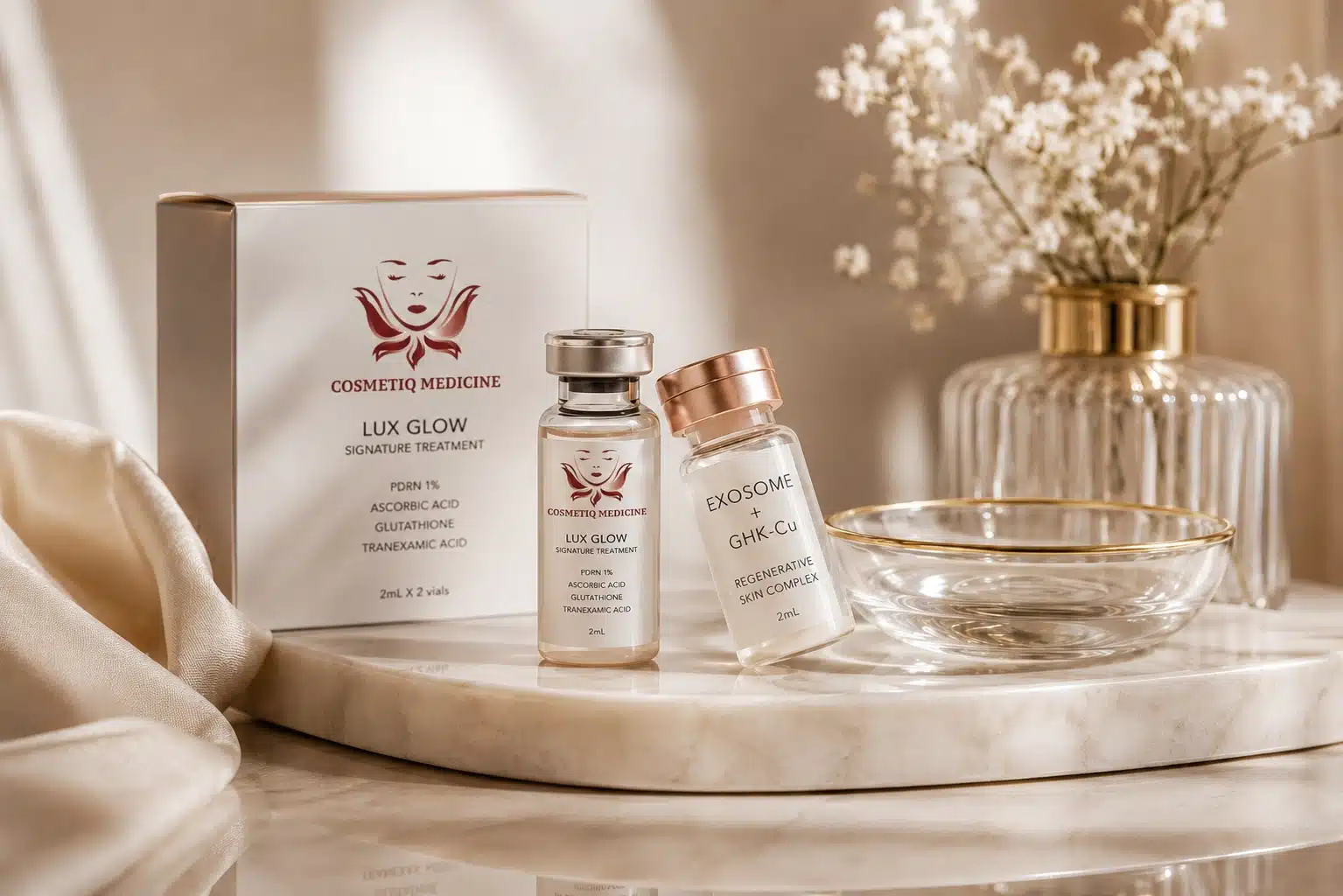
A note on honesty: an ingredient having strong published evidence in one form does not mean every formulation or delivery method carries that same evidence. Where the research is specific, we say so — and where it is not, we say that too.
Tranexamic Acid
The most clinically interesting component for pigment. Tranexamic acid has become one of the more studied options in melasma care, with systematic reviews of randomized trials examining its effect. Two caveats that matter: results differ substantially depending on how it is delivered — oral, topical, or into the skin — and the oral route in particular carries clotting considerations that require medical screening. Your provider confirms the route used in your protocol.
Ascorbic Acid (Vitamin C)
A well-known antioxidant with a long-standing role in brightening formulations, valued for supporting a more radiant, even-looking complexion and helping defend against environmental stress. Its real-world performance depends heavily on concentration, stability, and formulation — which is precisely why a professional protocol differs from a shelf product.
Glutathione
An antioxidant frequently included in complexion and brightening formulas. It is popular globally and genuinely interesting, but the human clinical evidence varies widely by route and dose — so we include it for its antioxidant rationale within the formula rather than as the reason the treatment works.
Hydrolyzed DNA (Polynucleotides)
The same low-molecular-weight polynucleotide base found across the REJURAN® line, most commonly salmon-derived. Research points toward support for skin quality, hydration, and the appearance of elasticity — the "skin health" half of the protocol, alongside the brightening half. The literature is growing but remains product-specific.
Exosome + GHK‑Cu Complex
Exosomes are cell-signaling vesicles and GHK‑Cu is a long-studied copper peptide; both are included to support a calm, comfortable, well-supported skin environment around treatment. Both are also earlier in their clinical research than the pigment ingredients above, and we describe them accordingly — no outcome promises rest on them.
How We Grade the Evidence
Pigment is the category where overclaiming does the most damage — to expectations and sometimes to skin. Here is the standard this page holds itself to.
Well established
Daily photoprotection as the foundation of every pigment plan. Professional assessment to identify which type of discoloration you have. Tranexamic acid's studied role in melasma care.
Emerging
Polynucleotide and hydrolyzed-DNA treatments for skin quality. Promising and actively researched, though the aesthetic evidence base remains smaller and less standardized than for established pigment therapies.
Early
Exosome-based aesthetic treatments and many GHK‑Cu claims — largely mechanistic and preclinical so far. Interesting science, still early, and never the basis for a promise.
The strongest thing we can offer is not a bigger claim — it is a correct diagnosis, a realistic plan, and a provider who will tell you when something is not the right fit.
Two goals, one protocol: supporting a brighter, more even-looking complexion while supporting the skin's overall quality and resilience.
Pigment Mapping
Not All Dark Spots Are the Same — and That Changes Everything
Before any brightening treatment in Portland or Vancouver, the useful question is not "what will fix this?" but "what is this?" Four common types of discoloration can look alike in the mirror and respond very differently to the same treatment. Here is how providers tell them apart.
Four Kinds of Discoloration
Type 01
Melasma
Symmetrical, blotchy patches — often across the cheeks, upper lip, or forehead. Frequently linked to hormones, heat, and light exposure, and known for fading and returning in cycles.
What to expect: managed, not cured. Lux Glow can be considered within a broader plan built on daily photoprotection and maintenance.
Type 02
Sun spots & solar lentigines
Discrete, well-defined brown spots from accumulated UV exposure — most often on the face, chest, and backs of the hands, and more common with age.
What to expect: often responsive to brightening care, though targeted laser or light treatment may work faster for defined spots.
Type 03
Post-inflammatory marks
The marks left behind after acne, irritation, or an aggressive treatment. More common and longer-lasting in richer skin tones — and easily worsened by treating them too aggressively.
What to expect: patience and gentleness win here. Calming the underlying cause comes before brightening it.
Type 04
Redness & vascular tone
Not pigment at all — visible vessels and flushing that read as uneven color. Brightening ingredients do not address this, because the target is blood vessels rather than melanin.
What to expect: a different tool entirely, which is exactly why the assessment comes first.
Many patients have more than one type at once — a common reason a single-product routine stalls partway to the result.
What Patients Tell Us They See
- Dark spots & discoloration
- Melasma patches
- Uneven skin tone
- Dull, tired-looking skin
- Sun damage
- Post-acne marks
- Lost radiance
- Makeup worn to even out color
How Lux Glow Compares to Other Brightening Options
A straight answer to the question most patients are actually weighing.
| Approach | How it works | Often suited to | Melasma consideration |
|---|---|---|---|
| Cosmetiq Lux Glow | A professional formula protocol combining brightening actives with skin-quality support | Dullness, uneven tone, and superficial discoloration where a barrier-conscious approach is preferred | May be considered within a broader melasma plan — not a cure |
| Chemical peel | Controlled exfoliation of the skin's surface layers | Surface texture, dullness, and some superficial pigment | Depth must be chosen carefully; too aggressive can worsen pigment |
| IPL & laser | Targeted light or laser energy directed at pigment or vessels | Defined sun spots and vascular redness | Requires careful device and setting selection; heat can trigger rebound |
| Microneedling | Micro-channels that remodel skin and assist topical delivery | Texture, scarring, and overall skin quality | Studied mainly as a partner to topical therapy rather than alone |
| Home brightening routine | Daily topical actives and — critically — daily sunscreen | Everyone. This is the maintenance layer under every plan | Essential; without photoprotection, results are temporary |
These approaches are not rivals. Most durable complexion plans combine two or three of them in a deliberate order.
Where Lux Glow Fits — and Where It Doesn't
May help improve the appearance of
- Dull, environmentally stressed skin that has lost its luminosity
- Uneven-looking tone and superficial discoloration
- Overall skin quality, hydration, and barrier resilience
- Melasma-prone skin, as one component of a broader, photoprotection-first plan
- Complexion refinement for patients who want a gradual, barrier-conscious approach
May call for a different or combined plan
- Deep, defined sun spots that may respond faster to targeted laser or light treatment
- Redness and visible vessels, which are vascular rather than pigment concerns
- Active acne or inflammation, which is treated before the marks it leaves behind
- Textural concerns and scarring, where RF microneedling may lead the plan
- Sun damage paired with crepey texture on the face and neck, where Cellular Rebirth may be the better fit
- Any new, changing, or irregular spot — which needs a medical evaluation, not a cosmetic one
If something on your skin is new, changing, itching, or bleeding, please have it looked at medically before booking anything cosmetic.
Not sure which kind of discoloration you have? That is the first thing we figure out — together.
Prefer to start from a photo? Try our photo treatment planner for a first read on your options.
Planning Your Treatment
Candidacy, Your Appointment & the Long Game
Complexion work is the most maintenance-dependent category in aesthetics — which makes the plan around the treatment as important as the treatment itself. Here is who tends to be a fit, how a Lux Glow visit unfolds at our Portland and Vancouver clinics, and what keeps a result once you have it.
Who Tends to Be a Candidate
Often a good fit
- Adults bothered by dullness, uneven tone, or superficial discoloration
- Patients with melasma-prone skin looking for a barrier-conscious option inside a broader plan
- Anyone willing to commit to daily sun protection — genuinely the deciding factor in pigment work
- People who want gradual complexion refinement rather than an aggressive resurfacing approach
Talk with us first
- Pregnant or breastfeeding patients — elective treatments are typically deferred, and pregnancy-related melasma often changes on its own
- Anyone with a personal or family history of clotting disorders, or taking hormonal or blood-thinning medication — relevant to how tranexamic acid is used
- Active infection, cold sores, or an inflammatory skin flare in the treatment area
- Allergies, including sensitivity to marine- or salmon-derived ingredients found in many polynucleotide formulas
- A history of keloids, recent procedures, or any new or changing spot that needs medical evaluation first
Candidacy — including whether tranexamic acid is appropriate for you and how it would be delivered — is confirmed in person by your provider, never by a web page.
How the Visit Unfolds
Consultation & pigment assessment
Your provider examines your skin in person to sort what kind of discoloration you have — melasma, sun damage, post-inflammatory marks, vascular tone, or a mix — alongside your history, medications, skin tone, and goals. This is the step that determines whether Lux Glow is the right recommendation at all.
Preparation & comfort
Skin is cleansed and prepped, and your provider walks through the comfort measures appropriate to your protocol. If any pre-treatment steps are advised for your skin type or pigment risk, they are discussed before treatment day rather than sprung on you at the appointment.
The treatment itself
Your provider delivers the Lux Glow protocol using the technique confirmed for your personalized plan. Appointment length depends on that plan — you will be told exactly how much time to set aside when you book.
Aftercare, sun protection & series planning
You leave with specific aftercare guidance, a serious conversation about daily photoprotection, and — if a series is recommended — a schedule mapped to how your skin responds. You will also know exactly how to reach the clinic with questions afterward.
The Part That Decides Your Result
Photoprotection Is the Treatment Between Treatments
Every credible authority on pigment says the same thing, and the American Academy of Dermatology puts it plainly: sun exposure darkens existing melasma and drives new patches, so daily broad-spectrum protection is essential both to fade discoloration and to keep it from returning. For pigment-prone skin, dermatologists frequently recommend a tinted sunscreen containing iron oxides, because visible light — not just UV — plays a role.
In practical terms, for Portland and Vancouver patients:
- Daily broad-spectrum sunscreen, year-round — including the overcast months
- Reapplication on long days outdoors, near windows, or driving
- Hats and shade during peak hours, especially in summer
- Consistency over intensity — the routine you actually keep beats the perfect one you abandon
We would rather you skip the treatment than skip this part.
What Changes When — Honestly
Pigment does not erase on a schedule. This is the realistic arc, and your provider will refine it for your plan.
Right after
Settling, not judging
Depending on how your treatment is delivered, temporary redness, mild swelling, tenderness, or dryness can occur and then settle. Any early freshness is a preview of skin quality — not the pigment verdict.
The first days
Gentle, protected care
Mild cleansing, diligent sunscreen, and a pause on strong actives and makeup near the treated area until your provider clears them. Being gentle now protects against the irritation that can leave marks of its own.
Over the weeks & series
Gradual, then maintained
Tone and brightness changes tend to develop gradually, and complexion protocols often build across a recommended series. Results vary from person to person — and with melasma especially, maintenance is part of the plan rather than a sign something went wrong.
Safety, Reviewed Before Anything Else
Every Lux Glow plan is built on the same review, whichever clinic you visit:
- Medical history & medications. A full review before treatment — including hormonal medications, blood thinners, clotting history, and supplements that affect skin, healing, or bruising.
- Skin tone & pigment risk. Richer skin tones carry a higher risk of post-inflammatory pigment, so treatment selection and intensity are assessed individually. No protocol is automatically appropriate for every skin type.
- Allergies. Tell your provider about all allergies, including any sensitivity to marine- or salmon-derived ingredients used in many polynucleotide products.
- Pregnancy & breastfeeding. Elective aesthetic treatments are typically postponed, and pregnancy-related pigment often shifts on its own afterward.
- Active irritation or infection. If skin in the treatment area is inflamed, broken, or flaring, treatment waits until it settles.
- Clear escalation guidance. You leave knowing what is expected, what is not, and how to reach the clinic promptly at (503) 572‑2675.
Unsure whether something in your history rules you out? Ask us before booking — it is a two-minute conversation.
Questions & Booking
Lux Glow Questions, Answered Honestly
The questions patients actually ask before booking a dark spot or melasma treatment in Portland or Vancouver — including the ones with uncomfortable answers.
What is Cosmetiq Lux Glow?
Cosmetiq Lux Glow is our signature complexion treatment, offered at both our Portland, OR and Vancouver, WA clinics. It combines the REJURAN® Tone-Up Booster — low-molecular-weight hydrolyzed DNA with ascorbic acid, glutathione, and tranexamic acid — with an exosome and GHK‑Cu complex. It is designed to support a brighter, more even-looking complexion alongside overall skin quality, and every plan begins with identifying what type of discoloration you actually have.
Can Lux Glow treat melasma?
It may be considered as one part of a melasma plan — not as a standalone solution, and not as a cure. Melasma is a chronic, recurring condition influenced by hormones, heat, and light exposure. A realistic melasma plan combines in-clinic treatment with daily photoprotection and ongoing maintenance, and your provider will be direct with you about what is achievable for your specific pattern.
Will my melasma come back?
It can — and pretending otherwise would not serve you. Melasma is known for recurring, particularly with sun exposure, heat, and hormonal shifts, and the American Academy of Dermatology notes it can persist for years. That is precisely why maintenance and daily sun protection are treated as part of the plan here rather than as an afterthought.
Is it safe for darker skin tones?
Candidacy is assessed individually rather than by category. Richer skin tones carry a higher risk of post-inflammatory hyperpigmentation, which makes treatment selection and intensity a genuinely clinical decision — one reason a barrier-conscious, formula-led approach is often preferred over aggressive resurfacing for pigment-prone skin. No page should tell you a protocol is safe for every skin type without an assessment, and this one will not.
How is this different from a chemical peel or the VI Peel?
A peel works by controlled exfoliation of surface layers; Lux Glow is a formula-led protocol that pairs brightening actives with skin-quality support. For melasma-prone skin, peel depth has to be chosen carefully because too much intensity can worsen pigment. Chemical peels and the VI Peel remain excellent tools — often used alongside Lux Glow in a sequenced plan rather than instead of it.
How is it different from IPL or laser treatment?
Light and laser devices deliver energy targeted at pigment or blood vessels, and they can be excellent for defined sun spots and vascular redness. With melasma and richer skin tones, heat and energy require careful device selection because the wrong choice can provoke rebound pigment. We recommend laser treatment when your pigment type calls for it — not as a default.
How many sessions will I need?
It depends on your pigment type, skin, and goals, and any specific number quoted before an assessment is guesswork. Complexion protocols typically build across a series, so your provider maps session count and spacing — plus any maintenance — to how your skin actually responds. With melasma in particular, maintenance is an expected part of the plan.
When will I see results?
Gradually. Some patients notice skin looking fresher and better hydrated relatively early, while changes in tone and brightness tend to develop over the following weeks and across a series. Pigment work is measured in months more often than days — and results vary from person to person, particularly depending on how consistent sun protection is.
Is there downtime?
Plan for short-term effects rather than true downtime: depending on how your treatment is delivered, temporary redness, mild swelling, tenderness, or dryness can occur and then settle. Aftercare is deliberately gentle — mild cleansing, diligent sunscreen, and a pause on strong actives near the treated area until your provider clears them, since irritation itself can leave marks on pigment-prone skin.
Do I really have to wear sunscreen every day?
For pigment concerns, yes — it is the single highest-value habit in the entire plan, and that includes our gray Pacific Northwest months. UVA passes through cloud cover and window glass, and visible light contributes to melasma too, which is why tinted sunscreens containing iron oxides are often recommended for pigment-prone skin. Treating discoloration without daily protection is like bailing a boat without patching it.
Can it be combined with other treatments?
Often, yes — most durable complexion plans are combinations. Lux Glow may be sequenced with peels, laser, microneedling, or medical-grade home care, and it pairs naturally with our other signature treatments: DNA Renewal for fine lines and texture, or Eye Luminance for the under-eye area. Timing and order matter with pigment, so combinations are coordinated by your provider.
Is tranexamic acid safe? I've read about clotting risks.
That is a well-informed question. Tranexamic acid is delivered several different ways — orally, topically, or into the skin — and the safety profile differs meaningfully by route, with oral use carrying clotting considerations that require medical screening. Your medical history, clotting history, and medications are reviewed before treatment, and your provider will confirm which route applies to your protocol and whether it is appropriate for you.
Is Lux Glow available in both Portland and Vancouver?
Yes. The same signature protocol is offered at Cosmetiq Medicine in Portland, Oregon and at our Vancouver, Washington clinic on SE Mill Plain Blvd — so you can book whichever side of the river fits your schedule.
The Signature Treatment Collection
Four protocols, four different jobs. Most patients start with one and combine once they know which concern belongs where.
You are here
Lux Glow
Dark spots, uneven tone, melasma-prone skin.
Signature Treatment
DNA Renewal
Fine lines, texture, hydration, early aging.
Signature Treatment
Eye Luminance
Under-eye quality, dark circles, crepey texture.
Signature Treatment
Cellular Rebirth
Face & neck, mature or crepey-looking skin.
One Signature Treatment, Two Clinics
Portland, Oregon
10735 SE Stark St, Suite 206
Portland, OR 97216
Physician-led complexion care for the Portland metro — Lux Glow sits alongside peels, laser, and injectables, so combination plans happen under one roof.
Book in PortlandVancouver, Washington
12000 SE Mill Plain Blvd
Vancouver, WA 98684
The same signature protocol on the Vancouver side — convenient for Camas, Orchards, and the rest of Clark County, no bridge required.
Book in VancouverRelated Treatments to Explore
Complexion plans are usually built from more than one tool. These are the pages patients read next:
Cosmetiq Lux Glow · Portland & Vancouver
Name the Spot Before You Treat It. That's Where We Start.
Book a consultation at either clinic and leave knowing what kind of discoloration you have, what can realistically change, and what it will take to keep it — whether the answer is Lux Glow, a combination plan, or something else entirely.
Prefer to talk first? Call (503) 572‑2675 or send us a question — no pressure, ever.