Sagging along the jaw is the change most people notice first and photograph worst — and it is the one area where a well-run radiofrequency protocol earns its reputation.
In XERF before and after photos, the visible change is almost always structural rather than surface-level: a cleaner shadow line under the jaw, less overhang at the jowl, and a sharper angle where the chin meets the neck. Most people need two sessions about four weeks apart, with the fullest change appearing between eight and twenty-four weeks as new collagen matures.
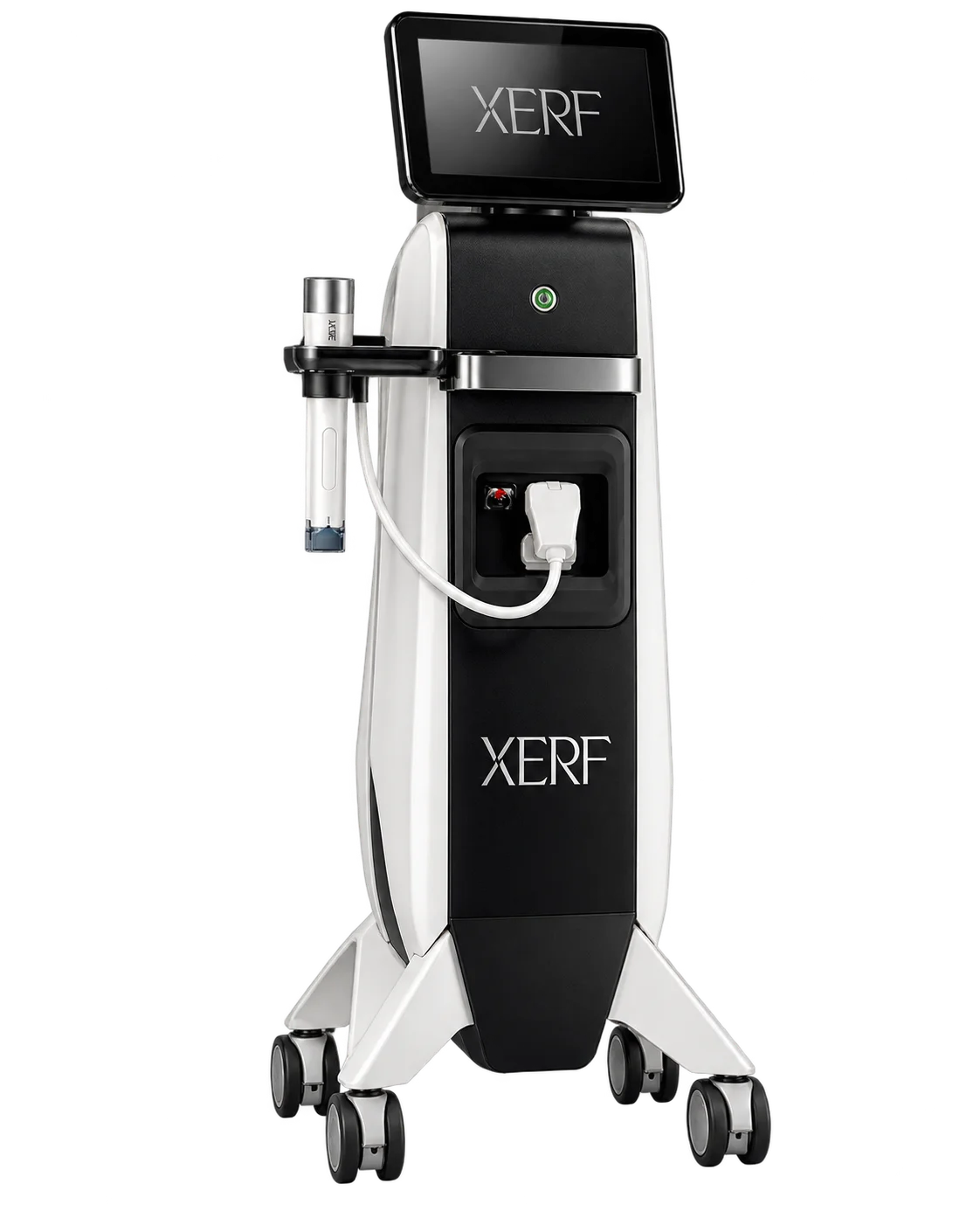
XERF is a non-invasive monopolar radiofrequency treatment. It does not remove tissue, and it does not substitute for surgery when laxity is advanced. What it does well is tighten mild-to-moderate looseness in the lower face and neck without needles, numbing, or downtime.
Nearly every question we field about XERF skin tightening in Portland and Vancouver comes down to a single, reasonable doubt: do the before and after photos actually show anything, or is it lighting and a better camera angle?
It is a fair question. RF skin tightening is a category that has been oversold for two decades, and the before and after galleries are frequently the worst offenders — different lighting, different head position, a slight chin lift that manufactures a jawline out of nothing.
So this article does something different. Each comparison below opens on the before photograph — press After to switch between the two — and under each one is a short read of what to look at — the specific anatomical landmarks that change when radiofrequency works, and the ones that do not change no matter what a photo suggests. If you learn to read the landmarks, you can evaluate any provider’s gallery, including ours.
A jawline cannot be photographed into existence. A shadow can. Knowing the difference is most of what separates a credible result from a marketed one.
Comparison one
XERF Before and After: Jowls and the Lower Face
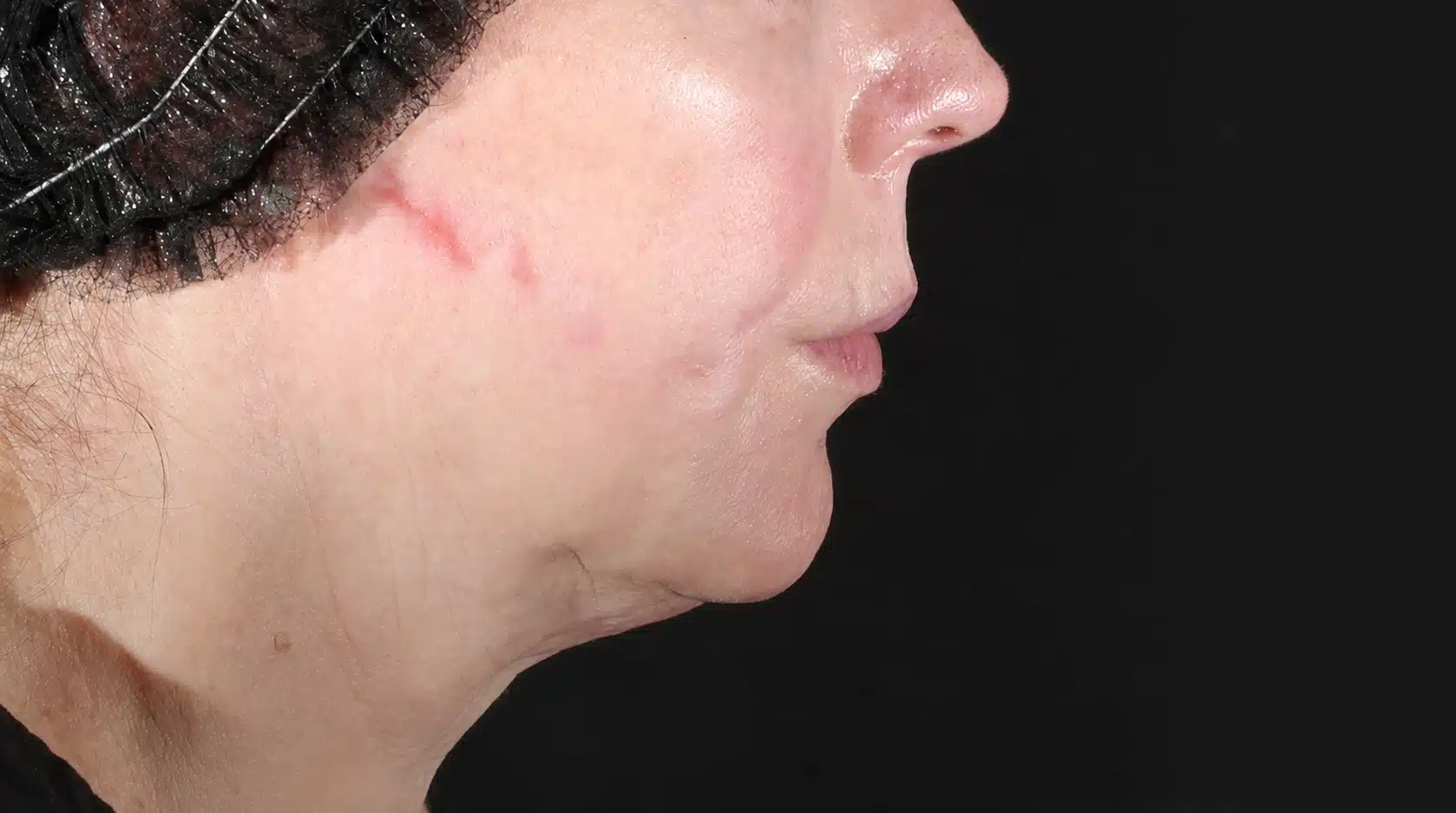
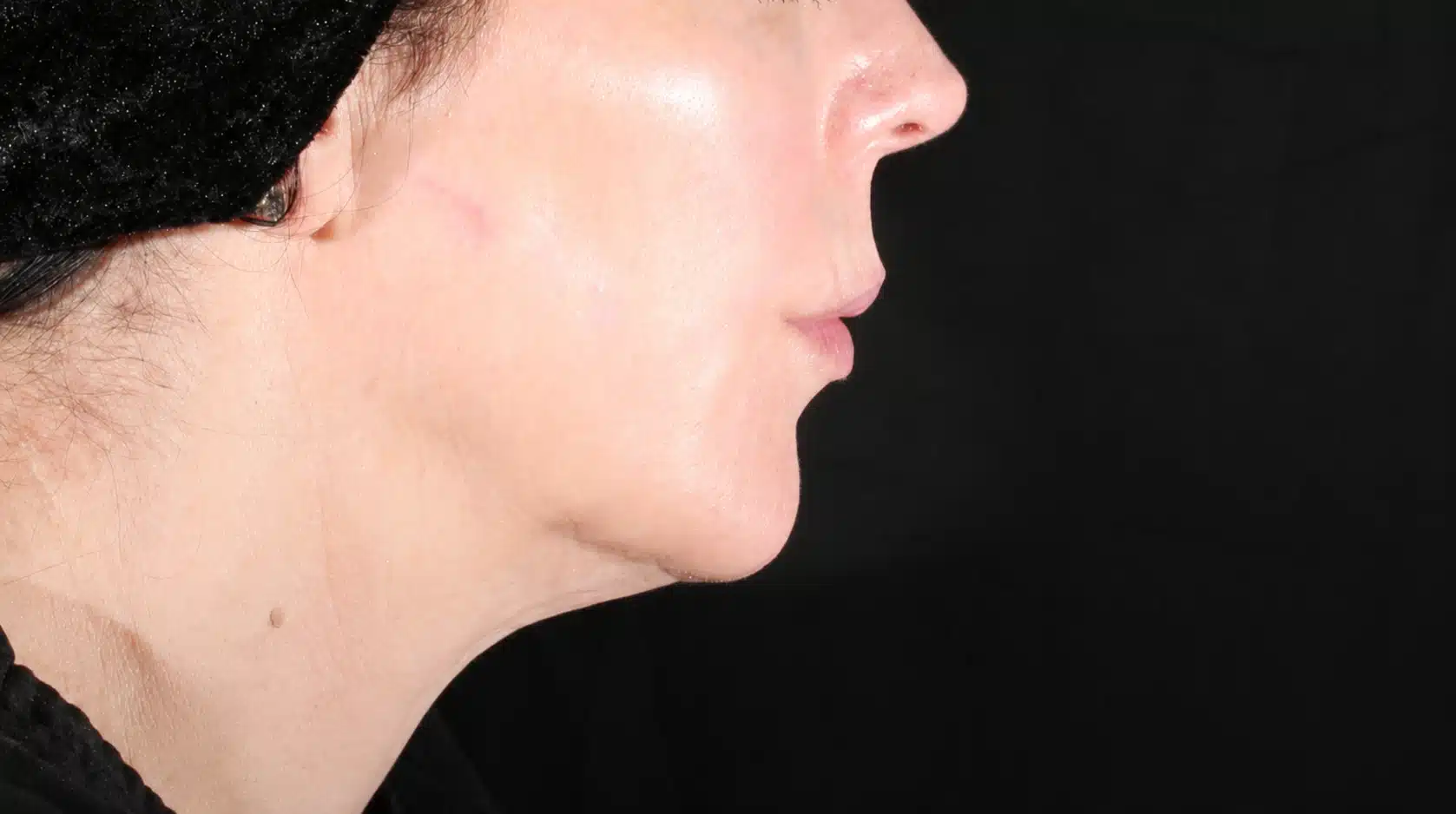
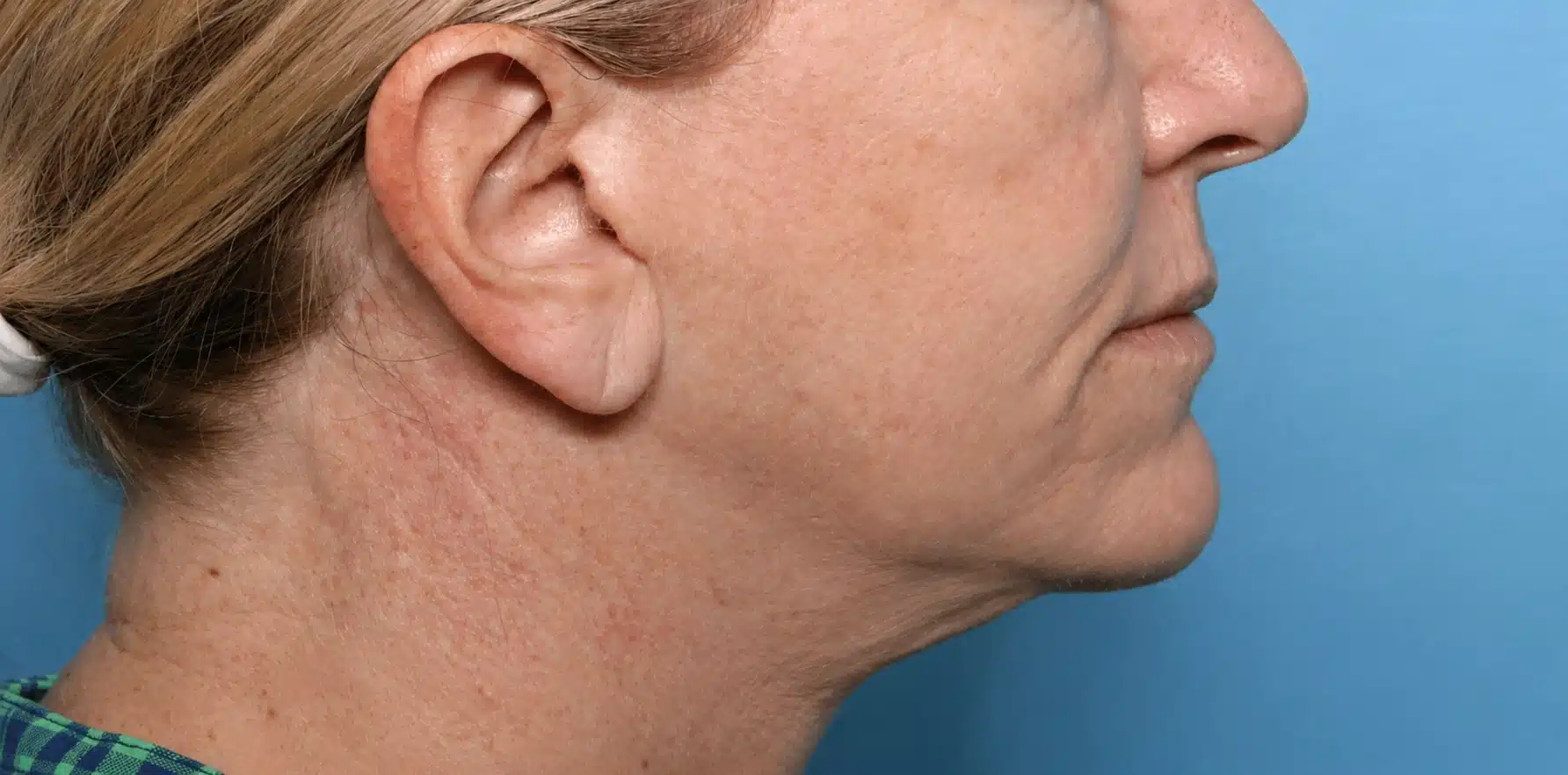
Jowls form when the retaining ligaments and fibrous septa that suspend the mid-face lose tension, and soft tissue that used to sit over the cheekbone drifts down to rest on the jawline. The result is a small shelf of tissue that breaks what used to be a continuous line from ear to chin.
This is the area where jowl tightening without surgery is most often searched and least often explained honestly. Radiofrequency does not lift tissue upward the way a surgical procedure repositions it. It contracts and thickens the connective scaffolding underneath, which reduces the overhang and softens the break in the jaw line.
 Before
After
Before
After
Use the Before and After buttons to switch between the two photographs. Individual results vary.
- 1The jawline breakFollow the mandible from the earlobe forward. In the before image the line interrupts partway along and resumes near the chin. A genuine result narrows that interruption; it rarely erases it.
- 2Overhang below the boneLook for tissue sitting below the jaw bone rather than on it. Reduction here is the single most reliable indicator that deep tissue contracted.
- 3The marionette shadowThe crease running down from the corner of the mouth softens when the tissue above it is better supported. If this line is unchanged but the jaw looks sharper, suspect the camera angle.
What is actually changing
Why Radio Frequency Skin Tightening Works on Jowls, Jawline and Neck
Skin laxity is a collagen problem before it is a skin problem. Dermal collagen content declines steadily from the mid-twenties onward, and photodamage degrades the elastin network that lets skin snap back. By the time jowls appear, the scaffolding has thinned — the surface is simply reporting what happened underneath.
Radiofrequency treats the scaffolding. RF energy passes through tissue and generates heat by resistance rather than by light absorption, which means — unlike lasers — it is not affected by skin tone and reaches deeper than light-based devices can. Heat that reaches the therapeutic window causes existing collagen fibers to contract immediately, then triggers a wound-healing response that lays down new collagen over the following months. The Cleveland Clinic’s overview of RF skin tightening describes the same two-phase mechanism, and a clinical review of radiofrequency for facial wrinkles and laxity notes that peak effect in most protocols lands around the three-month mark.
Two frequencies, three depths
Most monopolar RF devices deliver one frequency, which means one dominant depth of heating. XERF is the first multifrequency monopolar RF system, combining 6.78 MHz and 2 MHz so a provider can place energy at shallow, middle and deep tissue levels rather than at a single plane. According to Cynosure Lutronic, the manufacturer of XERF, the platform offers three depth settings and ten intensity levels, and adjusts in real time to each patient’s skin using impedance feedback.
That matters specifically for the jaw and neck. The tissue there is layered — thin skin, then fat, then the fibrous septa and SMAS that provide structural support. Heating only the dermis produces a texture improvement. Heating the septa is what produces a contour change. A device that can address both in one pass is why the results in the lower face read as structural rather than cosmetic.
The manufacturer reports in-vivo internal skin temperatures of 50°C, 60°C and 70°C measured by ultrasound-guided fiber-optic imaging across its depth settings. Those are the manufacturer’s own measurements, not independent findings, and they describe device performance rather than a promised outcome for any individual. XERF is also the subject of an ongoing registered clinical study evaluating safety and effectiveness for the lower face, submental area and neck, which is the exact region this article covers.
Why there is no needle and no numbing
Deep heating is normally uncomfortable, which is why most collagen-stimulating treatments either use microneedles to bypass the surface or require topical anesthetic. XERF handles it with cooling instead: an integrated cryogen delivery system holds the skin surface at a tolerable temperature while energy travels past it, and a pulse-shaping technology spreads delivery across a patterned tip so no single point takes the full load.
Practically, this is the difference between a treatment you schedule around and one you fit into a lunch break. There is no post-treatment redness to hide, no pinpoint bleeding, and no reason to change your evening plans — which is not true of Potenza RF microneedling or ablative resurfacing.
Comparison two
XERF Before and After: Jawline Definition
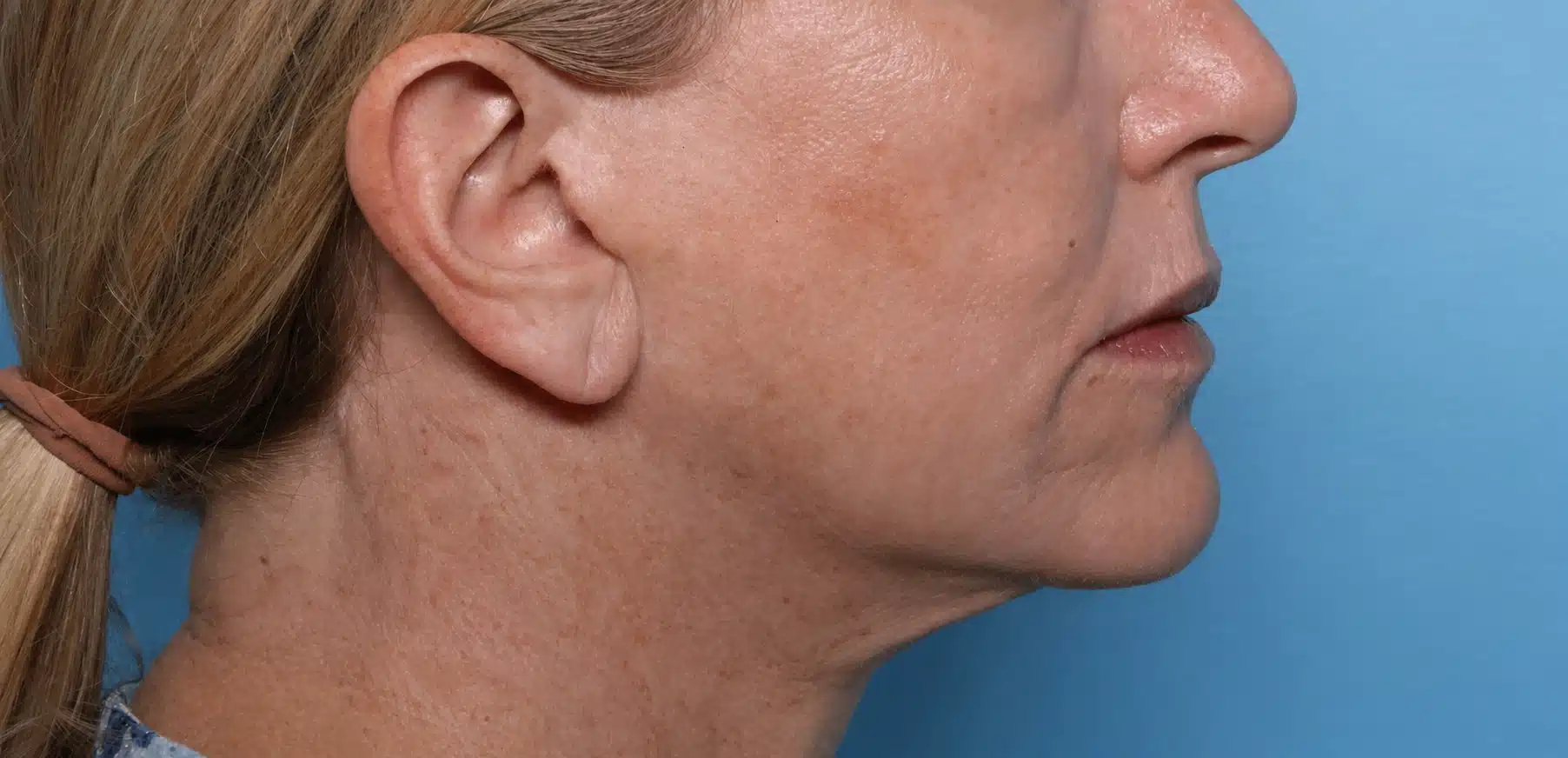
Non-surgical jawline contouring is usually sold as a filler conversation — add product along the mandible, create a harder edge. That works when the underlying bone structure needs projection. It works poorly when the actual problem is that soft tissue has lost tension and is draping over an otherwise good jaw.
Tightening and contouring solve different problems, and the photographs look different too. A filler result shows a jaw that projects further outward. A facial skin tightening result shows the same jaw with less noise around it.
 Before
After
Before
After
Switch between the photographs and check the same landmarks in each. Individual results vary.
- 1Continuity, not projectionA tightening result should make the existing jaw line continuous. If the jaw appears to stick out further than before, that is volume, not contraction.
- 2The pre-jowl notchThe small dip just in front of the jowl, roughly below the corner of the mouth, is one of the earliest areas to shallow out as deeper tissue firms.
- 3Ear-to-chin sweepTrace the full line in one motion. A real change reads as a single uninterrupted sweep; a photographic change reads as one improved segment with the rest unchanged.
For a fuller picture of how tightening, filler and thread techniques compare for the lower face, our guide to non-surgical jawline contouring in Portland covers when each approach is the right tool, and our overview of non-surgical facelift options maps out the wider landscape.
What to expect, and when
The XERF Results Timeline: Day One to Month Six
The most common reason people conclude a tightening treatment “did nothing” is that they judged it three weeks in. Collagen remodeling runs on a biological clock that no device can accelerate. Here is the honest sequence.
- Same day
- A mild tightening sensation and, for some, slight warmth or pink flush that settles within an hour or two. Makeup and normal activity resume immediately. This early tightening is collagen contraction, not the final result.
- Week 1–2
- The immediate contraction relaxes and the face often looks close to baseline again. This is expected and is where most people wrongly give up on the treatment.
- Week 4
- Typical timing for a second session. New collagen synthesis is underway but not yet visible to a casual glance.
- Week 8–12
- The window where most people first notice the jaw looking cleaner in photographs. Changes in the submental angle are usually the earliest to register.
- Month 4–6
- Peak effect for most protocols, as newly laid collagen matures and organizes. Standardized before and after photos are worth taking here, not earlier.
- Beyond
- Results are gradual, not permanent. Aging continues. Most patients maintain with an annual or twice-yearly session rather than repeating the full initial series.
If you want to track your own progression properly, our photo treatment planner is built for exactly this — consistent angle, consistent lighting, dated. It is also the fastest way to settle the question of whether a change is real.
Comparison three
XERF Before and After: Neck and Under-Chin
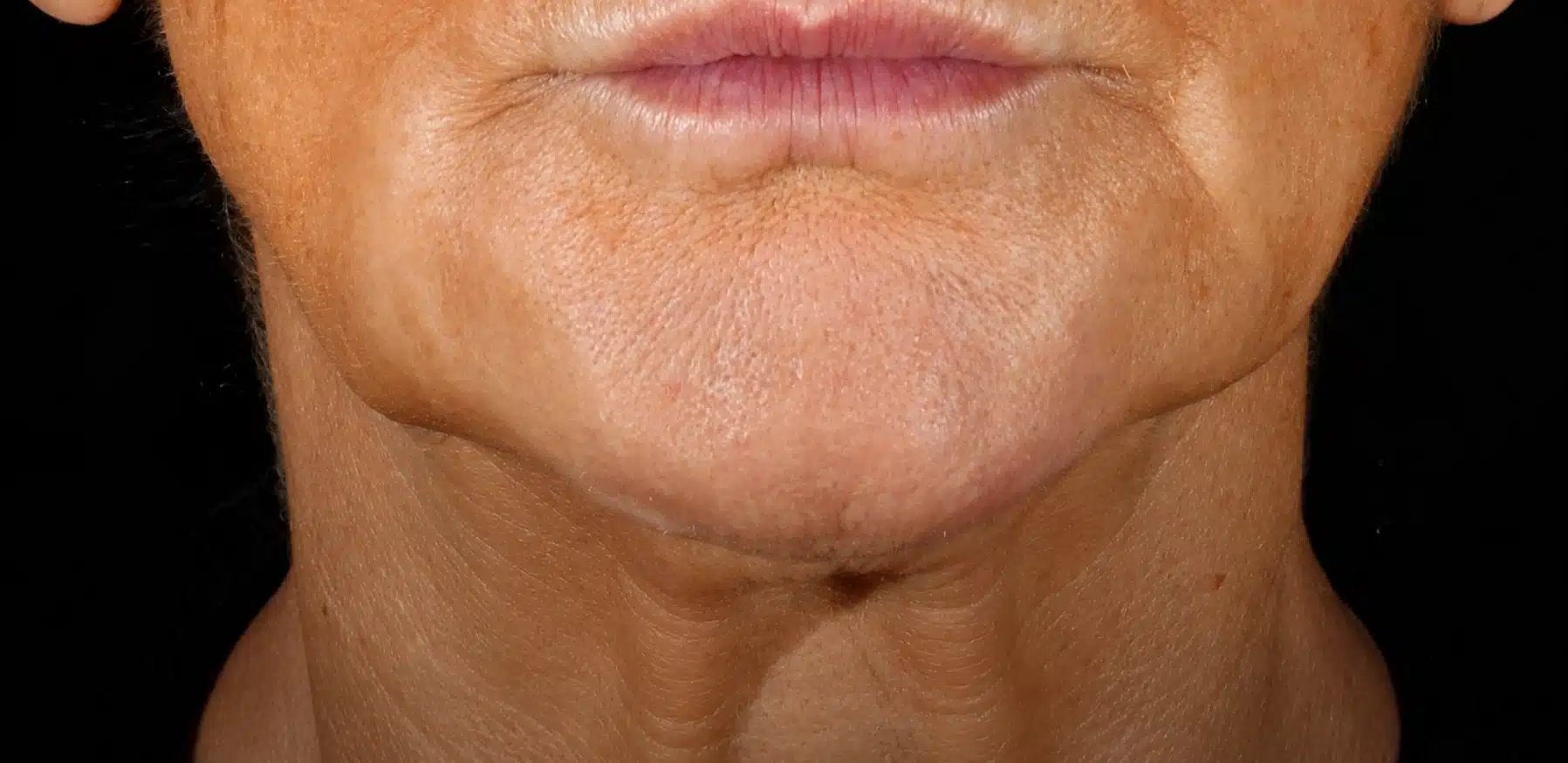
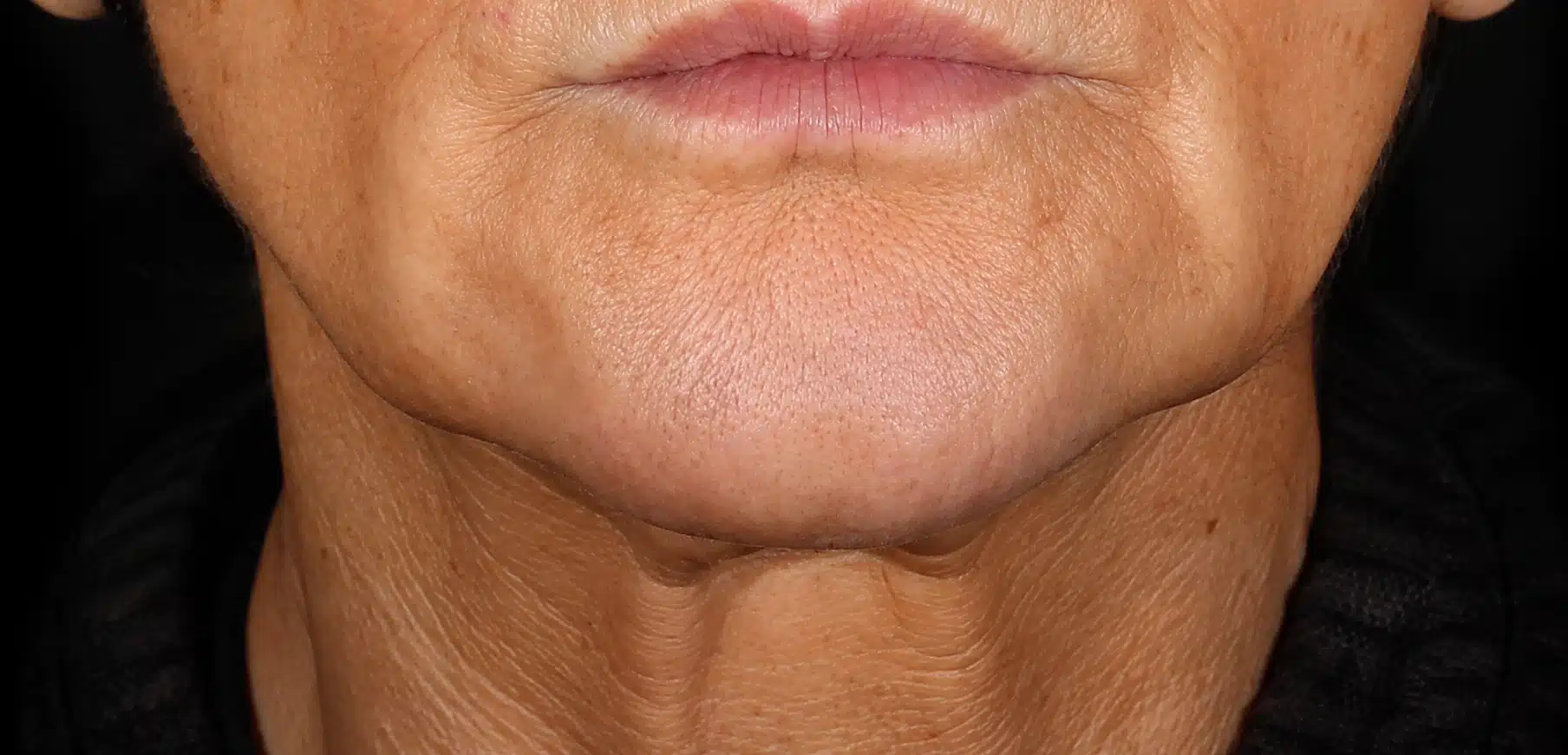
The neck is where skin laxity is least forgiving and most visible. Skin here is thin, it creases with every head movement, and it is routinely left out of sun protection routines for decades. It is also the area patients most want addressed and the one where expectations most need managing.
Two distinct problems live under the chin, and they respond to completely different treatments. Laxity — loose, crepey skin with poor snap-back — responds to radiofrequency. Submental fullness — an actual pad of fat below the chin — does not. Tightening skin over a fat pad produces a tighter-looking fat pad.
 Before
After
Before
After
The cervicomental angle is the landmark worth watching here. Individual results vary.
- 1The cervicomental angleThe corner where the underside of the chin meets the front of the neck. A sharper, more defined angle is the clearest evidence that deeper tissue tightened.
- 2Skin quality between the creasesHorizontal neck lines rarely disappear. What improves is the texture and firmness of the skin between them — less crepe, better light reflection.
- 3Head positionCheck the ear and shoulder placement in both frames. If the chin is lifted even slightly in the after image, discount the comparison entirely.
If the under-chin concern is genuine fullness rather than looseness, Kybella for submental fat targets the fat itself, and is frequently sequenced before a tightening series rather than instead of one. Reducing volume first, then tightening the skin that remains, is the order that produces the cleaner neck.
Protocol
How Many XERF Treatments You Need for Jowls, Jawline and Neck
Two sessions roughly four weeks apart is the standard starting point, and it is the protocol used in the registered clinical study of the device. A third session is sometimes added for more advanced laxity or for patients who want a stronger structural change in the neck.
Session length depends on how much territory is being covered. Jawline alone runs shorter than full lower face plus neck. Because there is no numbing period and no recovery, the appointment is essentially the treatment time.
Where XERF sits in a broader plan matters more than the session count. Tightening addresses one variable — structural support. It does not replace lost volume, and it does not soften dynamic lines. A lower face that has lost mid-face volume will look better with collagen biostimulators or Sculptra restoring the foundation before or alongside tightening. A jaw that clenches heavily may need masseter treatment with Botox or Dysport in Vancouver, WA to narrow the lower face at all. And where laxity has progressed past the point radiofrequency can address, PDO lifting threads or a surgical referral is the more honest recommendation.
The best result from any tightening device comes from correctly diagnosing which of the four variables — support, volume, muscle, skin quality — is actually driving what you see in the mirror.
Choosing between devices
XERF vs Morpheus8 vs RF Microneedling: What Actually Differs
All three are radiofrequency. The meaningful difference is how the energy gets in, and that single variable drives everything else — comfort, downtime, what the treatment is good at, and who it suits.
- XERF
- Non-invasive monopolar RF. Energy passes through intact skin from a handpiece; nothing penetrates. Dual frequency reaches shallow through deep layers. Best for structural tightening of jowls, jawline and neck. No needles, no numbing, no downtime.
- Potenza
- RF microneedling. Insulated needles deliver energy at a set dermal depth. Excellent for texture, pores, acne scarring and skin quality. Requires topical numbing and produces a day or two of redness and pinpoint marks. A different job, not a lesser one.
- Morpheus8
- RF microneedling. Same category as Potenza — needle-delivered fractional RF with comparable indications and recovery. Frequently searched by name in the Portland market, but the comparison that matters is microneedling versus non-invasive, not one brand against another.
- Biostimulators
- Injectable collagen stimulation. Sculptra and Radiesse build volume and collagen from within over months. Complementary to tightening rather than competitive with it — they address the foundation, not the scaffolding.
The practical decision usually breaks along downtime and target. If the complaint is texture, pores or scarring, microneedling wins. If the complaint is looseness along the jaw and under the chin, a non-invasive monopolar device reaches the tissue that matters without breaking the skin. Many patients eventually do both, in separate series.
We offer both approaches, which is the only reason this comparison is worth trusting from us. Our Potenza RF microneedling page covers the microneedling side in detail, and our energy-based facial treatment overview sets out the full menu.
Candidacy
Who Gets the Best XERF Results — and Who Does Not
The single strongest predictor of a good tightening result is the degree of laxity at the start. Radiofrequency rewards early and moderate looseness. It disappoints in advanced laxity, and no amount of session-stacking changes that.
Strong candidates
Mild to moderate laxity along the jaw and under the chin. Skin that still has some recoil when gently lifted. Patients in their late thirties through fifties who want to slow the trajectory rather than reverse a decade. Anyone who cannot take downtime — RF is chromophore-independent, so it is appropriate across skin tones, which is not true of every light-based option.
Poor candidates
Significant hanging skin or a heavy submental fat pad. Anyone expecting a surgical outcome from a non-surgical device. Active infection or inflammatory skin conditions in the treatment area. Pregnancy. Certain implanted electronic devices — a contraindication that must be raised at consultation, not on the day.
The mixed case
Most people are here, and it is the most useful conversation to have. Someone with mild jaw laxity and mid-face volume loss and sun damage will not be well served by any single treatment. Sequencing matters, and it is the reason we assess in person rather than quoting a plan over the phone. Our anti-aging treatment overview shows how these layer together, and our patient reviews reflect how we approach that sequencing.
Investment
What XERF Costs in Portland and Vancouver, WA
XERF is priced by treatment area and by the number of sessions in a series, because a jawline-only protocol and a full lower face plus neck protocol are not the same amount of work. Anyone quoting a single flat number without knowing which areas you want treated is quoting a marketing figure.
Two things are worth understanding before you compare prices across providers. First, a two-session series is the standard, so a per-session figure and a series figure are different numbers and should not be compared against each other. Second, monopolar RF is priced against the tissue depth it reaches, which is why non-invasive tightening and RF microneedling sit at different points even though both are “radiofrequency.”
Current figures live on our XERF treatment cost and results guide, and the wider menu is published on our treatment pricing page — we publish transparent pricing rather than requiring a consultation to learn a number. If you are treating multiple areas or planning a maintenance cadence, our membership changes the arithmetic considerably, and any active offers are listed on our current specials page.
Where to be treated
XERF Near Portland, Oregon and Vancouver, Washington
XERF is performed at our Vancouver, WA location at 12000 SE Mill Plain Blvd. All energy-based and laser treatments run out of Vancouver; our Portland office on SE Stark Street handles injectables, facial infusions and chemical peels. If you searched “XERF Portland” and landed here, Vancouver is where the device lives — and it is where the large majority of our Portland-area patients are treated.
That geography works in most people’s favor. The Mill Plain corridor is straightforward to reach from inner Portland, the eastside and North Portland via I-5 or I-205, and parking is not the ordeal it is in the central city. Patients travel to us from Camas, Salmon Creek, Hazel Dell, Felida, Ridgefield and Battle Ground on the Washington side, and from Northeast and Southeast Portland, the Alberta and Sellwood neighborhoods, Lake Oswego, Beaverton, West Linn and Happy Valley on the Oregon side.
Because there is no numbing period and no recovery, a XERF appointment is genuinely a same-day errand — there is nothing to recover from on the drive home. We can frequently accommodate consultations the same business day.
XERF is available at a growing number of practices across the Portland–Vancouver metro, and adoption is accelerating nationally. When you compare, the questions worth asking are not about the device — it is the same device everywhere. Ask how many sessions are included in the quoted price, which areas that price covers, who performs the treatment, and whether the practice takes standardized before and after photographs at consistent angles. That last one tells you the most.
You can see documented outcomes across our full treatment menu in the before and after gallery, and read more about the practice on our Vancouver, WA med spa page.
Common questions
XERF Before and After: Questions People Ask
How long before I see XERF before and after results?
Most people notice a change between eight and twelve weeks, with the fullest effect around four to six months. There is a mild immediate tightening on treatment day that relaxes within one to two weeks — that early phase is collagen contraction and is not the final result.
Does XERF work on jowls?
It reduces the overhang of tissue below the jaw bone in mild to moderate laxity by contracting and thickening the fibrous support underneath. It does not reposition tissue the way surgery does, so a heavy, well-established jowl will improve rather than resolve. Degree of starting laxity is the strongest predictor of outcome.
How many XERF sessions do I need for the neck and jawline?
Two sessions approximately four weeks apart is the standard protocol. A third is sometimes added for more advanced laxity or for patients wanting a stronger change in the neck. Most people then maintain with one session annually or twice yearly.
Is XERF better than Morpheus8 or RF microneedling?
Neither is better; they solve different problems. XERF is non-invasive monopolar RF that passes through intact skin to tighten structural tissue in the lower face and neck. Morpheus8 and Potenza are RF microneedling, which delivers energy through needles and excels at texture, pores and scarring. If your concern is looseness along the jaw, non-invasive monopolar RF is the more direct tool.
Does XERF hurt?
No numbing is required. An integrated cooling system holds the skin surface at a tolerable temperature while energy passes into deeper tissue, and pulse-shaping technology spreads delivery across the treatment tip. Most people describe a warm sensation with intermittent deeper heat. Comfort varies by individual and by the intensity setting used.
Is there any downtime after XERF?
No. Some people have mild warmth or a light flush that settles within an hour or two. Makeup, exercise and normal activity resume the same day. There is no peeling, no pinpoint bleeding and nothing that needs to be hidden.
Is XERF FDA cleared?
Yes. The XERF system received FDA 510(k) clearance in August 2025 under K251327. The device is cleared for use in dermatologic and general surgical procedures for electrocoagulation and hemostasis; the term “skin tightening” describes tightening effects that occur via soft tissue coagulation.
How long do XERF results last?
Newly formed collagen persists, but aging continues, so results are gradual rather than permanent. Most patients hold their improvement with periodic maintenance sessions rather than repeating the initial series. Sun protection and skin health have a meaningful effect on how long the change holds.
Can XERF be combined with Botox or filler?
Yes, and it frequently is, though timing is planned individually rather than treated as a fixed rule. Tightening addresses structural support while neuromodulators address dynamic movement and fillers address lost volume — separate variables that often need addressing together. Sequencing is set at consultation.
Do I have to go to Vancouver for XERF, or is it available in Portland?
XERF is performed at our Vancouver, WA location on SE Mill Plain Blvd. All laser and energy-based treatments are Vancouver-based; the Portland office handles injectables and non-energy treatments. Vancouver serves patients from both sides of the river, and most of our Portland-area XERF patients are treated there.
Next step
See Whether Your Laxity Is in the Range XERF Treats
The honest version of this assessment takes about fifteen minutes in person. We look at where laxity actually sits, whether volume or muscle is contributing, and whether tightening is the right first move or the wrong one — and we will say so if it is the wrong one. Standardized photographs are taken at baseline so there is something real to compare against later.
Cosmetiq Medicine — Vancouver, WA · 12000 SE Mill Plain Blvd
Call (503) 572-2675 · CosmetiqMedicine@gmail.com
Questions before booking? Contact our team.
About these photographs. Before and after images are unretouched and shown at the same crop and orientation. Results vary between individuals and depend on starting degree of laxity, skin quality, age, number of sessions and aftercare. These images represent individual outcomes and are not a guarantee or prediction of any specific result.
Regulatory. The XERF RF system is intended for use in dermatologic and general surgical procedures for electrocoagulation and hemostasis. All instances of the term “skin tightening” are used to describe tightening effects that occur via soft tissue coagulation. XERF is a trademark of Lutronic Corporation; Cynosure is a registered trademark of Cynosure, LLC. Morpheus8 and Potenza are trademarks of their respective owners and are referenced here for comparison only.
Medical. This article is general education, not medical advice, and does not establish a provider–patient relationship. Candidacy, contraindications and expected outcomes are determined at an individual consultation with a qualified provider.