Patient Guide · Injectables
Portland, OR & Vancouver, WA — Updated July 13, 2026 | By Cosmetiq Medicine
There is no such thing as “the best filler.” There are only the right materials, placed in the right layer, for the right face. Juvéderm, Sculptra, and Radiesse are three completely different technologies — hyaluronic acid gel, poly-L-lactic acid, and calcium hydroxylapatite — and each one solves a problem the others cannot. This guide breaks down the five Juvéderm formulas we use most, plus Sculptra, Radiesse, and Radiesse (+), so you walk into your Portland or Vancouver consultation already knowing which questions to ask.
Different fillers behave differently under the skin. Matching material to tissue is most of the artistry.
The Three Filler Families, Explained Simply
Every injectable on this page falls into one of three categories. Understanding the category tells you more than memorizing brand names.
Family 1
Hyaluronic Acid
The Juvéderm Collection. A smooth gel made from a modified form of hyaluronic acid, a sugar your body already produces. Adds volume the moment it is injected. Reversible with an enzyme called hyaluronidase.
Family 2
Poly-L-Lactic Acid
Sculptra. Not really a “filler” at all — it is a collagen stimulator. It asks your own fibroblasts to rebuild structure over months. Gradual in, gradual out.
Family 3
Calcium Hydroxylapatite
Radiesse and Radiesse (+). A hybrid: microspheres of a mineral found naturally in bone, suspended in gel. You get lift immediately and collagen stimulation afterward.
If you want the full menu of what we place and where, our dermal fillers in Portland page walks through treatment areas and pricing, and our dermal fillers in Vancouver, WA page covers the same for patients on the Washington side of the river.
The Juvéderm Collection: Five Formulas, Five Jobs
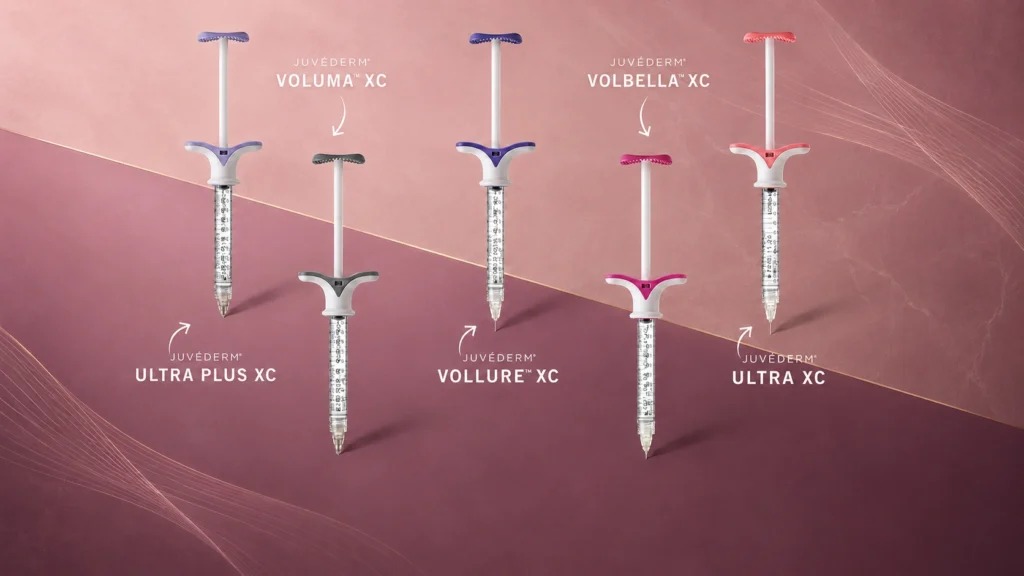
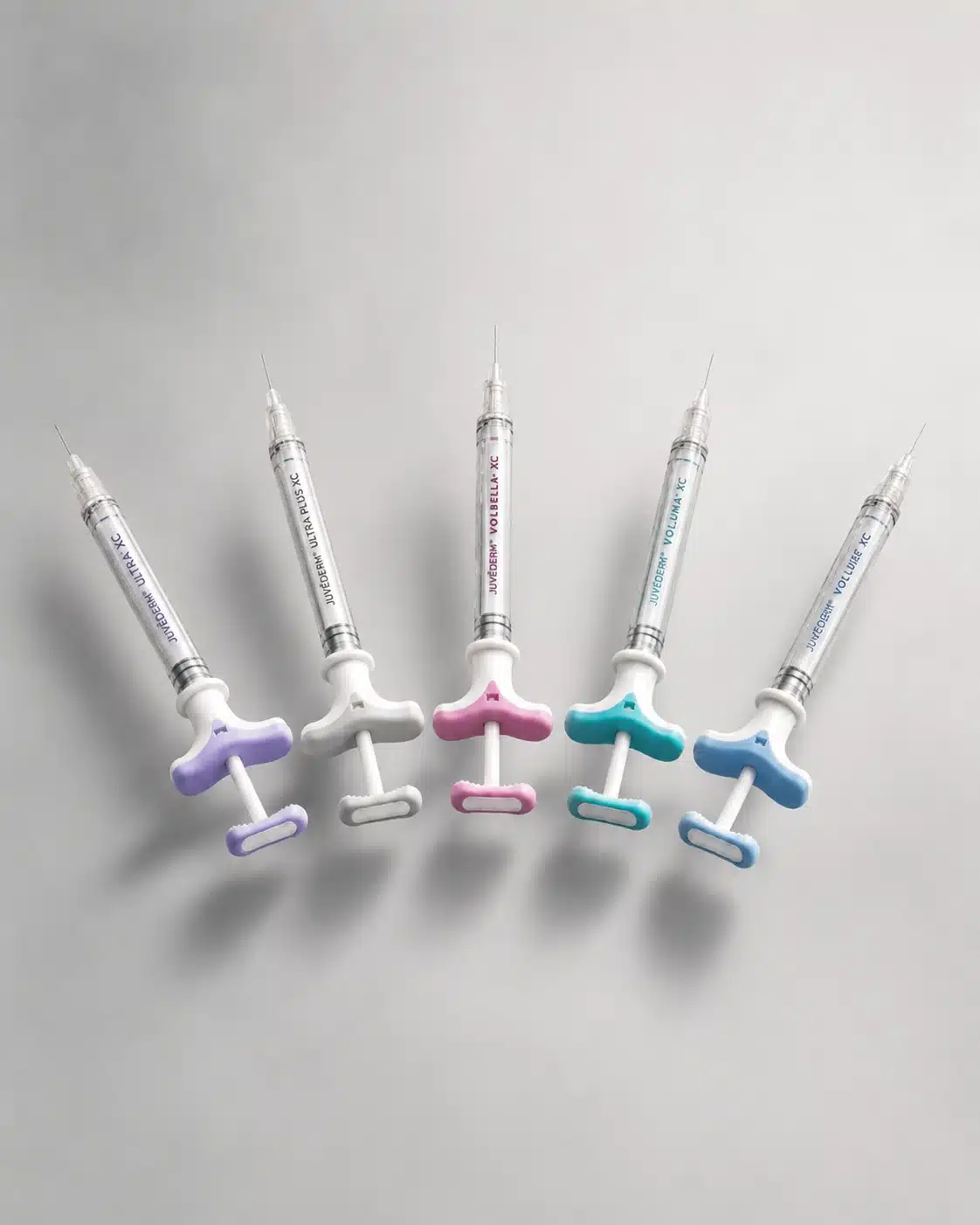
Juvéderm is not one product. Allergan Aesthetics describes the Juvéderm Collection of Fillers as six FDA-approved hyaluronic acid gels designed for seven specific areas of the face, with results that appear immediately and can last one to two years depending on the product and the area treated.
Two things separate them: how thick the gel is (its lift capacity) and how it is cross-linked. The “Vol” products — Voluma, Vollure, Volbella — use Vycross technology, which blends high and low molecular weight hyaluronic acid to produce a smoother, longer-lasting gel. All five contain lidocaine (that is what the “XC” stands for), so the injection itself is far more comfortable than patients expect.
The Collection at a Glance
Ultra XC
Lip volume
Ultra Plus XC
Deeper folds
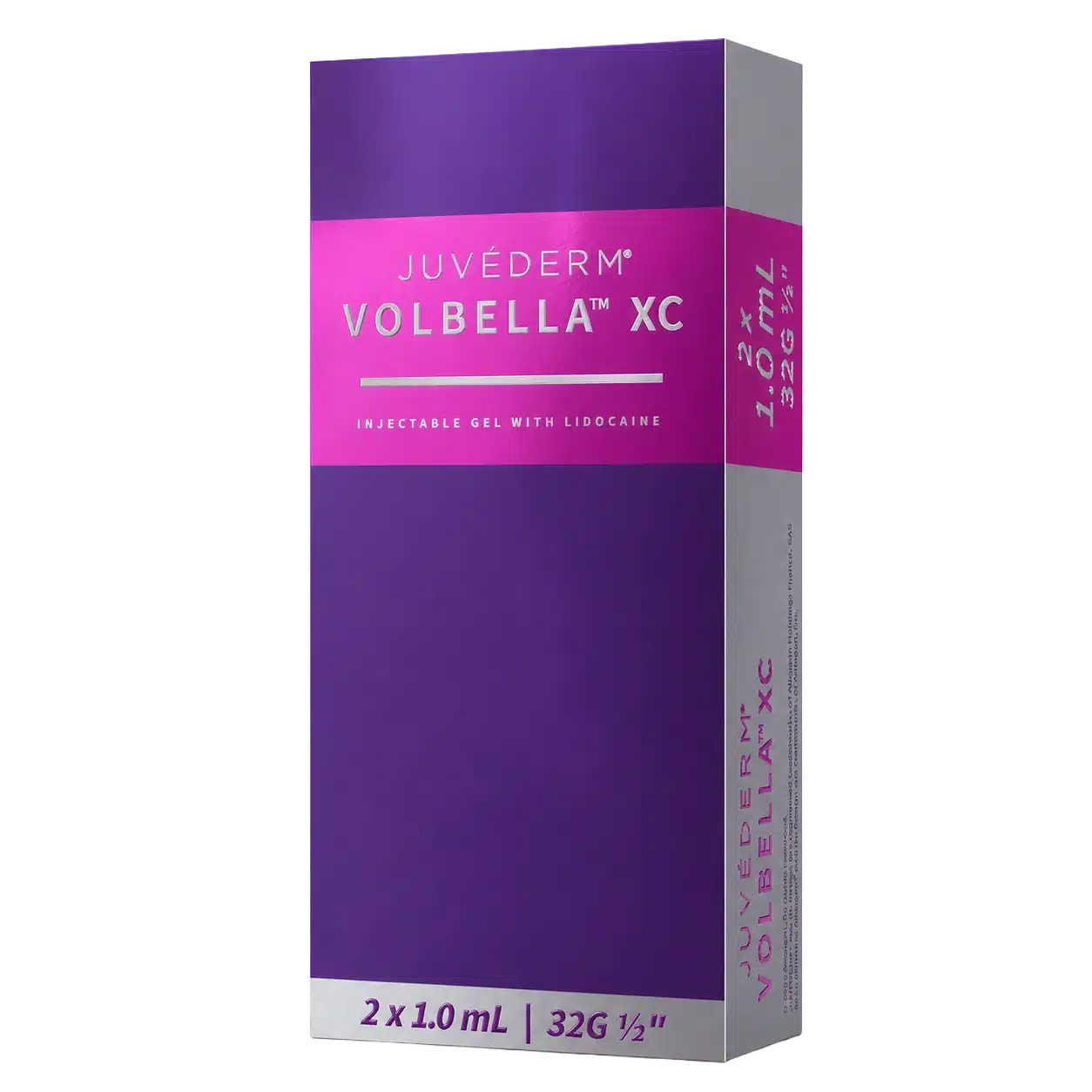
Volbella XC
Lips, under-eyes
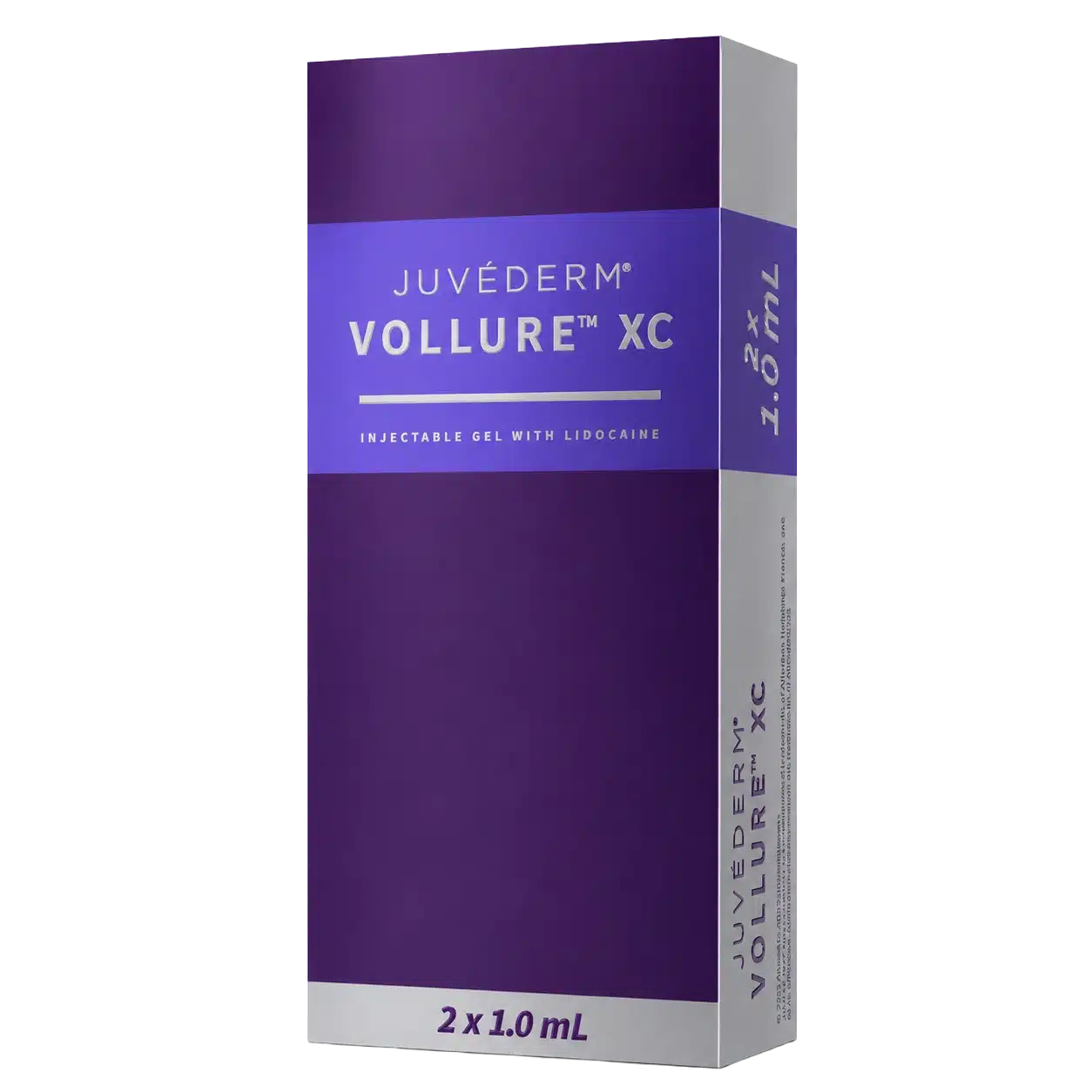
Vollure XC
Smile lines
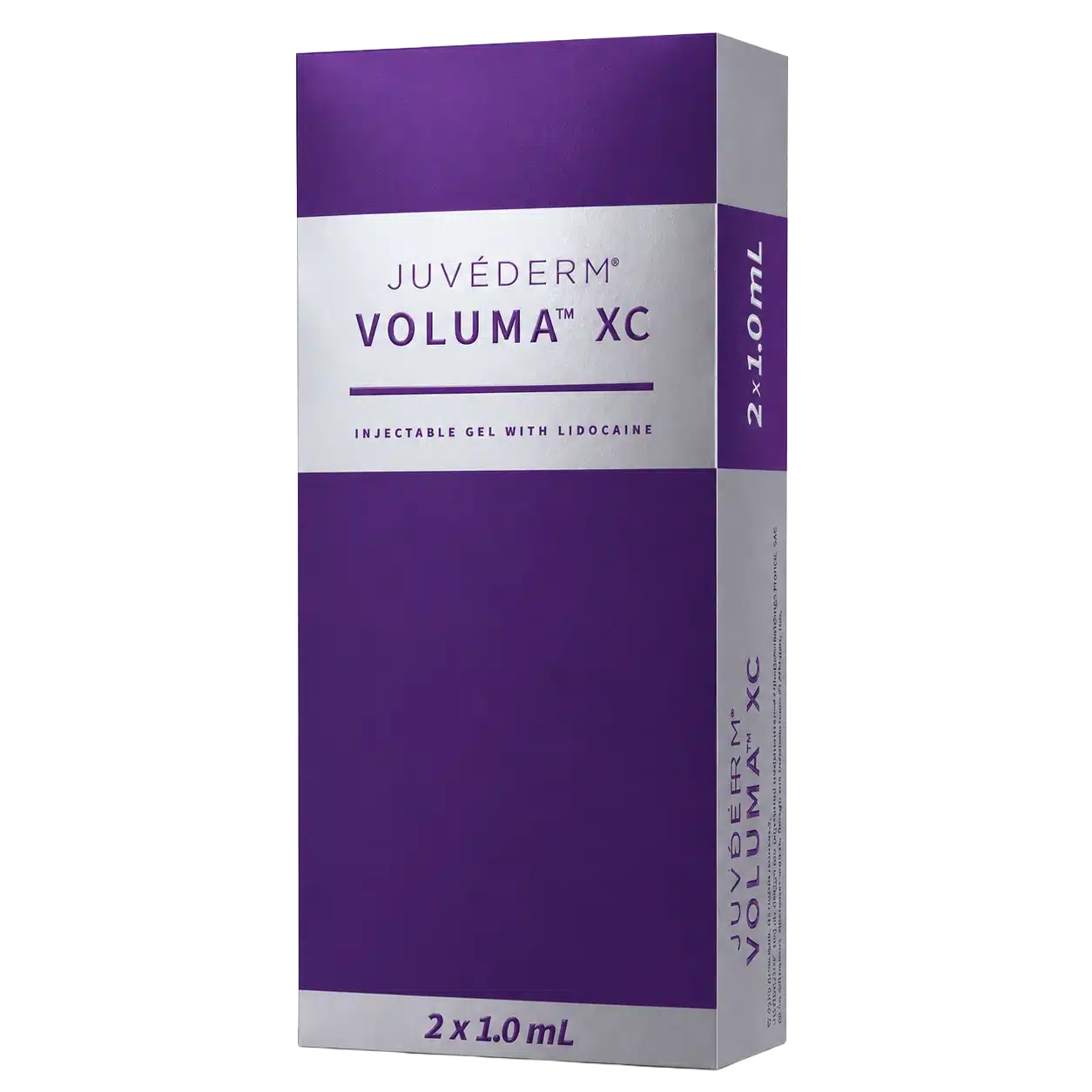
Voluma XC
Cheeks, chin, temples
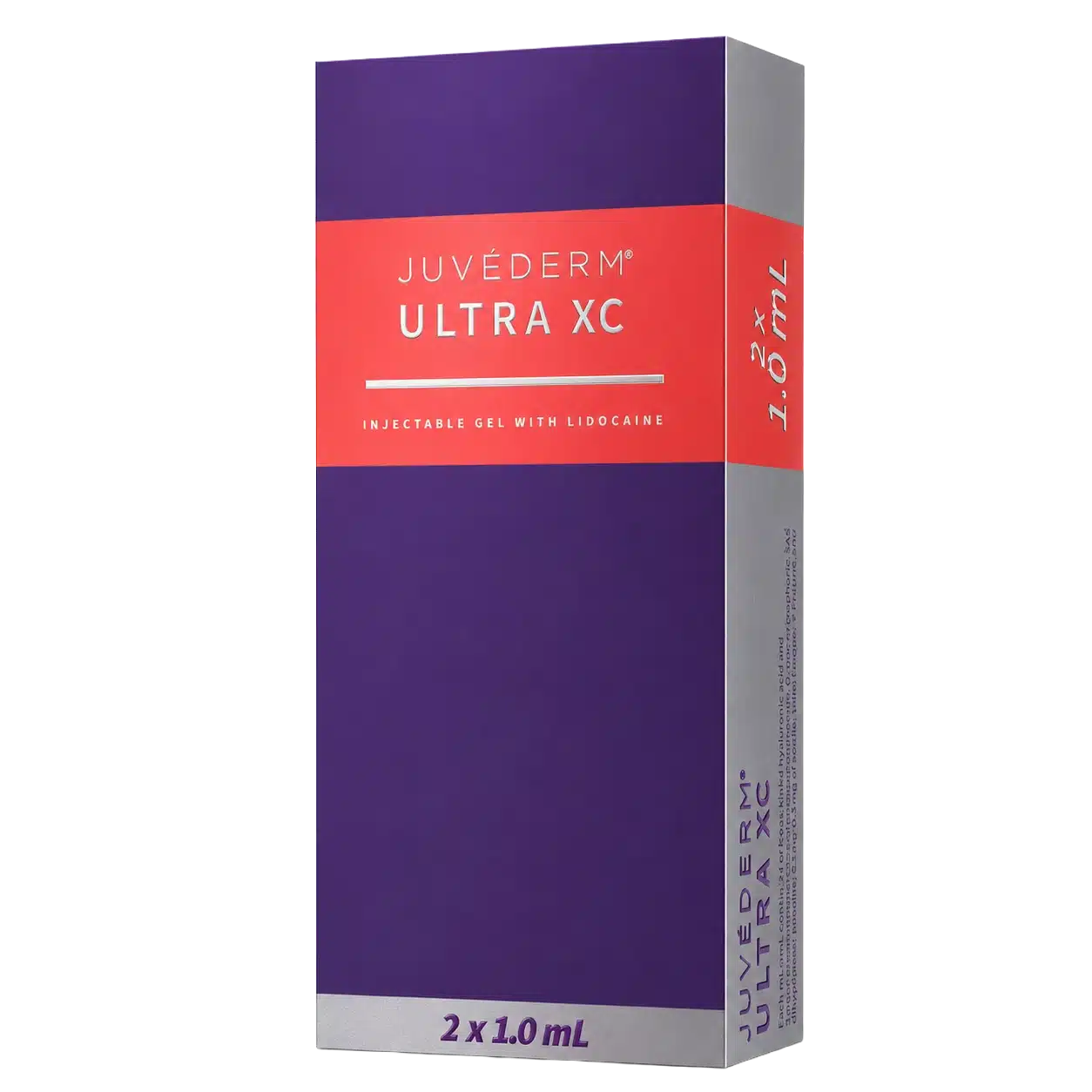
Juvéderm Ultra XC — the classic lip filler
Approved for: correction of moderate to severe facial wrinkles and folds, such as nasolabial folds. Ultra XC is also indicated for injection into the lips and perioral area for lip augmentation in adults over 21.
Why we reach for it: Ultra XC gives noticeable, plush fullness. It is the right call when a patient genuinely wants their lips to look fuller rather than simply hydrated and defined. Per Juvéderm’s clinical data, lip results with optimal treatment can last up to one year. If you are researching lip filler in Portland and Vancouver, this is usually the product being discussed when someone says “I want volume.”
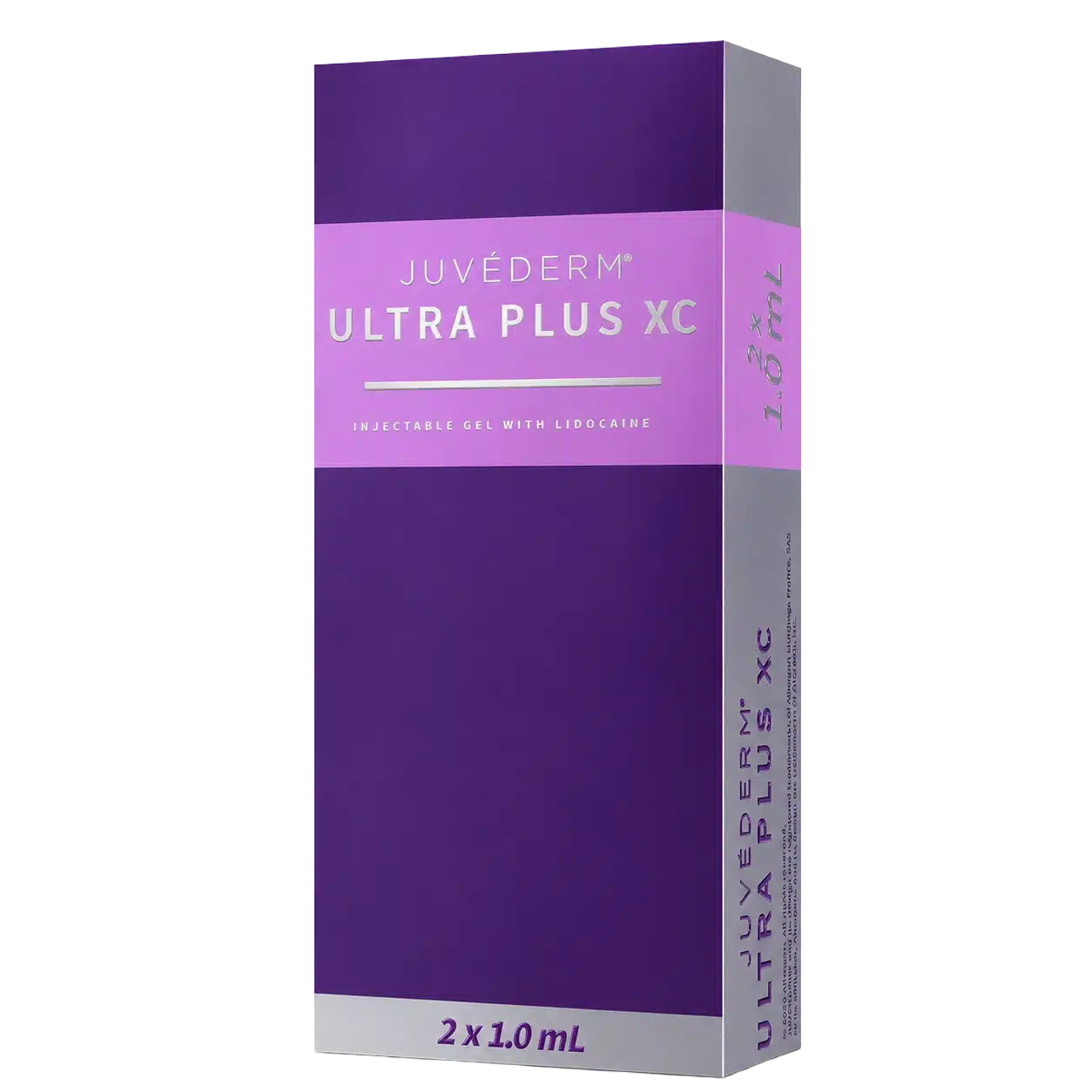
Juvéderm Ultra Plus XC — the heavier fold filler
Approved for: injection into facial tissue for correction of moderate to severe facial wrinkles and folds, such as nasolabial folds.
Why we reach for it: Ultra Plus is a thicker, more robust version of Ultra. When a smile line is deep enough that a softer gel would simply disappear into it, Ultra Plus holds. It is a workhorse for the lower face rather than a finesse product.
Juvéderm Volbella XC — the finesse product
Approved for: injection into the lips for lip augmentation and correction of perioral rhytids (those vertical “lipstick lines”), and for improvement of infraorbital hollowing — the under-eye hollow — in adults over 21.
Why we reach for it: Volbella is the lightest, most spreadable gel in the collection. It is the answer to “I want my lips to look like mine, just better rested,” and it is the only Juvéderm formula carrying an FDA approval for the under-eye area. Lip results can last up to a year with optimal treatment.
One detail worth knowing: Allergan states that Volbella XC should only be injected into undereye hollows by providers who have completed the specific training for that treatment area. It is a fair question to ask any injector before you book — and a reasonable one for our team to answer. The under-eye is the least forgiving place on the face to get filler wrong. See our under-eye filler guide for the full picture.
Juvéderm Vollure XC — smooth folds that still move
Approved for: injection into the mid-to-deep dermis for correction of moderate to severe facial wrinkles and folds, such as nasolabial folds, in adults over 21.
Why we reach for it: Vollure occupies the middle ground between Ultra Plus and Volbella — enough structure to soften a deep line, soft enough that your face still moves like your face. This is the product for patients whose main fear is looking “done.”
Juvéderm Voluma XC — the structural lifter
Approved for: deep injection for cheek augmentation to correct age-related volume deficit in the midface, for augmentation of the chin region to improve the chin profile, and for augmentation of the temple region to improve moderate to severe temple hollowing, in adults over 21. Allergan and AbbVie announced nationwide availability of the temple indication in October 2024, making it the newest approval in the collection.
Why we reach for it: Voluma is the strongest, most lifting gel in the Juvéderm line. It goes deep — often onto bone — and it rebuilds the scaffolding the rest of the face hangs from. Most patients who think they need a filler in their smile lines actually need support in the cheek above it.
Per the Voluma clinical program, most patients were satisfied with their cheek results through two years post-treatment, and 98% of patients treated in the temples said they would recommend the treatment to a friend. Facial balancing — treating cheek, chin, and jaw as one connected structure — is where Voluma earns its reputation.
And the two you will hear about next: Volux XC and SkinVive
Volux XC is the sixth member of the collection, indicated for improvement of jawline definition in adults over 21 with moderate to severe loss of jawline definition — it is the firmest gel Allergan makes. Separately, Juvéderm SkinVive is not a volumizer at all; it is a microdroplet injectable for skin smoothness and hydration. Patients frequently confuse the two, and the difference matters: one builds a jawline, the other builds glow.
The Biostimulators: Sculptra, Radiesse, and Radiesse (+)
These three do something hyaluronic acid cannot: they get your own body to build collagen. Sculptra does it slowly and exclusively. Radiesse does it while also lifting on day one.
Collagen Stimulators at a Glance
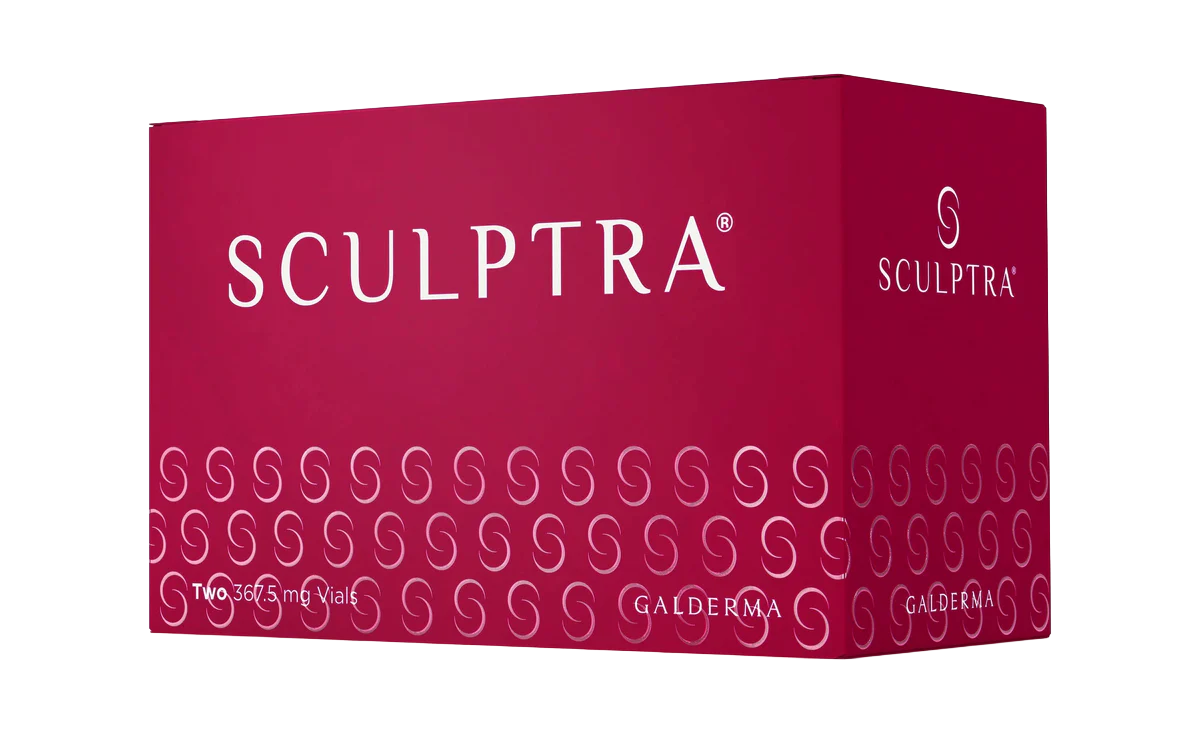
Sculptra
Poly-L-lactic acid · gradual
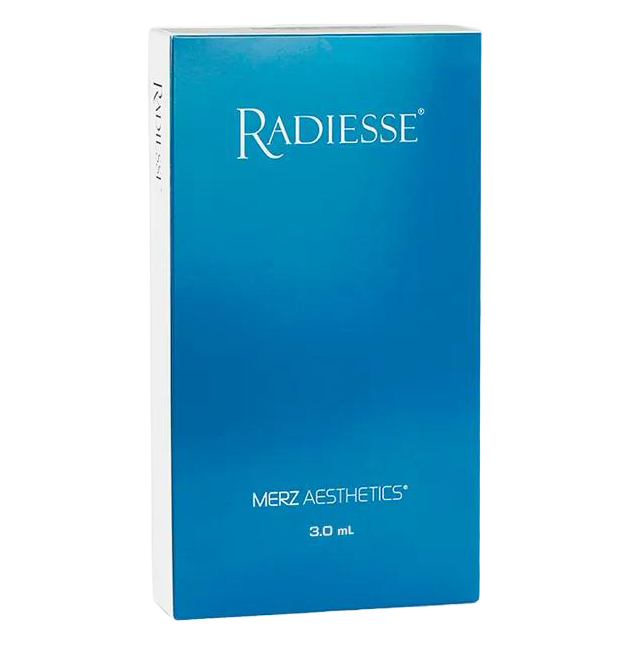
Radiesse
Folds, hands, décolleté
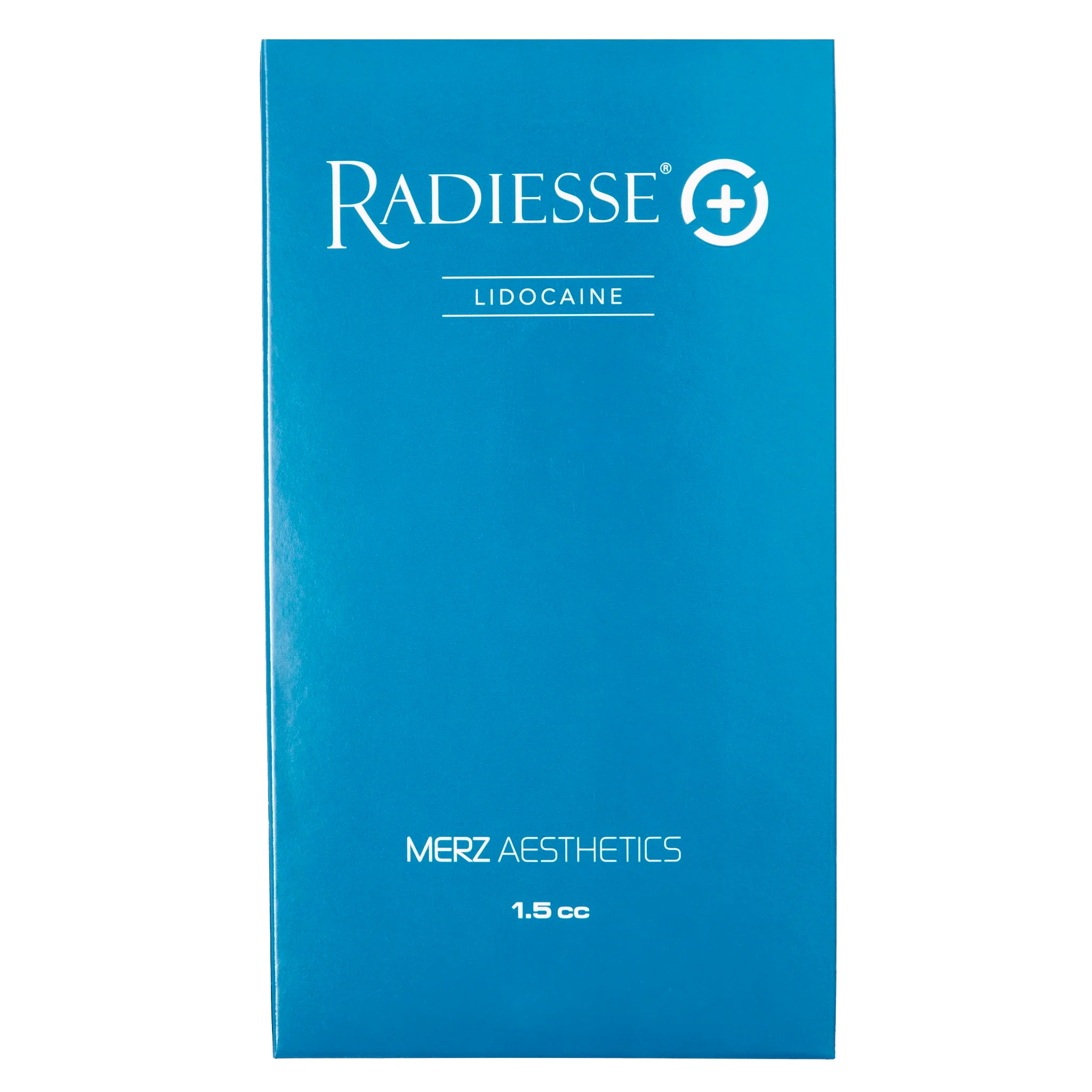
Radiesse (+)
Jawline contour
Sculptra: rebuilding collagen, not filling space
Sculptra is the first and original FDA-approved poly-L-lactic acid injectable, made by Galderma. It is indicated for correction of shallow to deep nasolabial fold contour deficiencies, fine lines and wrinkles in the cheek region, and other facial wrinkles. Galderma received expanded FDA approval for cheek wrinkles in April 2023.
Here is the mental model that makes Sculptra click. Hyaluronic acid fillers are like inflating a tire — the product itself is the volume. Sculptra is more like fertilizer. The poly-L-lactic acid microparticles are absorbed by your body over the following days, and in the process they trigger your own fibroblasts to lay down new collagen. The result you eventually see is yours. That is also why it is slow: the treatment plan is typically about three sessions over a few months, with results developing gradually and, per Galderma’s clinical data, lasting up to two years.
The trade-off is honesty about time. You will not leave your first appointment looking transformed. The swelling from the injection may briefly flatter you and then subside, and the real change arrives quietly over weeks. Patients who want to see a difference in the mirror that same afternoon should be treated with hyaluronic acid instead — and a good injector will tell you that rather than sell you the more expensive vial.
What the data shows: in Galderma’s clinical program, 95% of patients had improved skin glow two years after Sculptra treatment, and 86% had improved jawline contour two years after treatment when Sculptra was injected into the cheek region. That second figure is the one worth pausing on — it is a jawline benefit produced by treating the cheek, which tells you something real about how facial support actually works.
Who it is not for: Sculptra should not be used by people who are allergic to any ingredient in the product or who have a history of keloid formation or hypertrophic scarring, and safety has not been established in patients who are pregnant, lactating, breastfeeding, or under 18. It is also not injected into the lips or the area immediately around the eyes.
Sculptra sits alongside the other collagen biostimulators we offer at both locations, and full treatment details are on our Sculptra page.
Radiesse: immediate structure that keeps working
Radiesse, made by Merz Aesthetics, is built from calcium hydroxylapatite microspheres suspended in a gel carrier. On injection, the gel provides immediate correction. Over time the gel is absorbed and the microspheres act as a scaffold, stimulating your fibroblasts to produce collagen — per Merz, collagen for up to a year and elastin for up to nine months after a single injection. That dual action is the entire point of the product: HA-like immediacy, Sculptra-like regeneration, in one syringe.
Radiesse is FDA-approved for subdermal implantation for correction of moderate to severe facial wrinkles and folds, such as nasolabial folds. It is also indicated for hand augmentation to correct volume loss in the dorsum of the hands — the back of the hands — and, when diluted 1:2 with sterile saline, for correction of décolleté wrinkles in patients 22 and older. Hands are the giveaway nobody thinks to treat until they see a photo of their own.
Radiesse (+): the only FDA-approved jawline filler
Radiesse (+) is the lidocaine-containing formulation, and it carries an indication Radiesse does not: deep injection for soft tissue augmentation to improve moderate to severe loss of jawline contour in adults over 21. Merz launched it as the first and only FDA-approved injectable treatment for jawline contour improvement, following FDA approval of the supplemental Premarket Approval Application in September 2021.
In the pivotal study, 75.6% of treated subjects achieved at least a 1-point improvement on the jawline assessment scale on both jawlines at week 12, with no treatment-related serious adverse events. Merz also notes that the FDA requires indication-specific training for the jawline indication, and that providers must complete it before administering the treatment.
If “non-surgical jawline contouring” is what brought you here, this is one of two or three tools that genuinely deliver it — and it is often paired with Kybella when submental fullness is blurring the jaw from below, or with lifting threads when laxity is the real culprit. Full details on our Radiesse treatment page.
Reference
The Eight, Side by Side
Material, purpose, timeline, and whether it can be undone — the four things that actually decide which syringe is opened.
Juvéderm Ultra XC
Hyaluronic acid · Reversible
Plush lip volume and correction of moderate to severe folds. Results are visible the moment you sit up.
Onset — Immediate
Juvéderm Ultra Plus XC
Hyaluronic acid · Reversible
A heavier gel for nasolabial folds deep enough that a softer product would vanish into them.
Onset — Immediate
Juvéderm Volbella XC
Hyaluronic acid, Vycross · Reversible
The lightest gel in the collection. Subtle lips, vertical lip lines, and the only Juvéderm approved for under-eye hollows.
Onset — Immediate
Juvéderm Vollure XC
Hyaluronic acid, Vycross · Reversible
Softens a deep line while leaving expression intact. The choice for patients whose fear is looking overdone.
Onset — Immediate
Juvéderm Voluma XC
Hyaluronic acid, Vycross · Reversible
The structural lifter. Cheeks, chin profile, and temples — the scaffolding the rest of the face hangs from.
Onset — Immediate
Sculptra
Poly-L-lactic acid · Not reversible
Diffuse collagen loss across the cheek region, and skin quality rather than shape. You grow the result yourself.
Onset — Gradual, over months
Radiesse
Calcium hydroxylapatite · Not reversible
Lower-face folds, the backs of the hands, and — diluted — the décolleté. Lift now, collagen later.
Onset — Immediate, then builds
Radiesse (+)
Calcium hydroxylapatite, lidocaine · Not reversible
The only injectable with an FDA approval for jawline contour. Also treats lower-face folds.
Onset — Immediate, then builds
How to Ask
Start With the Concern, Not the Brand
Most patients arrive asking for a product. Better outcomes come from arriving with a complaint. Here is the translation.
“My lips look thin.”
Volume goal → Juvéderm Ultra XC. Definition and hydration without obvious size → Volbella XC. If you have had filler before and your lip border looks blurred or the product has drifted above the lip line, read our guide to lip filler migration before adding anything new.
“I look tired even when I’m rested.”
Usually the under-eye. Volbella XC holds the FDA approval for improvement of infraorbital hollowing. Frequently the real fix is above it — restoring midface support with Voluma so the under-eye stops reading as a crater.
“My face is sliding downward.”
Midface volume loss. Voluma XC for immediate structural lift; Sculptra when the loss is diffuse and you would rather rebuild collagen across the whole cheek region than place a defined bolus.
“I want a sharper jawline.”
Radiesse (+) carries the FDA jawline contour indication. Juvéderm Volux XC is the hyaluronic acid alternative. Which one depends on your tissue, your timeline, and whether reversibility matters to you.
“My hands give away my age.”
Radiesse is specifically indicated for hand augmentation to correct volume loss in the dorsum of the hands. No hyaluronic acid product on this page carries that approval.
“My skin quality is the problem, not my volume.”
This is where filler is the wrong tool entirely. Consider SkinVive, Potenza RF microneedling at our Vancouver location, or Sculptra for its documented skin-glow benefit. Adding volume to skin that needs texture work makes a face look heavy, not younger.
The Overlooked Part
Reversibility Is a Strategy, Not a Safety Net
Nearly every comparison article mentions that hyaluronic acid fillers can be dissolved with hyaluronidase and that Sculptra and Radiesse cannot. Almost none of them explain what that should actually change about your decision.
Reversibility is most valuable where the margin for error is smallest and the tissue is thinnest — lips, under-eyes, and anywhere you are trying something for the first time. That is the case for starting with hyaluronic acid: not because it is safer in some absolute sense, but because a first-time patient does not yet know what they want, and the ability to undo a result you dislike is worth a great deal in that moment.
Allergan itself states plainly that the effectiveness of removal of any dermal filler has not been studied. “It’s reversible” is not a blank check.
Where reversibility matters far less is deep, structural work in stable tissue — jawline, hands, the collagen framework of the cheek. There, permanence is closer to a feature than a risk, and the biostimulators earn their place.
The practical takeaway is that sequence matters. A sensible plan often starts with structure — Voluma or a biostimulator — lets it settle, and only then refines the lips and under-eyes. Patients who reverse that order tend to end up chasing symptoms and paying twice.
Before You Book
Safety, Side Effects, and What Recovery Really Looks Like
Juvéderm. Per Allergan, the most commonly reported side effects with Juvéderm injectable gels are redness, swelling, pain, tenderness, firmness, lumps or bumps, bruising, discoloration, and itching. For Volbella XC, dryness has also been reported. These effects are consistent with other facial injection procedures and most resolve within 30 days.
Sculptra. The most common effects after initial treatment include injection site swelling, tenderness, redness, pain, bruising, bleeding, itching, and lumps. Small nodules under the skin that can be felt when pressing on the treated area are the characteristic risk — which is why compliance with the post-treatment massage protocol genuinely matters.
Radiesse. Merz notes that injection into the back of the hand may cause adverse events lasting more than 14 days and may result in temporary difficulty performing activities — 48% of study patients reported this — and that nodules or lumps in the dorsum of the hand were reported by 12% and can last up to a year. Neither Radiesse nor Radiesse (+) has established safety or effectiveness in the lips. Injection of Radiesse (+) into the jawline may temporarily alter jaw function.
Across all three families the serious risk is the same, and it is rare: accidental introduction of product into a blood vessel, which can cause vascular occlusion. Every manufacturer flags it. This is the single strongest argument for choosing an injector on the basis of anatomical training rather than price — and for reading our guide to vetting a safe injector if the deal you found seems too good.
Tell your provider about blood thinners, aspirin, or NSAIDs, which can increase bruising; a history of cold sores; prior filler in the same area; autoimmune conditions or immunosuppressive therapy; and any history of keloids or severe allergies. None of these are automatic disqualifiers. They are simply information your injector needs before a needle comes near you.
Investment
What Fillers Cost in Portland and Vancouver
Filler is priced per syringe or per vial, not per face, which is why online prices vary so widely and why nobody can quote you accurately without seeing you. Allergan itself notes that Juvéderm treatment can range from roughly $600 to $1,400, with cost varying by the products chosen and by provider.
The number that matters is cost per year of result — not cost per syringe.
A single syringe of a longer-lasting product placed correctly frequently outperforms three syringes of a cheaper one placed to chase a symptom. Sculptra costs more up front and requires a series of sessions, but with results lasting up to two years, the annualized math often lands closer than patients expect.
Current per-syringe pricing for both locations lives on our med spa treatment pricing page. If you treat regularly, our membership plans are built for exactly that pattern, and CareCredit and payment plans are available. You can also see real outcomes in our before and after gallery.
Download — PDF
The Dermal Filler Comparison Guide
All eight products side by side, and the questions to ask at consultation.
Download — PDF
The Dermal Filler Aftercare Guide
The first 48 hours, the first two weeks, and exactly when to call us.
Two Locations
Where to Be Treated
The full Juvéderm Collection, Sculptra, Radiesse, and Radiesse (+) are available at both offices. Bring your concern — let the material follow from it.
Not sure where to start? Our photo treatment planner is a low-pressure first step, our Vancouver, WA med spa page covers everything offered on the Washington side, and you can browse the full treatment menu or simply contact us with a question.
Answered
Frequently Asked Questions
What is the difference between Juvéderm, Sculptra, and Radiesse?
They are three different materials. Juvéderm is a hyaluronic acid gel that adds volume immediately and can be dissolved. Sculptra is poly-L-lactic acid, a collagen stimulator that works gradually over months and is not reversible. Radiesse is calcium hydroxylapatite, which gives immediate correction and then stimulates collagen — per Merz, collagen for up to a year and elastin for up to nine months after a single injection — and is also not reversible.
Which Juvéderm is best for lips?
It depends on the goal. Juvéderm Ultra XC is indicated for lip augmentation and delivers noticeable fullness. Volbella XC is the lighter formula, indicated for lip augmentation and correction of perioral lines, and is the better choice for subtle definition. With optimal treatment, lip results with either product can last up to one year.
How long does Sculptra take to work?
Sculptra is gradual by design, because it stimulates your own collagen rather than filling space directly. The treatment plan is typically about three sessions over a few months, and per Galderma’s clinical data, results can last up to two years. In that clinical program, 95% of patients had improved skin glow two years after treatment.
What is the difference between Radiesse and Radiesse (+)?
Radiesse (+) is the lidocaine-containing formulation and carries an additional FDA indication for improving moderate to severe loss of jawline contour in adults over 21 — the first and only FDA-approved injectable treatment for jawline contour improvement, approved in September 2021. Radiesse is indicated for facial wrinkles and folds and for hand augmentation to correct volume loss in the back of the hands.
Can dermal filler be dissolved if I don’t like it?
Hyaluronic acid fillers, including the entire Juvéderm Collection, can be treated with hyaluronidase, an enzyme that breaks down hyaluronic acid. Sculptra and Radiesse cannot be dissolved. Worth noting: Allergan states that the effectiveness of removal of any dermal filler has not been studied, so reversibility should inform your choice of injector, not replace it.
What are the most common side effects of dermal filler?
For Juvéderm, Allergan reports redness, swelling, pain, tenderness, firmness, lumps or bumps, bruising, discoloration, and itching, most resolving within 30 days. Sculptra’s most common effects after initial treatment include injection site swelling, tenderness, redness, pain, bruising, bleeding, itching, and lumps. The rare but serious risk across all fillers is injection into a blood vessel, which is why injector training matters more than price.
Do you offer fillers in both Portland and Vancouver?
Yes. The full Juvéderm Collection, Sculptra, Radiesse, and Radiesse (+) are available at our Portland, OR location on SE Stark St and our Vancouver, WA location on SE Mill Plain Blvd. Consultation is where the product decision gets made, and it starts with your concern rather than a brand name.
Sources
Allergan Aesthetics — Juvéderm Collection of Fillers · Juvederm.com · Juvéderm treatment areas and clinical data · AbbVie — Voluma XC temple indication, October 2, 2024 · SculptraUSA.com, Galderma · Galderma — FDA approval of Sculptra for cheek wrinkles, April 26, 2023 · Radiesse.com, Merz Aesthetics · Merz Aesthetics — Radiesse (+) jawline contour launch
This guide is educational and is not medical advice. Product indications, longevity, and side effect profiles are as published by the manufacturers. Individual results vary. All treatments require an in-person consultation and a good faith exam with a licensed provider.
Medicare & Weight Loss Access
Portland, OR — July 3, 2026 | By Cosmetiq Medicine
Starting this week, Medicare is covering GLP-1 weight-loss medications for the first time in the program’s history. The new Medicare GLP-1 Bridge took effect July 1, 2026, letting eligible beneficiaries access drugs like Wegovy, Zepbound, and Foundayo for a flat $50 monthly copay — a fraction of the roughly $350 many patients pay out of pocket today. It’s a genuine access breakthrough. But it’s a narrow one, and understanding exactly who it helps, and who it leaves out, matters just as much as the headline.
What Happened: Medicare Opens the Door to GLP-1 Coverage
The Centers for Medicare & Medicaid Services (CMS) launched the Medicare GLP-1 Bridge on July 1, marking the first time federal law has allowed Medicare Part D to help pay for a medication prescribed solely for weight loss. For more than two decades, a federal exclusion blocked Part D plans from covering weight-loss drugs at all, no matter a patient’s health risks.
CMS Administrator Dr. Mehmet Oz pointed to cost as the barrier the program is meant to solve, noting that “too many seniors are currently unable to access them due to high cost.” The Bridge is a temporary fix, not a permanent law change: it runs through December 31, 2027, under a section of federal authority that lets CMS test new approaches to care delivery before Congress acts.
Three medications are covered under the program: Novo Nordisk’s Wegovy, available as both an injection and a pill, and two products from Eli Lilly — the Zepbound KwikPen injection and the Foundayo daily pill. Single-dose Zepbound pens and vials are not included, only the multi-dose KwikPen. Notably absent is Ozempic, the drug that made GLP-1 medications a household name. Ozempic remains FDA-approved for type 2 diabetes rather than weight loss, so it falls outside this program’s scope even though it shares the same active ingredient as Wegovy.
Who Qualifies — and How the Bridge Program Works
Coverage isn’t automatic. A patient has to be enrolled in a participating Medicare Part D plan, and their provider must submit a prior authorization request establishing medical necessity. Beneficiaries need to meet at least one of the following, based on their BMI and health history when they first started GLP-1 therapy:
- A BMI of 35 or higher
- A BMI of 30 or higher, with a history of heart failure, uncontrolled hypertension, or chronic kidney disease
- A BMI of 27 or higher, with prediabetes, a previous heart attack or stroke, or symptomatic peripheral artery disease
Beneficiaries who already have GLP-1 coverage under Part D for a separate condition, such as type 2 diabetes or sleep apnea, aren’t eligible for the Bridge; they stay on their existing coverage. And because the program runs outside standard Part D benefit design, the $50 copay doesn’t count toward a patient’s deductible or their annual out-of-pocket cap, and it can’t be stacked with manufacturer coupons or other discounts.
What the Price Drop Actually Looks Like
Numbers make this easier to grasp than percentages do. Without insurance, Wegovy carries a list price around $1,350 a month, according to GoodRx pricing data. Even through manufacturer self-pay programs, most eligible Medicare-age patients not on the Bridge are still looking at $149 to $449 a month, depending on the drug and dose, per CNN’s reporting on the launch. The $50 flat copay is a genuinely different tier of pricing, not just a modest discount.
Sources: GoodRx and CNN. Figures are representative list and self-pay prices; actual cost varies by drug, dose, pharmacy, and any manufacturer program a patient already qualifies for.
Why This Is Being Called a Turning Point
The Kaiser Family Foundation (KFF), a nonpartisan health policy research organization, estimates that about 3.8 million Medicare beneficiaries currently meet the Bridge’s eligibility criteria. That’s out of roughly 69 million people enrolled in Medicare nationwide, meaning even at launch, only around one in eighteen beneficiaries qualifies.
Juliette Cubanski, KFF’s director of Medicare policy, has been clear that the program doesn’t change federal law permanently; it relies on a temporary demonstration authority instead, and its future past 2027 is genuinely uncertain. Her advice for anyone wondering if they qualify is simple: “a good first step is to talk to their clinician.”
The Angle Most Coverage Is Missing
Nearly every story covering this launch, from CBS to NPR to ABC, frames it purely as a Medicare story. That’s accurate, but it leaves out the bigger picture: this program does nothing for the tens of millions of American adults under 65 who are also managing weight and metabolic health, and who have no path to $50-a-month GLP-1 coverage through this Bridge.
It also, quietly, does very little for most people already on Medicare. KFF’s own numbers show that even among Medicare’s roughly 69 million beneficiaries, only about one in eighteen currently meets the Bridge’s BMI and health-history requirements. For everyone else — under 65, over 65 but ineligible, or simply not interested in navigating a federal prior-authorization process — the real question this news raises isn’t “does Medicare cover this now?” It’s “where can I get affordable, medically supervised GLP-1 care regardless of my age or insurance status?”
How Cosmetiq Medicine Keeps GLP-1 Weight Loss Accessible in Portland & Vancouver
That’s a question we hear often at Cosmetiq Medicine, and it’s one our GLP-1 weight loss program was built to answer directly. You don’t need to be on Medicare, and you don’t need to hit a specific age, to start GLP-1 weight loss treatment with our medical team at either our Portland, OR or Vancouver, WA clinic.
Every patient begins with a full medical consultation and evaluation, not a quick screening questionnaire. From there, our clinical team builds a personalized GLP-1 weight loss treatment plan around your health history, goals, and starting point, with ongoing monitoring and adjustments so your plan keeps working as your body changes. It’s the same structured, medically supervised approach the Medicare Bridge was designed to fund for a narrow slice of seniors, available now to any qualified adult, regardless of age or insurance status.
Cost is the real barrier behind this whole news cycle, which is exactly why CMS built a temporary $50 bridge in the first place. It’s also why we offer payment plans to help make GLP-1 weight loss and our other treatments easier to fit into a monthly budget, so affordable access to GLP-1 weight loss isn’t limited to Medicare beneficiaries or a two-year federal pilot program.
What This Means for Patients Here at Home
For our patients in Portland and Vancouver, this news is genuinely good, even if it doesn’t apply to most of them directly. It signals that federal regulators increasingly view GLP-1 therapy as legitimate, evidence-based medicine worth covering, not a lifestyle drug. That shift in tone tends to ripple outward over time, even for patients whose coverage doesn’t come from Medicare.
In the meantime, our GLP-1 weight loss program remains open at both locations, with the same medical oversight, upfront evaluation, and ongoing monitoring that any responsible GLP-1 program should include, Medicare Bridge or not. If you’ve been priced out, waitlisted, or simply unsure where to start, our team can walk you through eligibility, planning, and the full range of injectable, laser, and wellness treatments that pair well with a weight-management plan.
Bottom Line
Medicare covering GLP-1 medications for weight loss, even temporarily, is a real milestone, the kind of policy shift that’s been debated in Washington for years. But “Medicare now covers it” isn’t the same as “it’s now accessible.” For the vast majority of people asking about GLP-1 weight loss this week, age and insurance status still won’t be the deciding factor at Cosmetiq Medicine.
Frequently Asked Questions
What is the Medicare GLP-1 Bridge program?
It’s a temporary CMS demonstration that lets eligible Medicare Part D beneficiaries access GLP-1 medications prescribed solely for weight loss at a $50 monthly copay. It began July 1, 2026, and is scheduled to run through December 31, 2027.
Which medications does the Bridge program cover?
Wegovy (injection and pill), the Zepbound KwikPen injection, and the Foundayo pill. Ozempic is not included, since it’s approved for diabetes rather than weight loss.
Who qualifies for the $50 copay?
Medicare Part D beneficiaries with a BMI of 35 or higher, a BMI of 30 or higher with heart failure, uncontrolled hypertension, or chronic kidney disease, or a BMI of 27 or higher with prediabetes, a prior heart attack or stroke, or symptomatic peripheral artery disease.
How many people actually qualify?
KFF estimates about 3.8 million of Medicare’s roughly 69 million beneficiaries meet the criteria, a small share of the overall Medicare population.
Do I need Medicare or a certain age to start GLP-1 weight loss treatment at Cosmetiq Medicine?
No. Cosmetiq Medicine’s GLP-1 weight loss program at our Portland, OR and Vancouver, WA locations is open to qualified adults regardless of age or Medicare status, with payment plans available to help manage cost.
Sources: U.S. Centers for Medicare & Medicaid Services · CBS News · CNN · KFF (Kaiser Family Foundation) · GoodRx · Wegovy (Novo Nordisk) · Zepbound (Eli Lilly) · Foundayo (Eli Lilly)