
Injectables · Filler Correction
Portland, OR & Vancouver, WA — Updated August 19, 2026 · By Cosmetiq Medicine
If you have spent the last week holding your phone at unflattering angles trying to work out whether that ridge above your lip is swelling or something more permanent, this is the article for you.
Here is the short version, before anything else. Migrated lip filler is not inevitable, it is not a normal stage of healing, and in most cases it is correctable. But the internet’s standard answer — “just get it dissolved” — skips over the single most important question, which is what is actually in your lips. That question determines whether dissolving is a straightforward appointment, a longer process, or not an option at all.
This guide covers how to tell migration from ordinary swelling, what migrated filler looks like on the top lip versus the bottom lip, why it happens, and what correction genuinely involves — including the parts that most “just dissolve it” advice leaves out. It is written for people considering dermal filler treatment in Portland and Vancouver, WA, and for people who already have filler somewhere else and are not sure what to do about it.
The short answers
Does lip filler always migrate? No. It is a recognized complication, not a guaranteed outcome.
Is it swelling or migration? Swelling improves measurably day over day and largely resolves inside two weeks. Migration does not.
Can it be fixed? Usually — if the product is hyaluronic acid. If it is not, or nobody knows what it is, that changes the plan.
Does lip filler always migrate? No — but the odds depend almost entirely on who injected it
This is the question people actually type into Google at 11pm, usually phrased as is lip filler migration inevitable or do all lip fillers migrate. The honest answer is no, and the framing of the question is slightly off. Migration is not a property of filler. It is a property of how filler was placed.
The American Academy of Dermatology describes fillers as among the safest cosmetic treatments available, and notes that most patients experience only minor, temporary side effects. But the AAD is also explicit that serious side effects rise dramatically when injections are performed in a non-medical setting or by someone without adequate training — and the specific problems it lists are lumps, ridges and over-filled areas. Those are the raw materials of migration.
So the useful reframe of “how common is lip filler migration” is this: it is uncommon in conservative, anatomically-informed hands, and considerably more common when volume is stacked session over session by someone working from a template. That is why the honest version of this conversation always circles back to provider selection rather than filler brand.
One more piece of context that rarely makes it into med spa blogs: the FDA notes that while most filler side effects appear shortly after injection, some emerge weeks, months, or even years later. Migration sits squarely in that delayed category, which is exactly why so many people assume the shape they are looking at is simply how their lips settled. It usually is not.
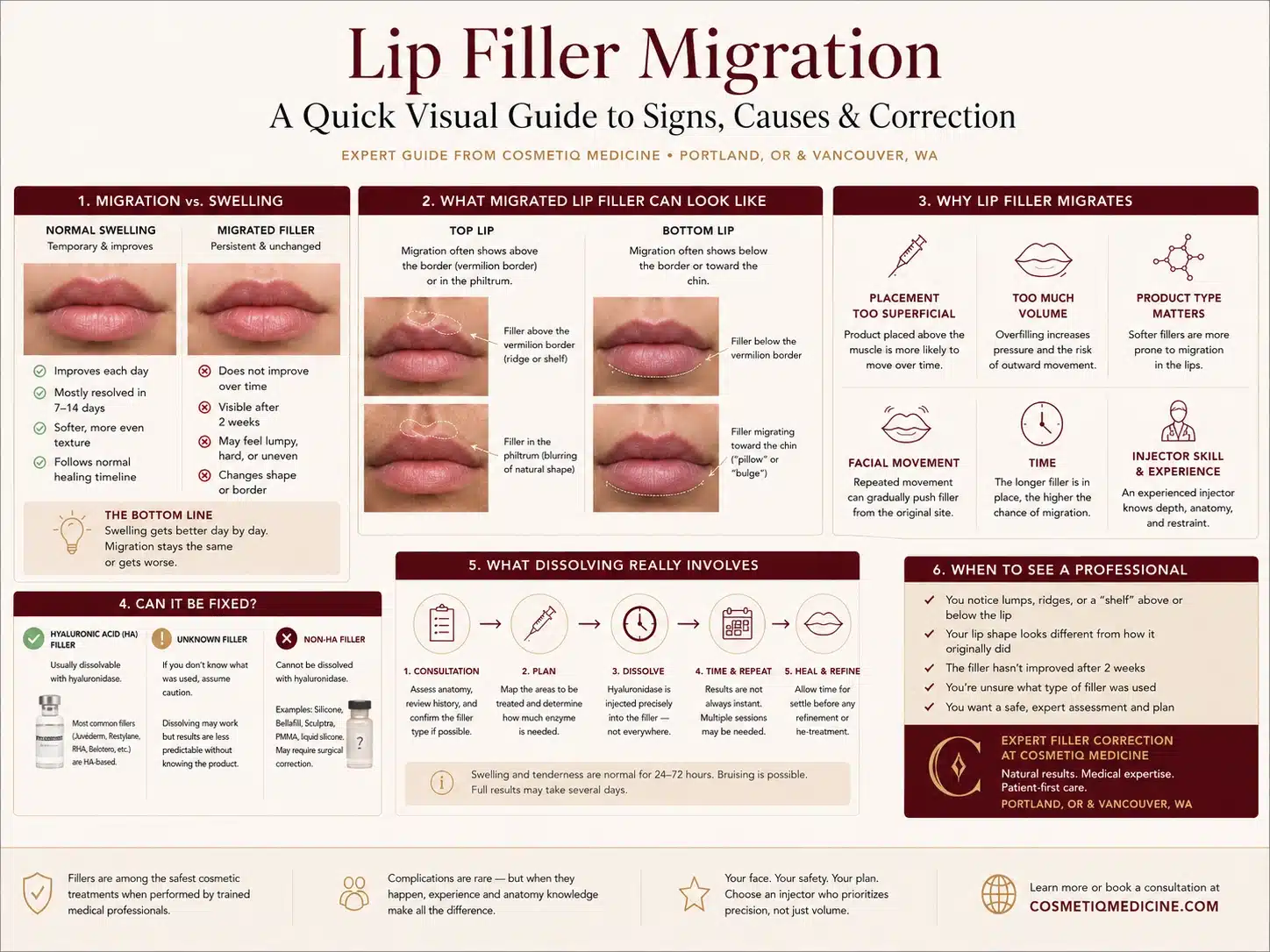
Lip filler migration or swelling? Use the two-week line
This is the most-searched version of the whole topic and the one most often answered badly. The distinction is not about how big your lips look. It is about the direction of travel.
Post-injection side effects such as redness, swelling, tenderness and occasional bruising typically clear within seven to fourteen days, and often sooner, according to the AAD. The key word is clear. Swelling is a curve that bends downward. Every morning should be slightly better than the last, even if unevenly.
Reads as swelling
Generalised puffiness across the whole lip. Improves noticeably day to day. Softens under gentle pressure. Peaks in the first 48 hours. Largely resolved by day 14.
Reads as migration
A defined ridge or shelf in one specific place. Static or worsening across weeks. Firm, and does not soften. Frequently appears late — a month or several months out, not on day three.
Practical rule: give it the full two weeks before you judge anything. If you are at week three and the shape is structurally different from what you expected — not “still a bit puffy” but genuinely a different lip — that is the point to have it looked at rather than wait it out. Migrated product does not reabsorb on the same schedule that inflammation resolves on.
What migrated lip filler actually looks like
Migration presents differently depending on which lip it happened in, and most guides collapse the two into one description. They are not the same problem and they do not look the same in the mirror.
Top lip migration
This is the pattern people mean when they search lip filler migration top lip. Product moves upward past the vermilion border into the skin between the lip and the nose. The visible signature is a raised band or step sitting above where your lip actually ends — sometimes described as a shelf or a filler moustache. It is most obvious in profile and in flat, overhead light.
Secondary tells on the upper lip: the cupid’s bow flattens and loses its two peaks, the philtral columns blur into the surrounding skin, and lipstick starts feathering or sitting oddly because the border it was tracing has moved. Many people notice the makeup problem before they notice the shape.
Bottom lip migration
Lower lip migration tends to project forward and roll outward rather than climb. In profile the lip juts rather than curves, and the wet line — the internal edge you normally cannot see — becomes visible at rest. Front-on it can look relatively normal, which is why bottom lip migration is often caught later than top lip migration.
When both lips are involved you get the profile that gets called a duck bill. Worth noting that the AAD warns about this outcome directly as a consequence of over-treatment: patients with naturally thin lips who are given dramatically fuller lips can end up with a result that reads as unflattering rather than enhanced. Over-filling and migration are close cousins.
A five-point mirror check
- Look at your profile, not just front-on. Migration is a depth problem and shows up in silhouette first.
- Find your vermilion border and trace it. Is there volume sitting on the wrong side of that line?
- Rest your lips closed and relaxed. Migration is often more visible at rest than when you are smiling or talking.
- Press gently. Swelling yields. Migrated product tends to feel firm and defined.
- Compare against a photo from before your first appointment — not against a photo from two treatments ago. Gradual change is easy to normalise.
One honest caveat before you diagnose yourself: not every asymmetry is migration. Ohio State’s Wexner Medical Center makes the point that no face is perfectly symmetrical, lips included, and that changing the natural balance of a face can make small pre-existing irregularities more noticeable rather than creating new ones. Some of what people identify as migration is baseline asymmetry that filler has simply made easier to see — which is a different problem with a different fix.
Why filler ends up where nobody put it
Four variables drive most of it, and all four sit on the provider’s side of the table rather than the patient’s.
Pressure. Too much product in a compartment that cannot hold it. The gel goes to the path of least resistance, which is usually upward and outward.
Plane. Filler placed too superficially has nothing structural anchoring it. Ordinary daily movement — talking, eating, smiling — walks it out of position over months.
Product. Fillers differ in cohesivity, cross-linking and water-binding behaviour. A formulation engineered for deep structural support behaves badly in thin, highly mobile lip tissue. Harvard Health puts it plainly: choosing the right filler requires a provider with a thorough understanding of facial anatomy and familiarity with the full range of available products and their injection techniques.
Pattern. Layering session after session without reassessing what is already in there. This is the quiet one. Nobody’s individual appointment was excessive; the cumulative total was.
We have covered the mechanics in more depth elsewhere — see our guide to the clinical causes and early warning signs of migration, and our practical breakdown of how migration is prevented before it starts. This article picks up where those leave off: what happens once it has already occurred.
At a glance
The part most “just dissolve it” advice leaves out
Search this topic and you will find the same three-word answer everywhere: get it dissolved. That answer contains a large unstated assumption — that what is in your lips is hyaluronic acid.
Hyaluronidase, the enzyme used to reverse filler, only breaks down hyaluronic acid. It does nothing to the other filler families. And the other filler families are not exotic — they are on the same menu. Per the AAD’s own longevity data, hyaluronic acid gel lasts roughly four to twelve months, calcium hydroxylapatite six months to a year, poly-L-lactic acid one to three years, and PMMA is classified as permanent. Harvard Health adds that PMMA, while more durable, carries its own complication profile including lump formation and visibility under the skin.
The FDA states it directly: if you want fillers removed or reduced, you may need additional procedures or surgery to do it — those procedures carry their own risks, and it may be difficult or impossible to remove some filler materials at all.
This matters most for exactly the people most likely to be reading this: someone whose filler was placed years ago, or at a practice that has since closed, or at a party, salon or home setting where no product record exists. The AAD is unambiguous that filler should never be injected in any of those environments — and one of the least-discussed reasons is that when something needs correcting later, there is no chart to consult.
So the real first step in correcting migrated lip filler is not dissolving. It is identification. Before any correction plan, an experienced injector should be establishing what was used, roughly how much, how many sessions, over what span of time, and in what plane. If you can retrieve your treatment record from a previous provider — product name and lot number — bring it. It changes the plan more than anything else you can bring to a consultation.
What dissolving migrated lip filler actually involves
Assuming the product is hyaluronic acid — which it is for most lip filler placed in a medical setting — reversibility is genuinely one of the category’s real advantages. Harvard Health lists it as a primary benefit of HA fillers: they can be dissolved with a specific solution if there is an adverse event, or simply if the patient dislikes the result.
But “dissolving” is not one uniform procedure with one uniform dose, and this is where a lot of correction goes sideways. A 2025 study in the Journal of Cosmetic Dermatology, published open-access through the National Library of Medicine, ran controlled dissolution experiments across filler types and found meaningful differences in what it takes to break each one down.
Dose is product-dependent
The researchers found roughly 500 units per 1 mL generally sufficient for biphasic fillers, while more heavily cross-linked monophasic fillers often required up to 750 units per 1 mL, plus multiple injections and massage.
Technique changes the result
Injecting the enzyme directly into the filler mass was consistently more effective than applying it around the outside. Surface application alone was insufficient for the more cross-linked products.
The window is short
Enzyme activity in tissue diminished significantly within about thirty minutes, which is why dosing and placement have to be right during the appointment rather than adjusted afterward.
The practical translation for a patient: a provider who does not know which product they are dissolving is estimating. Under-dose a heavily cross-linked filler and you get a partial correction that leaves the shape half-changed and the patient assuming dissolving “did not work.” That same study also confirmed that saline alone does nothing — it can hydrate a filler mass but does not degrade it — so there is no shortcut version of this.
Two safety notes that belong in any honest version of this conversation. Hyaluronidase can provoke hypersensitivity reactions, particularly at higher doses, which is why it belongs in a medical setting with antihistamines and corticosteroids on hand and why your allergy history is a real part of the consultation, not a formality. And because the enzyme acts on hyaluronic acid generally, precision matters — correction should be targeted to the migrated product rather than applied broadly.
Most patients see visible change quickly, with the area continuing to settle over the following week or two. Heavily layered or longstanding migration sometimes needs a second session. You can see correction outcomes in our before-and-after gallery.
After dissolving: the reset, and when to refill
Expect a period where your lips look smaller than you remember them — sometimes smaller than your actual baseline. That is normal and largely temporary. Tissue that has been holding volume needs time to rehydrate and re-settle, and immediately post-dissolution is the worst possible moment to judge a final result or to make a decision about refilling.
If you do want volume back, the case for a conservative restart is strong. The AAD’s guidance on natural-looking outcomes is that results look more natural with a conservative approach, and that dramatic volume in naturally thin lips is the specific route to an unflattering result. Rebuilding gradually — smaller volumes, longer intervals, reassessment between sessions — is also the direct antidote to the layering pattern that causes migration in the first place.
It is also worth separating two different goals that often get conflated. Correcting migration is a structural problem. Addressing age-related lip volume loss and perioral texture is a different conversation with a different treatment plan, and the two should not be solved in the same appointment. Current costs for injectable treatments are listed on our treatment pricing page; correction planning is quoted at consultation, once there is an actual assessment to quote against.
Five questions worth asking before anyone injects — or dissolves
- What product, specifically? Not “a hyaluronic acid filler.” The product name. You want it in your record because you may need it years from now.
- How much, this session and in total? Cumulative volume across all sessions is the number that predicts trouble, and it is the number nobody tracks.
- What depth are you placing it at, and why? A provider who can answer this in anatomical terms is thinking about plane. That is the variable that keeps product anchored.
- What happens if this migrates? The answer should be a specific plan, not reassurance that it will not.
- Is this a medical setting? The AAD’s position is that filler should never be injected at a non-medical spa, a party, a salon, or in someone’s home. The FDA similarly advises working with a licensed provider experienced in injecting fillers and trained in managing complications.
Getting evaluated in Portland or Vancouver, WA
A migration consultation at Cosmetiq Medicine starts with assessment rather than treatment: identifying where product has relocated, establishing what is known about the original filler, and mapping whether the right answer is targeted correction, full dissolution and a fresh start, or simply time. Our expert injectors handle correction work on filler placed elsewhere regularly, including cases that are several years old.
Injectable treatments — including lip filler and migration correction — are available at both locations. Our Portland office is on SE Stark Street, and dermal filler treatment in Vancouver, WA is available on SE Mill Plain Boulevard. Transparent pricing is discussed up front, and consultations can often be scheduled the same business day.
Concerned about your results?
Book a lip filler evaluation
Bring any records you have from a previous provider — product name and lot number are the two most useful things you can walk in with.
Frequently asked questions
Does lip filler always migrate?
No. Migration is a recognized complication, not an inevitable outcome. The odds are driven far more by how much product was placed, at what depth, which formulation was chosen, and how many sessions were layered on top of one another than by whether you had filler at all.
How do I know if my lip filler migrated or if it is just swelling?
Swelling improves measurably day over day and generally clears within seven to fourteen days. Migration presents as a defined ridge or shelf in one specific location, stays static or worsens across weeks, feels firm rather than soft, and often appears late — a month or several months after treatment rather than in the first few days.
What does migrated lip filler look like on the top lip?
Product moves upward past the vermilion border into the skin above the lip, producing a raised band or step sitting above where the lip actually ends. Supporting signs include a flattened cupid’s bow that has lost its two peaks, philtral columns that blur into surrounding skin, and lipstick that starts feathering because the border it was tracing has shifted.
Can all migrated filler be dissolved?
Only hyaluronic acid filler responds to hyaluronidase. Other filler families — calcium hydroxylapatite, poly-L-lactic acid, PMMA — do not, and the FDA states that removal may require additional procedures or surgery, that those carry their own risks, and that some filler materials may be difficult or impossible to remove. That is why identifying the original product is the real first step in correction.
Why does the amount of hyaluronidase needed vary so much?
Because cross-linking differs between products. Published research found roughly 500 units per 1 mL generally sufficient for biphasic fillers, while more heavily cross-linked monophasic fillers often required up to 750 units per 1 mL along with multiple injections and massage. The same research found that injecting the enzyme directly into the filler mass works better than applying it around the outside.
Will my lips look deflated after dissolving?
Temporarily, often yes — sometimes smaller than your original baseline. Tissue that has been holding volume needs time to rehydrate and re-settle, which is why the period immediately after dissolution is the worst moment to judge a final result or decide about refilling.
Sources
- U.S. Food and Drug Administration. Dermal Filler Do’s and Don’ts for Wrinkles, Lips and More.
- American Academy of Dermatology. Fillers: FAQs.
- Liu, K. Dermal fillers: The good, the bad and the dangerous. Harvard Health Publishing, Harvard Medical School.
- Lauro, K. How lip fillers work, how much they cost and other common questions about cosmetic lip procedures. The Ohio State University Wexner Medical Center.
- Hong, G.-W., Hu, H., Wan, J., et al. How Should We Use Hyaluronidase for Dissolving Hyaluronic Acid Fillers? Journal of Cosmetic Dermatology, 2025. Via the National Library of Medicine.
This content is provided for general educational purposes and does not replace an individualized consultation. If you have concerns about filler placement, migration, or correction, schedule an evaluation with a qualified provider.