Medical Aesthetics News
Portland, OR — July 24, 2026
By Cosmetiq Medicine
A clinical review published this week put a number on something injectors have been watching for three years: the facial changes that follow rapid weight loss on GLP-1 medications are now driving measurable demand for aesthetic treatment. Two-thirds of facial plastic surgeons report more patients arriving with weight-loss-related facial concerns. Separately, radiographic imaging out of Vanderbilt University Medical Center has quantified how much midface volume is lost per kilogram — and where it goes from.
The more useful finding is buried underneath the headline numbers, and it has less to do with which treatment you choose than when you start the conversation.
What the new clinical review says about GLP-1 facial changes
On July 22, 2026, Medscape published a clinical review examining whether the phenomenon nicknamed “Ozempic face” is changing how aesthetic medicine is practiced. The review draws on member survey data from the American Academy of Facial Plastic and Reconstructive Surgery (AAFPRS), the largest specialty association in facial plastic surgery, representing more than 2,200 surgeons worldwide.
The survey numbers behind the headline
The AAFPRS 2025 Annual Survey reported four figures that matter to anyone weighing a weight-loss program against its effect on their face:
67% of surveyed facial plastic surgeons reported an increase in patients seeking treatment related to rapid weight loss — up 45% from the prior year.
Second consecutive year of 50% growth in facial fat grafting procedures, as patients sought to restore lost fullness.
One in four surgeons predicted GLP-1 use would drive a spike in non-surgical treatment demand.
80% of all procedures reported by members were non-invasive, with neurotoxins and fillers the most requested.
AAFPRS president Dr. Anthony Brissett attributed the demand to fat disappearing from the face faster than skin adapts, describing patient complaints of hollowed cheeks, increased skin laxity, and more pronounced jowls
.
Why this data is from December 2025, not this week
Worth being precise, because most coverage is not. The clinical review is dated July 22, 2026. The survey underneath it was fielded in December 2025 by ACUPOLL Precision Research and released publicly on February 24, 2026. What is new this week is the clinical interpretation, not the underlying dataset. The trend it describes has been building for at least two survey cycles.
How much facial volume is actually lost? Vanderbilt put a number on it
Until recently, the entire conversation ran on before-and-after photos and clinician impressions. A retrospective imaging study from Vanderbilt University Medical Center, published in Otolaryngology–Head and Neck Surgery, changed that by measuring the change on CT and MRI scans instead of eyeballing it.
7% of midface volume per 10 kilograms lost
Researchers analyzed imaging from 20 patients on GLP-1 receptor agonists, median age 54, with an average treatment duration of 321 days and average weight loss of 11.0 kg. The published findings reported:
Ten kilograms is roughly 22 pounds. For a patient who loses 40 pounds on a medically supervised program, the regression line predicts something in the range of 13% of midface volume. The authors described their work as among the first quantitative assessments of the phenomenon, and the sample is small enough that the number should be read as a useful estimate rather than a guarantee.
Superficial fat pads, not deep — and why that distinction matters
This is the detail nearly every summary of the study leaves out. When researchers ran the correlation, weight loss tracked closely with loss in the superficial fat compartments (rho = 0.590, P = .006). It did not track with loss in the deep compartments (r = 0.115, P = .629).
In plain terms: the change appears concentrated in the layer closest to the skin surface, not the deeper structural pads that sit against bone. That matters because the two layers are addressed by different approaches. It also complicates the reflex assumption that every GLP-1 patient needs deep structural correction.
The angle most coverage is missing: timing may matter more than technique
Read the coverage of the AAFPRS survey and you will come away thinking the answer to weight-loss facial change is fat grafting. That is what the 50% growth figure points to, and it is repeated in nearly every write-up.
There is a selection effect worth naming. The survey polled facial plastic surgeons. Surgeons report surgical volume. The same survey found that one in four of them expected the real spike to land in non-surgical treatment — a prediction that received almost no coverage, despite non-invasive procedures already accounting for 80% of what those members do.
The question the survey does not answer at all is sequencing. Nobody asked whether patients should be treated during active weight loss or after weight stabilizes. That gap is where the more interesting evidence sits.
A small case series treated patients during weight loss, not after
A case series published in Aesthetic Surgery Journal Open Forum in October 2025 followed four patients on GLP-1 receptor agonists who received a hyperdiluted calcium hydroxylapatite biostimulator in the lower face while they were still actively losing weight. Across two treatment sessions and six months of follow-up, patients lost an average of 24.3 pounds — about 9.2% of starting body weight — and their measured facial metrics held steady or improved.
Four patients lost roughly 24 pounds each. Cheek measurements went up, not down.
Reported changes: cheek volume +9.8%, jowl volume −55.8%, nasolabial fold depth −46.2%, marionette line depth −20.6%.
What a 4-patient case series can and can’t tell you
It cannot tell you this approach works reliably. Four patients, retrospectively reviewed, with no control group, is a signal and nothing more. Anyone presenting it as proof is overselling it.
What it does do is reframe the question. If facial change during rapid weight loss is measurable, predictable per kilogram, and concentrated in a specific tissue layer, then the timing of a treatment plan becomes a real clinical variable rather than an afterthought. The survey data describes patients showing up after the change has happened. The case series asks what happens when the plan starts earlier. Those are different conversations, and only one of them is being reported.
What GLP-1 patients in Portland and Vancouver are actually asking about
Search behavior tracks the clinical picture. A Google Trends analysis published in the Journal of Cosmetic Dermatology in 2026 found that relative search volume for the term “Ozempic face” rose 4,600% between November 2021 and December 2024, with searches pairing the term with providers climbing alongside it. Public awareness of the aesthetic side of weight-loss medication is no longer a niche concern.
Separately, a national survey of aesthetic providers reported that the number of patients arriving on these medications more than doubled between 2023 and 2024, with midface volume loss, skin laxity, and deepening folds cited as the concerns providers saw most.

The “did I trade my body for my face” consultation
At our Portland and Vancouver locations, this is the consultation that has changed most in the past two years. It is rarely someone who regrets losing weight. It is someone pleased with the scale and unsettled by photographs — and unsure whether what they are seeing will settle on its own, or whether waiting makes it harder to address.
Two things are worth separating in that conversation. Volume change and skin quality change are not the same problem, they do not respond to the same approach, and the imaging data suggests they may not even be happening in the same tissue layer. A plan that treats them as one thing tends to overcorrect one and ignore the other.
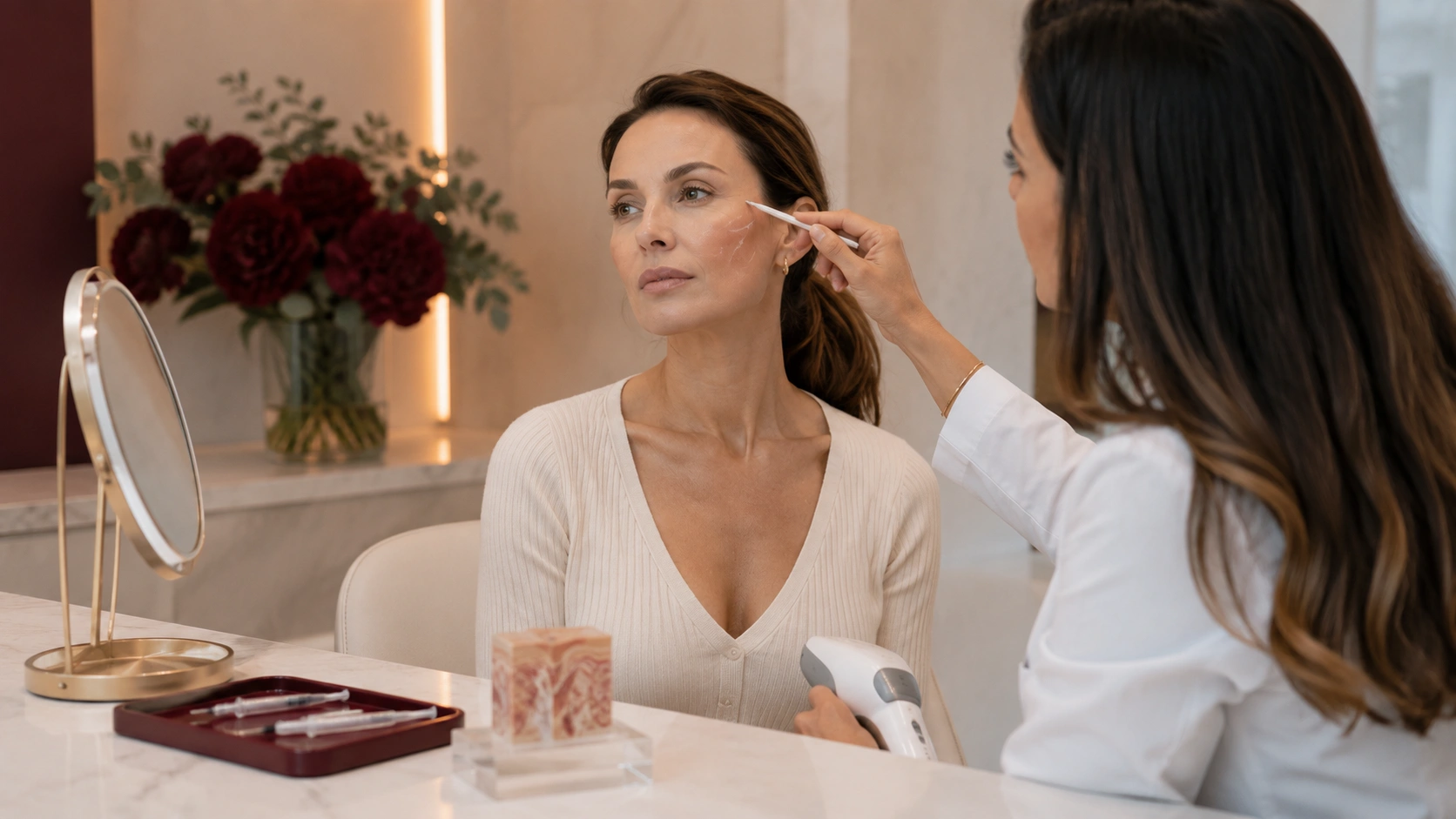
Approaches discussed at consultation, and where each is available
Nothing below is a recommendation for any individual. Which approach suits a given patient depends on their anatomy, their weight-loss timeline, their medical history, and a clinical assessment. Our full menu of med spa treatments in Portland and Vancouver sets out what we offer at each location.
- Collagen biostimulators. The category the calcium hydroxylapatite case series falls under, working gradually over a series of sessions rather than immediately. Discussed at both locations — see collagen biostimulator treatments and our calcium hydroxylapatite biostimulator page.
- Hyaluronic acid fillers. The most-requested category in the AAFPRS data. Available at both locations: dermal fillers in Portland and dermal fillers in Vancouver, WA.
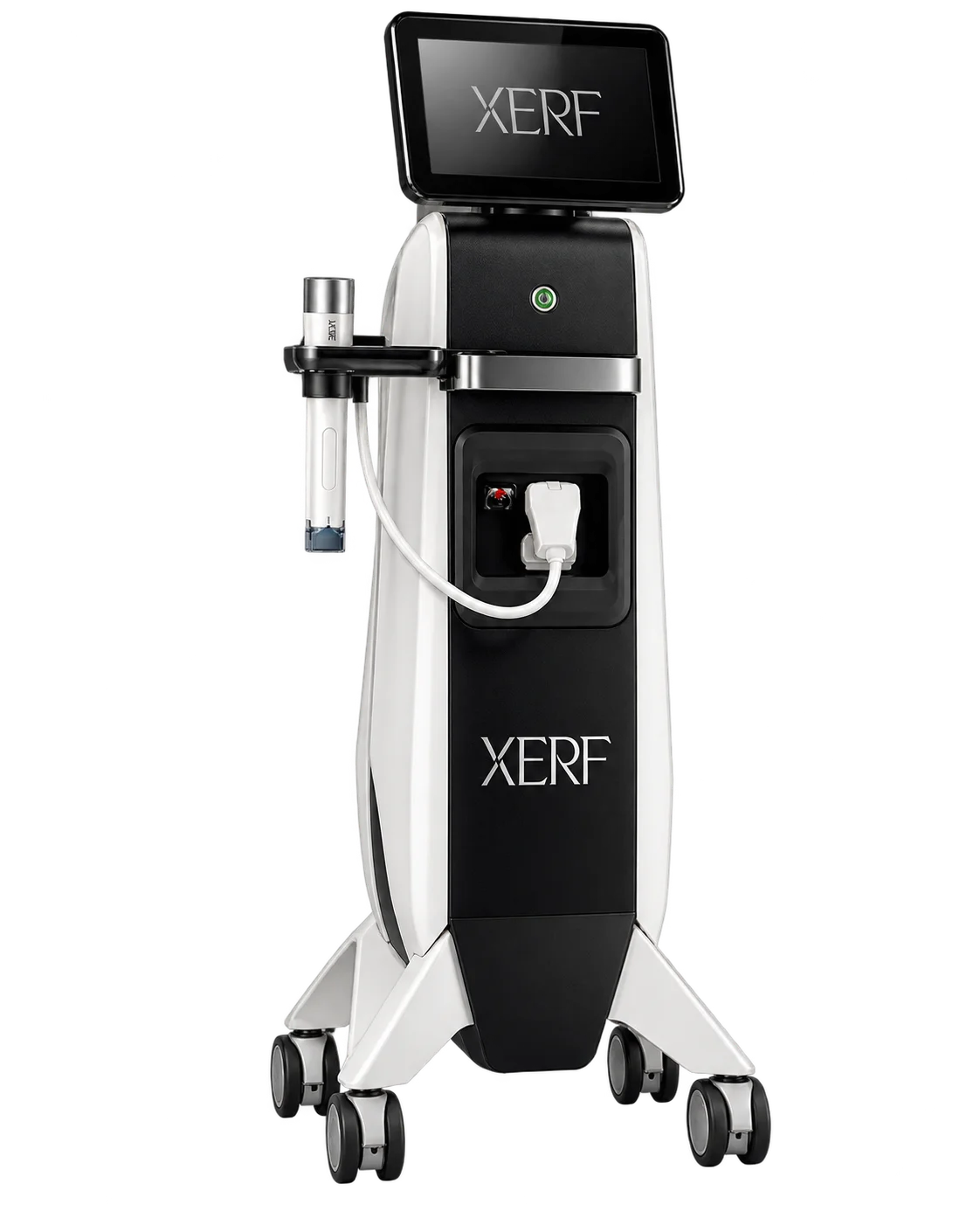
- Radiofrequency microneedling. Aimed at skin quality rather than volume. This is an energy-based treatment offered only at our Vancouver, WA location, serving Portland and Vancouver clients — see radiofrequency microneedling and our Vancouver, WA med spa.
- Medically supervised weight management. If you are earlier in the process, sequencing can be planned from the start rather than reverse-engineered later. See our medical weight loss program.
What this means if you’re on a weight-loss program in the Portland–Vancouver metro
Three practical takeaways follow from the evidence above, and none of them require you to do anything today.
First, what you are noticing is documented. It is not vanity or imagination. Imaging has measured it, and the rate is roughly proportional to how much weight you have lost.
Second, the surgical answer is not the only answer. The 50% fat grafting growth figure comes from surgeons reporting surgical volume. A quarter of those same surgeons expected non-surgical demand to be where the real growth lands.
Third, timing is a legitimate question to raise. The published research has not settled whether treating during active weight loss beats waiting for weight to stabilize. But it is now a question with evidence attached, and it is worth asking out loud rather than defaulting to “wait and see.”
Questions worth asking at a consultation
- How much more weight am I expecting to lose, and does that change what we do now?
- Is what I am seeing primarily a volume change, a skin quality change, or both?
- What would a staged plan look like across the next six to twelve months?
- What does each stage cost, and what happens if I stop after the first one?
Our treatment pricing page lists costs up front so that last question can be answered before you walk in.
The bottom line
The demand shift is real and documented across two survey cycles. The volume change is now measurable at roughly 7% of the midface per 10 kilograms lost, concentrated in the superficial fat compartments. And the treatment conversation being reported — surgical volume restoration after the fact — is narrower than the evidence base supports.
If you are on a medically supervised weight-loss program in Portland or Vancouver and have started noticing changes in the mirror that the scale did not warn you about, you are describing something the literature has now measured. That is a better starting point for a conversation than a before-and-after gallery.
Talk it through first
Book a consultation with our board-certified clinical team
Our expert injectors will assess where you are in your weight-loss timeline before recommending anything. Transparent pricing, and often same business day availability at both locations.
Book in Portland, ORBook in Vancouver, WA
Prefer to ask a question first? Contact us or call (503) 572-2675. You can also try our photo treatment planner.
Frequently asked questions
How much facial volume is lost on GLP-1 medications?
A retrospective imaging study of 20 patients at Vanderbilt University Medical Center, published in Otolaryngology–Head and Neck Surgery, reported a median 9.0% decrease in total midfacial volume and a rate of roughly 7% of midface volume lost per 10 kilograms of total weight loss. Ten kilograms is about 22 pounds. The sample was small, so the figure is best treated as an estimate rather than a prediction for any individual.
Is “Ozempic face” happening in the deep or superficial fat of the face?
In the Vanderbilt data, weight loss correlated with volume loss in the superficial fat compartments (rho = 0.590, P = .006) but not the deep compartments (r = 0.115, P = .629). Superficial compartments decreased by a median 11.0% and deep compartments by 7.0%. This suggests the change is concentrated closer to the skin surface than to bone.
Are more people seeking treatment for weight-loss facial changes?
Yes. In the AAFPRS 2025 Annual Survey, fielded in December 2025, 67% of surveyed facial plastic surgeons reported an increase in patients seeking treatment related to rapid weight loss, up 45% from the previous year. Members also reported a second consecutive year of 50% growth in facial fat grafting. Separately, relative search volume for the term “Ozempic face” rose 4,600% between November 2021 and December 2024, according to a Google Trends analysis in the Journal of Cosmetic Dermatology.
Should I wait until my weight stabilizes before seeking treatment?
The published research has not settled this. A case series of four patients in Aesthetic Surgery Journal Open Forum reported that facial measurements held steady or improved when a hyperdiluted calcium hydroxylapatite biostimulator was used during active weight loss, with patients losing an average of 24.3 pounds over the study period. Four patients with no control group is a signal, not proof. The AAFPRS survey did not ask about sequencing at all, which is why raising the timing question at consultation is worthwhile.
Which of these treatments are available in Portland versus Vancouver?
Injectable treatments including dermal fillers and collagen biostimulators are offered at both our Portland, OR and Vancouver, WA locations. Radiofrequency microneedling is an energy-based treatment offered only at our Vancouver, WA location, serving Portland and Vancouver clients. Medically supervised weight management is available at both locations.
Sources
- “GLP-1 Drugs: Is Ozempic Face Changing Aesthetic Care?” Medscape, July 22, 2026. medscape.com (subscription may be required)
- “AAFPRS Reveals the Trends Defining Facial Plastic Surgery.” American Academy of Facial Plastic and Reconstructive Surgery, February 24, 2026. Survey fielded December 2025 by ACUPOLL Precision Research. prnewswire.com
- Sharma RK, Vittetoe KL, Barna AJ, et al. “Radiographic Midfacial Volume Changes in Patients on GLP-1 Agonists.” Otolaryngology–Head and Neck Surgery. 2025;173(2):360–366. DOI: 10.1002/ohn.1209. aao-hnsfjournals.onlinelibrary.wiley.com
- Durairaj KK, McCarthy AD, Yambao M, Linnemann-Heath J. “Hyperdilute CaHA-CMC Preserves Facial Volume in GLP-1 Receptor Agonist Users Undergoing Rapid Weight Loss.” Aesthetic Surgery Journal Open Forum. October 21, 2025. DOI: 10.1093/asjof/ojaf088. ncbi.nlm.nih.gov
- McCarthy AD, Durairaj K, Linneman-Heath J, et al. “Rising Public Interest in Weight Loss Medications and Growing Awareness of Their Aesthetic Sequelae: An Infodemiologic Google Trends Analysis and Clinical Diagnostic Patterning.” Journal of Cosmetic Dermatology. 2026;e70670. DOI: 10.1111/jocd.70670. ncbi.nlm.nih.gov
- “Survey Maps Facial Aesthetic Concerns After GLP-1–Associated Weight Loss.” Interview with Joely Kaufman, MD, FAAD. Plastic Surgery Practice, February 17, 2026. plasticsurgerypractice.com
This article is for general information and reports on published research. It is not medical advice and does not describe expected outcomes for any individual. Treatment suitability is determined by clinical assessment. Individual results vary.
Medicare & Weight Loss Access
Portland, OR — July 3, 2026 | By Cosmetiq Medicine
Starting this week, Medicare is covering GLP-1 weight-loss medications for the first time in the program’s history. The new Medicare GLP-1 Bridge took effect July 1, 2026, letting eligible beneficiaries access drugs like Wegovy, Zepbound, and Foundayo for a flat $50 monthly copay — a fraction of the roughly $350 many patients pay out of pocket today. It’s a genuine access breakthrough. But it’s a narrow one, and understanding exactly who it helps, and who it leaves out, matters just as much as the headline.
What Happened: Medicare Opens the Door to GLP-1 Coverage
The Centers for Medicare & Medicaid Services (CMS) launched the Medicare GLP-1 Bridge on July 1, marking the first time federal law has allowed Medicare Part D to help pay for a medication prescribed solely for weight loss. For more than two decades, a federal exclusion blocked Part D plans from covering weight-loss drugs at all, no matter a patient’s health risks.
CMS Administrator Dr. Mehmet Oz pointed to cost as the barrier the program is meant to solve, noting that “too many seniors are currently unable to access them due to high cost.” The Bridge is a temporary fix, not a permanent law change: it runs through December 31, 2027, under a section of federal authority that lets CMS test new approaches to care delivery before Congress acts.
Three medications are covered under the program: Novo Nordisk’s Wegovy, available as both an injection and a pill, and two products from Eli Lilly — the Zepbound KwikPen injection and the Foundayo daily pill. Single-dose Zepbound pens and vials are not included, only the multi-dose KwikPen. Notably absent is Ozempic, the drug that made GLP-1 medications a household name. Ozempic remains FDA-approved for type 2 diabetes rather than weight loss, so it falls outside this program’s scope even though it shares the same active ingredient as Wegovy.
Who Qualifies — and How the Bridge Program Works
Coverage isn’t automatic. A patient has to be enrolled in a participating Medicare Part D plan, and their provider must submit a prior authorization request establishing medical necessity. Beneficiaries need to meet at least one of the following, based on their BMI and health history when they first started GLP-1 therapy:
- A BMI of 35 or higher
- A BMI of 30 or higher, with a history of heart failure, uncontrolled hypertension, or chronic kidney disease
- A BMI of 27 or higher, with prediabetes, a previous heart attack or stroke, or symptomatic peripheral artery disease
Beneficiaries who already have GLP-1 coverage under Part D for a separate condition, such as type 2 diabetes or sleep apnea, aren’t eligible for the Bridge; they stay on their existing coverage. And because the program runs outside standard Part D benefit design, the $50 copay doesn’t count toward a patient’s deductible or their annual out-of-pocket cap, and it can’t be stacked with manufacturer coupons or other discounts.
What the Price Drop Actually Looks Like
Numbers make this easier to grasp than percentages do. Without insurance, Wegovy carries a list price around $1,350 a month, according to GoodRx pricing data. Even through manufacturer self-pay programs, most eligible Medicare-age patients not on the Bridge are still looking at $149 to $449 a month, depending on the drug and dose, per CNN’s reporting on the launch. The $50 flat copay is a genuinely different tier of pricing, not just a modest discount.
Sources: GoodRx and CNN. Figures are representative list and self-pay prices; actual cost varies by drug, dose, pharmacy, and any manufacturer program a patient already qualifies for.
Why This Is Being Called a Turning Point
The Kaiser Family Foundation (KFF), a nonpartisan health policy research organization, estimates that about 3.8 million Medicare beneficiaries currently meet the Bridge’s eligibility criteria. That’s out of roughly 69 million people enrolled in Medicare nationwide, meaning even at launch, only around one in eighteen beneficiaries qualifies.
Juliette Cubanski, KFF’s director of Medicare policy, has been clear that the program doesn’t change federal law permanently; it relies on a temporary demonstration authority instead, and its future past 2027 is genuinely uncertain. Her advice for anyone wondering if they qualify is simple: “a good first step is to talk to their clinician.”
The Angle Most Coverage Is Missing
Nearly every story covering this launch, from CBS to NPR to ABC, frames it purely as a Medicare story. That’s accurate, but it leaves out the bigger picture: this program does nothing for the tens of millions of American adults under 65 who are also managing weight and metabolic health, and who have no path to $50-a-month GLP-1 coverage through this Bridge.
It also, quietly, does very little for most people already on Medicare. KFF’s own numbers show that even among Medicare’s roughly 69 million beneficiaries, only about one in eighteen currently meets the Bridge’s BMI and health-history requirements. For everyone else — under 65, over 65 but ineligible, or simply not interested in navigating a federal prior-authorization process — the real question this news raises isn’t “does Medicare cover this now?” It’s “where can I get affordable, medically supervised GLP-1 care regardless of my age or insurance status?”
How Cosmetiq Medicine Keeps GLP-1 Weight Loss Accessible in Portland & Vancouver
That’s a question we hear often at Cosmetiq Medicine, and it’s one our GLP-1 weight loss program was built to answer directly. You don’t need to be on Medicare, and you don’t need to hit a specific age, to start GLP-1 weight loss treatment with our medical team at either our Portland, OR or Vancouver, WA clinic.
Every patient begins with a full medical consultation and evaluation, not a quick screening questionnaire. From there, our clinical team builds a personalized GLP-1 weight loss treatment plan around your health history, goals, and starting point, with ongoing monitoring and adjustments so your plan keeps working as your body changes. It’s the same structured, medically supervised approach the Medicare Bridge was designed to fund for a narrow slice of seniors, available now to any qualified adult, regardless of age or insurance status.
Cost is the real barrier behind this whole news cycle, which is exactly why CMS built a temporary $50 bridge in the first place. It’s also why we offer payment plans to help make GLP-1 weight loss and our other treatments easier to fit into a monthly budget, so affordable access to GLP-1 weight loss isn’t limited to Medicare beneficiaries or a two-year federal pilot program.
What This Means for Patients Here at Home
For our patients in Portland and Vancouver, this news is genuinely good, even if it doesn’t apply to most of them directly. It signals that federal regulators increasingly view GLP-1 therapy as legitimate, evidence-based medicine worth covering, not a lifestyle drug. That shift in tone tends to ripple outward over time, even for patients whose coverage doesn’t come from Medicare.
In the meantime, our GLP-1 weight loss program remains open at both locations, with the same medical oversight, upfront evaluation, and ongoing monitoring that any responsible GLP-1 program should include, Medicare Bridge or not. If you’ve been priced out, waitlisted, or simply unsure where to start, our team can walk you through eligibility, planning, and the full range of injectable, laser, and wellness treatments that pair well with a weight-management plan.
Bottom Line
Medicare covering GLP-1 medications for weight loss, even temporarily, is a real milestone, the kind of policy shift that’s been debated in Washington for years. But “Medicare now covers it” isn’t the same as “it’s now accessible.” For the vast majority of people asking about GLP-1 weight loss this week, age and insurance status still won’t be the deciding factor at Cosmetiq Medicine.
Frequently Asked Questions
What is the Medicare GLP-1 Bridge program?
It’s a temporary CMS demonstration that lets eligible Medicare Part D beneficiaries access GLP-1 medications prescribed solely for weight loss at a $50 monthly copay. It began July 1, 2026, and is scheduled to run through December 31, 2027.
Which medications does the Bridge program cover?
Wegovy (injection and pill), the Zepbound KwikPen injection, and the Foundayo pill. Ozempic is not included, since it’s approved for diabetes rather than weight loss.
Who qualifies for the $50 copay?
Medicare Part D beneficiaries with a BMI of 35 or higher, a BMI of 30 or higher with heart failure, uncontrolled hypertension, or chronic kidney disease, or a BMI of 27 or higher with prediabetes, a prior heart attack or stroke, or symptomatic peripheral artery disease.
How many people actually qualify?
KFF estimates about 3.8 million of Medicare’s roughly 69 million beneficiaries meet the criteria, a small share of the overall Medicare population.
Do I need Medicare or a certain age to start GLP-1 weight loss treatment at Cosmetiq Medicine?
No. Cosmetiq Medicine’s GLP-1 weight loss program at our Portland, OR and Vancouver, WA locations is open to qualified adults regardless of age or Medicare status, with payment plans available to help manage cost.
Sources: U.S. Centers for Medicare & Medicaid Services · CBS News · CNN · KFF (Kaiser Family Foundation) · GoodRx · Wegovy (Novo Nordisk) · Zepbound (Eli Lilly) · Foundayo (Eli Lilly)