
Lip filler is supposed to make your lips look like a better version of themselves — not move somewhere you never asked it to go.
So when product starts creeping above your lip line, spreading into a “duck bill” shape, or pooling unevenly months after your appointment, it’s unsettling. It’s fair to wonder if something went wrong, or if this is simply what filler does over time.
Here’s the direct answer: lip filler migration is real, it’s documented in clinical literature, and it is largely preventable. It is not random bad luck, and it is not something you have to live with. Understanding why it happens — and who’s actually equipped to fix it — is the difference between chasing the problem for years and resolving it in one or two visits.
This guide walks through what migration actually is, why it happens, how to recognize it early, and what correction looks like, based on clinical literature and the standards we hold ourselves to at Cosmetiq Medicine across our Portland and Vancouver locations.
What Lip Filler Migration Actually Is
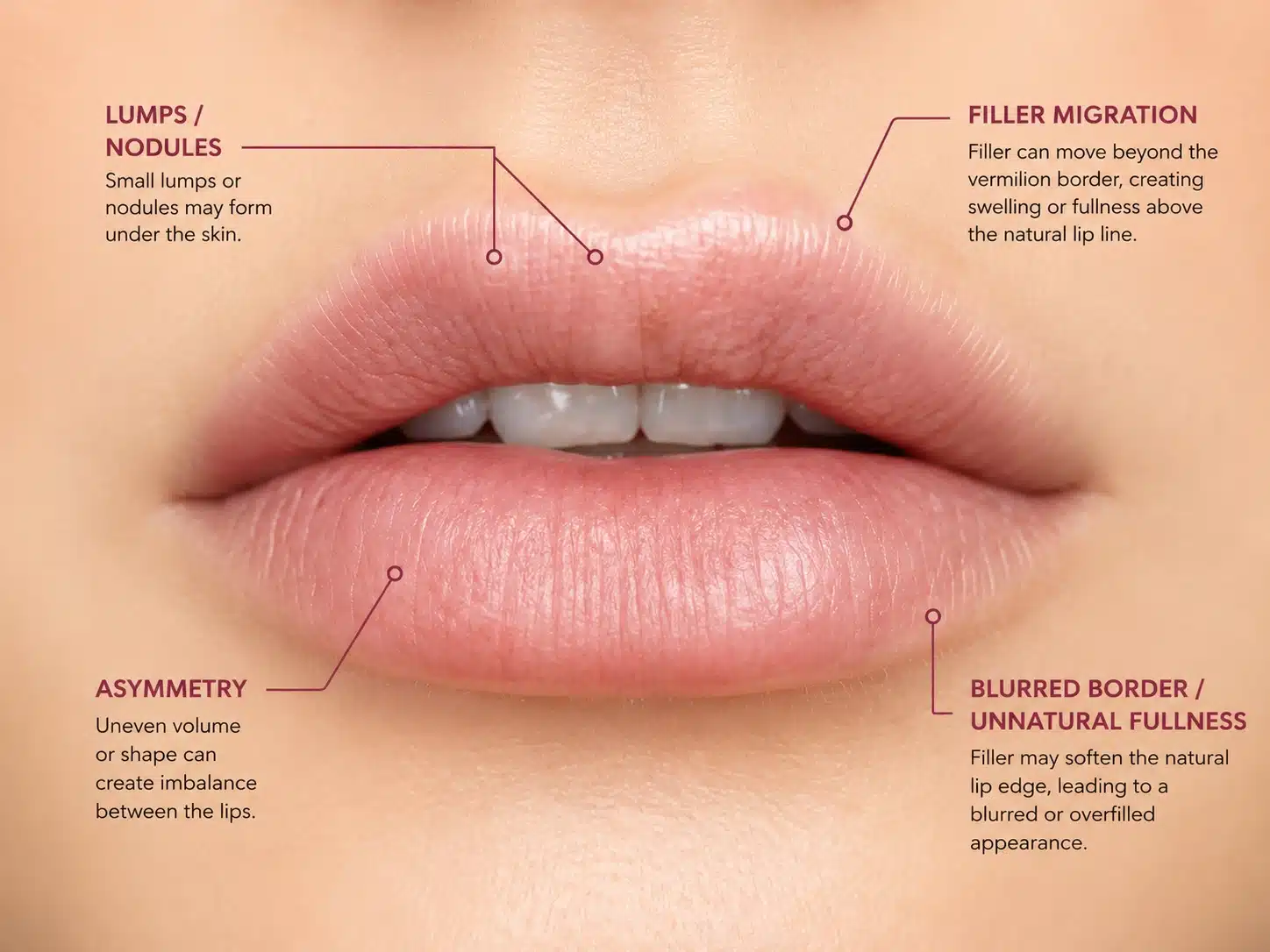
Lip filler migration describes hyaluronic acid (HA) moving away from its original injection site into surrounding tissue. Instead of staying contained within the lip border, the product spreads — most often upward into the skin above the upper lip, creating what’s commonly called a “filler mustache” or “shelf,” or outward into a flattened, overextended shape sometimes nicknamed “duck lips.”
It’s worth separating two things that get confused constantly: normal post-injection swelling, and true migration.
Swelling after a filler appointment is expected. Lips can look fuller and slightly uneven for several days to two weeks while the tissue settles. That’s not migration — that’s healing.
True migration shows up later, and doesn’t resolve on its ownTrue migration tends to develop gradually, sometimes months after treatment, and it doesn’t resolve the way normal swelling does. The filler has structurally relocated, and it needs intervention to correct.
Why It Happens: The Clinical Reasons
Migration isn’t typically about the patient. It’s almost always a product of decisions made at the time of injection — and the research backs this up clearly.
- Overfilling. When too much product is placed into the lip in a single session, or across repeated sessions without giving tissue time to settle, internal pressure builds. That pressure pushes filler into spaces it was never meant to occupy.
- Injection placed too superficially. Filler injected too close to the skin’s surface lacks the structural tissue depth needed to hold it in place. Without that anchoring, normal daily movement — talking, eating, smiling — gradually shifts it outward and upward over time.
- Wrong product for the area. Not every hyaluronic acid filler is engineered for lips. Formulations with high water-binding capacity or low cohesivity are more prone to spreading once injected into thin, highly mobile lip tissue.
- Repeated layering without reassessment. Filler added session after session — without dissolving or reevaluating what’s already there — accumulates in ways that compound the risk. This is one of the most consistent findings across clinical and training literature on the subject.
- Technique and injector experience. A provider who understands lip anatomy, vascular structures, and tissue planes can control depth and placement with precision. A provider working from a generalized template increases the odds of product ending up where it shouldn’t.
None of these are things a patient does wrong by simply getting filler. They’re variables controlled entirely by the provider — which is exactly why provider selection matters more than almost any other factor in this conversation.
The Early Warning Signs
Migration is far easier to correct early. Most people who develop noticeable migration didn’t see it happen overnight — it built gradually, and the signs were there before they became obvious.
Visible and Physical Signs to Watch For
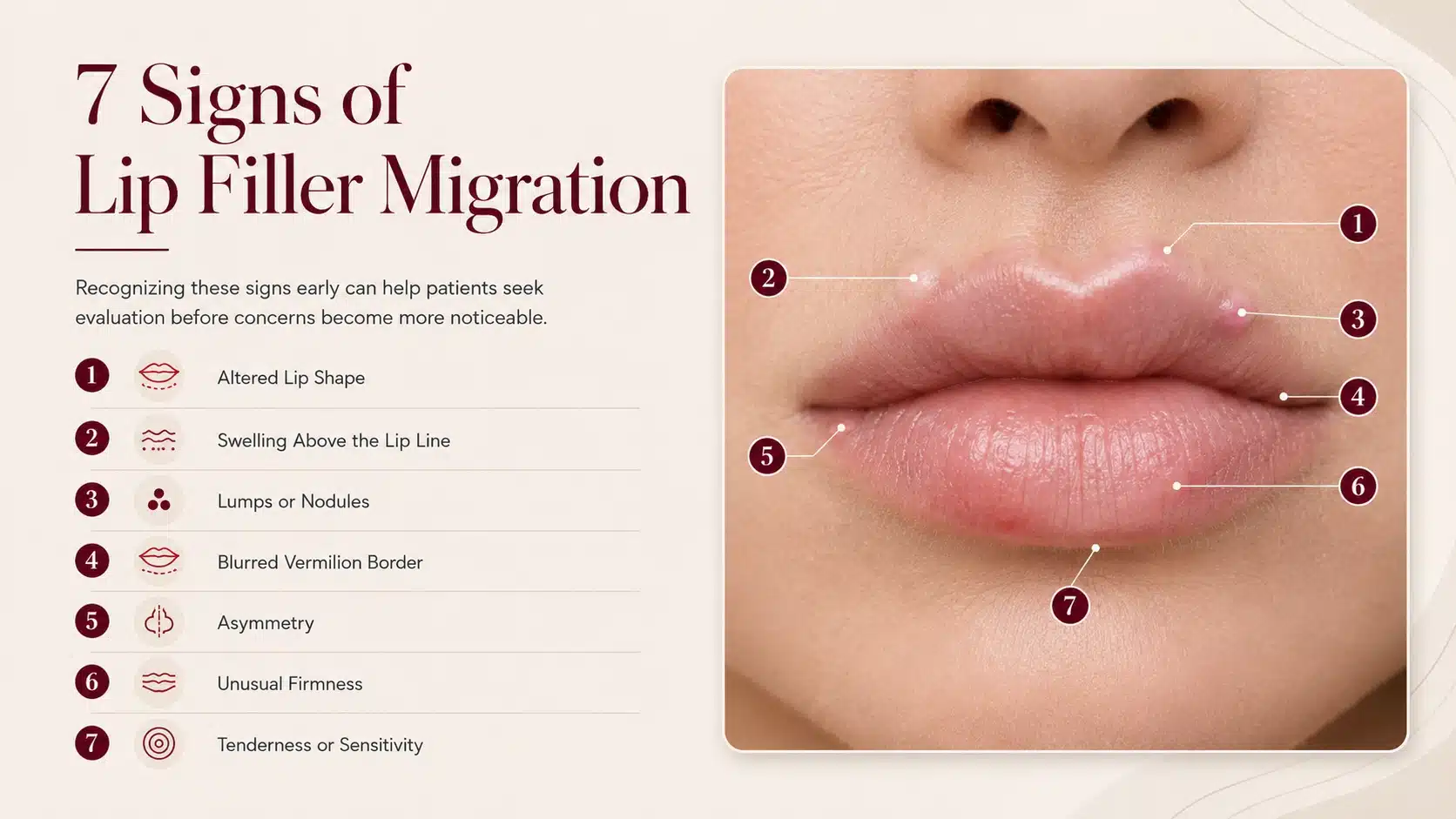
- A faint line, ridge, or “shelf” forming just above the upper lip border, separate from the lip itself
- A flattened or unnaturally wide upper lip that loses its natural curve
- Lumps or firm areas that don’t soften with gentle massage
- Asymmetry that develops or worsens over time, rather than resolving
- Lips that look overfull from certain angles but strangely flat from others
- A “duck bill” profile where the lower lip projects forward and outward
- Persistent puffiness well beyond the normal one-to-two-week healing window
When to Seek Evaluation, Not Just Wait
A good general rule: if it’s been more than three weeks since your last appointment and something still looks off — not just “still a little swollen” but structurally different from what you expected — it’s time to have it looked at by an experienced injector. Migrated filler does not resolve on its own the way ordinary inflammation does. Waiting typically allows it to become more established, not less.
How Migration Is Diagnosed and Corrected
The reassuring part of this conversation: hyaluronic acid filler is reversible. That’s one of the core advantages of HA-based products over older, permanent filler substances — and it’s precisely why an experienced provider can usually correct migration in one or two visits.
Hyaluronidase: The Clinical Standard for Reversal
Hyaluronidase is an enzyme that breaks down hyaluronic acid. It’s the same mechanism the body uses naturally to metabolize HA filler over time, just accelerated and precisely targeted by an injector. Clinical literature published through the American Society for Dermatologic Surgery and peer-reviewed plastic surgery journals consistently identifies hyaluronidase as the standard tool for resolving filler complications — including nodules, vascular occlusions, and excess volume.
The process is more nuanced than people often expect. Hyaluronidase dosing depends on the filler involved — older formulations may dissolve with as little as 5 to 15 units per 0.1 mL, while many modern, more heavily cross-linked fillers require substantially higher concentrations to break down fully. This is exactly why correction should be handled by a provider who understands filler chemistry, not just a generic dissolving protocol. Too little under-corrects the problem; using it without precision can also affect surrounding healthy tissue.
Migration is recognized in the clinical literature alongside nodule formation, infection, and vascular occlusion as one of the established complication categories associated with dermal filler use — worth knowing, because it confirms this isn’t a fringe issue or something patients are imagining. It’s a documented, treatable clinical reality with an established treatment pathway.
What to Expect During Correction
A proper migration consultation involves examining the tissue, identifying exactly where the filler has relocated, and mapping a treatment plan — which may mean full dissolution and a fresh start, or a more targeted, partial correction depending on how the original filler was placed. For overfilled or puffy results, hyaluronidase is sometimes diluted with saline and delivered as multiple smaller injections across the area, to control the correction precisely rather than dissolving more broadly than necessary.
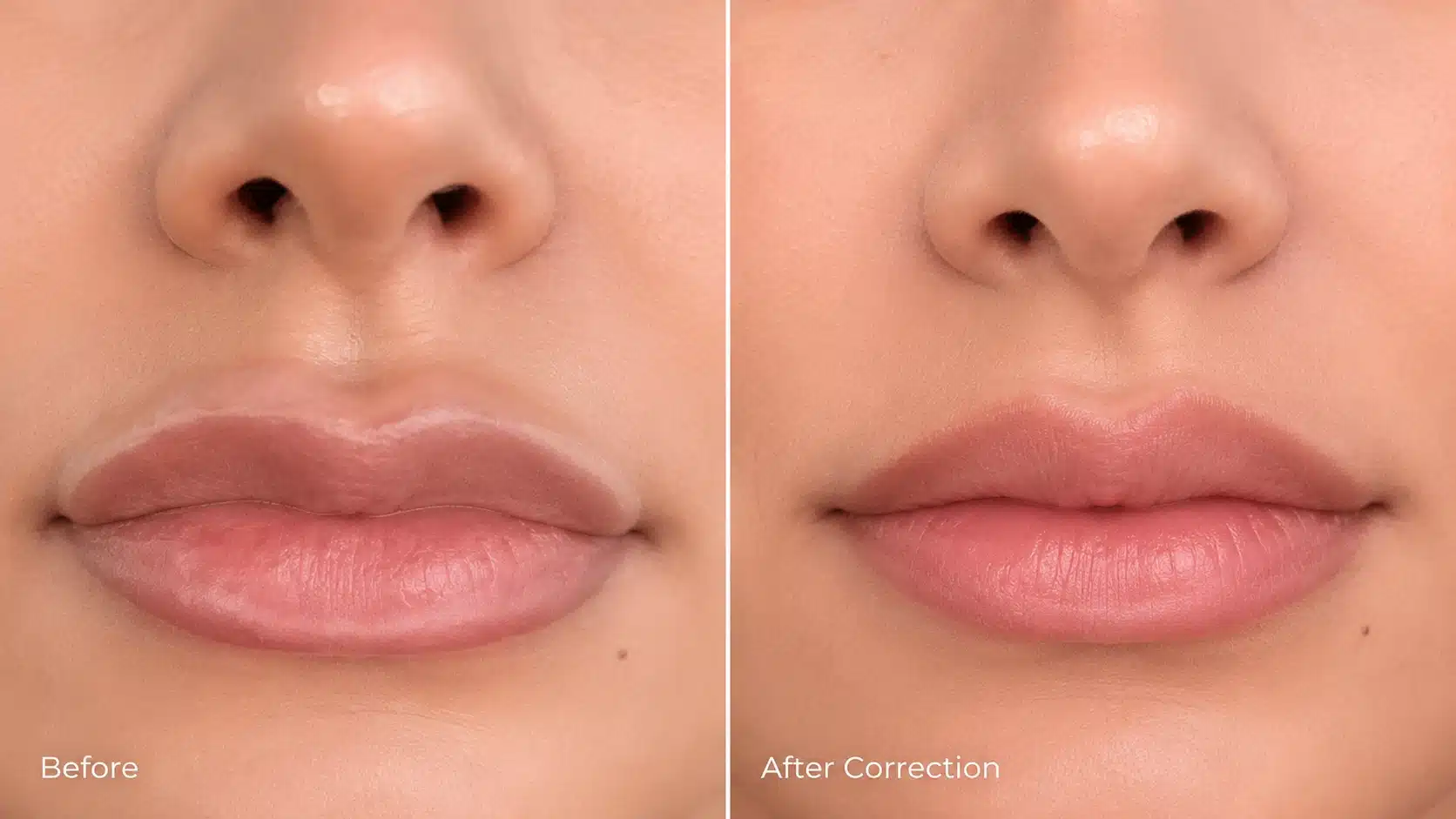
Results from hyaluronidase are often visible within a day or two, with the treated area continuing to settle over the following one to two weeks. Most patients need just one session; more complex or longstanding migration occasionally requires a second round. You can see real correction outcomes in our before-and-after gallery.
How We Approach Prevention
Migration is, fundamentally, a prevention problem before it’s ever a correction problem. The single biggest factor in whether someone experiences migration isn’t the brand of filler — it’s the judgment and technique of the person holding the needle.
As an Allergan Diamond provider, our approach to lip filler is built around conservative, anatomy-first injection — adding volume gradually, respecting the natural vermilion border, and choosing product formulations suited specifically to lip tissue rather than defaulting to whatever’s on hand. We’d rather bring a patient back for a small touch-up in a few weeks than overcorrect in a single visit and create the very risk we’re trying to avoid.
If you’re dealing with filler placed elsewhere that has migrated, we also provide correction consultations — assessing what’s there, explaining your options clearly, and walking you through a realistic timeline and plan before any treatment begins.
Portland & Vancouver
You’re not stuck with it.
We hear versions of this concern often: filler placed somewhere else, sometimes years earlier, that’s started to shift or settle unevenly. You don’t need to start over with guesswork. A proper evaluation — looking at depth, volume, and product type — is the starting point for any correction plan, whether that means a full reset or a more conservative refinement. Injectable treatments, including lip filler and migration correction, are available at both our Portland and Vancouver, WA med spa locations.
Concerned About Your Results?
Book a lip filler evaluation
Frequently Asked Questions
Is lip filler migration common?
It’s a recognized complication in clinical literature, but its frequency varies enormously based on technique, product choice, and how conservatively the filler was placed. With an experienced injector using appropriate products and gradual volumizing, the risk is meaningfully lower than with rushed or overfilled treatments.
Can migrated filler be fixed completely?
In most cases, yes. Because hyaluronic acid filler is enzymatically reversible, hyaluronidase can dissolve migrated product, after which the lips can either be left natural or re-treated with a more conservative, properly placed approach.
How long after my appointment would migration show up?
It’s typically not immediate. Migration tends to develop gradually — sometimes weeks, sometimes months after treatment — which is part of why it’s frequently mistaken for “just how my lips settled.”
Does migrated filler go away on its own?
Not reliably. Unlike normal post-injection swelling, which resolves within one to two weeks, true migration tends to persist or worsen without intervention.
What’s the difference between normal swelling and migration?
Swelling is temporary and improves day by day in the first two weeks. Migration is more localized, doesn’t follow that improvement pattern, and often appears as a distinct ridge, lump, or shape change rather than generalized fullness.
Will dissolving my filler hurt or damage my lips permanently?
No. Hyaluronidase targets hyaluronic acid specifically and has a long track record of safe use in correcting filler complications when administered by a trained provider at an appropriate dose.
Sources
- American Society for Dermatologic Surgery Task Force. Preventing and Treating Adverse Events of Injectable Fillers: Evidence-Based Recommendations. ASDS, 2021.
- Murray, G., et al. Considerations for Proper Use of Hyaluronidase in the Management of Hyaluronic Acid Fillers. Plastic and Reconstructive Surgery, American Society of Plastic Surgeons (Open Access), 2025.
- Hyaluronidase for Dermal Filler Complications: Review of Applications and Dosage Recommendations. JMIR Dermatology, 2024.
- Complications of Hyaluronic Acid Fillers and Their Management. ScienceDirect, Journal of Cutaneous and Aesthetic Surgery.
- American Board of Cosmetic Surgery. Injectable Dermal Fillers Guide.
This content is provided for general educational purposes and does not replace an individualized consultation. If you have concerns about filler placement, migration, or correction, schedule an evaluation with a qualified provider.