Lip filler migration is filler that has moved outside the intended lip compartment, most often spreading above the upper vermillion border where it reads as a shelf, a soft shadow, or a blurred lip line. It is largely preventable, and almost every factor that drives it is decided before the needle goes in.
The variables that matter are placement depth, product selection, how much volume the tissue is asked to hold, and how long you wait between sessions. None of those are decided by luck. They are decided at the consultation, which is why prevention is a conversation you have before treatment rather than a problem you manage afterward.
Lip filler migration at a glance
- Definition
- Hyaluronic acid filler that has spread beyond the intended lip compartment into surrounding tissue.
- Most common location
- Above the upper vermillion border, producing a raised ledge or a shadow line above the lip.
- Typical onset
- Weeks to months after treatment. Puffiness in the first 72 hours is usually swelling, not migration.
- Primary drivers
- Injection depth, product cohesivity, cumulative volume, and short intervals between sessions.
- Reversible
- Yes. Hyaluronic acid filler can be broken down with hyaluronidase.
- Best prevention window
- The consultation, before any product is selected or injected.
01What Lip Filler Migration Actually Is
Lip tissue is not a sealed container. It is a mobile, highly vascular structure that compresses and stretches thousands of times a day through speaking, eating, and expression. Filler placed into it sits in a defined compartment, and that compartment has edges. Migration is what happens when product crosses one of those edges and settles where it was never intended to be.
The upper lip is where this is most visible. The vermillion border is the ridge that separates the coloured lip from the surrounding skin, and it is the line the eye reads as the boundary of the mouth. When filler travels past it, the border softens and the skin immediately above the lip lifts slightly. The result is the look people describe as a shelf, a ledge, or a shadow that was not there before.
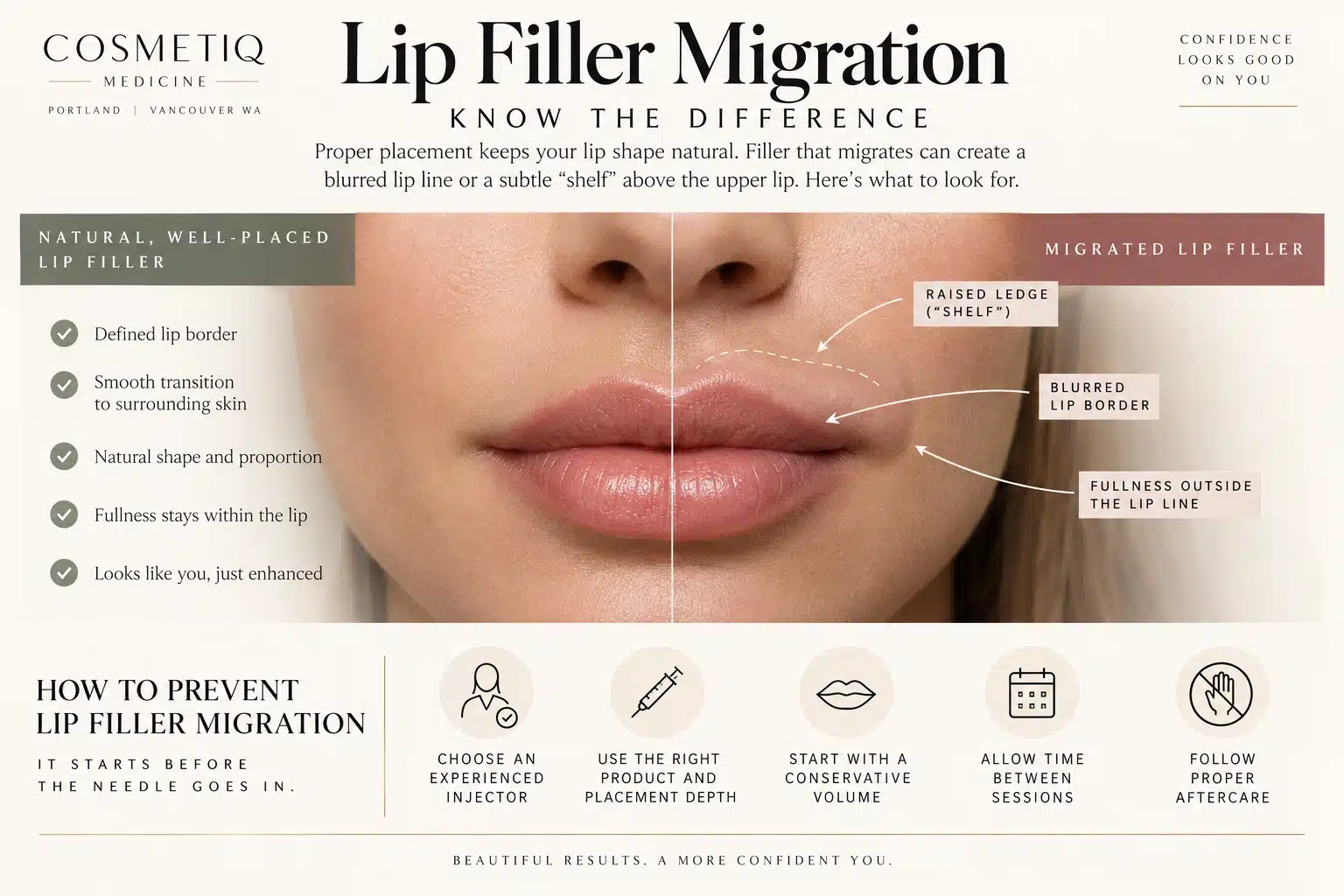
The lip does not look bigger. It looks less defined. That distinction is what separates migration from a result you simply dislike.
Migration Is Not the Same as Swelling
This is the single most common confusion, and the timeline resolves it. Hyaluronic acid attracts water, so lips swell after injection. That swelling peaks within roughly 24 to 48 hours and settles substantially over the first week. It is symmetrical, it is soft, and it recedes.
Migration does not recede. It appears gradually, often weeks after the swelling has fully resolved, and it holds a fixed shape. If your lips looked settled at week three and a raised line above the border appeared at week eight, that is not delayed swelling. If your lips looked enormous on day two and looked normal by day ten, that was swelling behaving exactly as expected.
For a full visual breakdown of what each looks like side by side, our companion piece on identifying migrated lip filler covers the specific signs to check in the mirror.
02Why Lip Filler Migrates
Migration is rarely caused by one mistake. It is usually the accumulation of several small decisions, each defensible on its own, that together ask more of the tissue than it can hold in place.
Placement Depth Is the Primary Driver
The lip has very little room for error. Imaging research using ultrasound to map lip anatomy and filler position has found that the subcutaneous layer of the lip averages under one millimetre, which means filler frequently ends up deeper than intended. That same work associated vertical injection technique with deeper deposition and observable evidence of migration.
The practical consequence is that depth control in the lip is measured in fractions of a millimetre, and technique choice has a direct effect on where product ends up six months later. This is skill, not product marketing.
Product Choice Decides How Far Filler Can Travel
Hyaluronic acid fillers are not interchangeable. They differ in cohesivity, which is how tightly the gel holds itself together, and in how readily they integrate with surrounding tissue. A softer, more spreadable gel placed superficially in a mobile lip behaves very differently from a cohesive product placed in the correct plane.
There is no single product that cannot migrate and no product that always will. What matters is whether the product is matched to your anatomy, your existing filler history, and the plane it is going into. Our overview of how different dermal filler formulations behave explains those differences in more detail.
Volume Beyond What the Tissue Can Support
A lip has a finite capacity to hold product in place without displacing it. Push past that and the filler does not simply stay put and look fuller. It finds the path of least resistance, and in the upper lip that path runs upward and outward across the border.
This is why conservative, staged treatment consistently produces more durable results than a single large session. Half a syringe placed accurately and reviewed at two weeks gives both you and your injector information. A full syringe placed in one sitting gives you a result you cannot adjust for months.
Stacking Sessions Before the Previous Filler Has Resolved
Hyaluronic acid lip filler does not disappear on a neat schedule. Residual product can persist well past the point where the visible result has faded, which means a top-up at month six is often being layered onto filler that is still present. Repeat that across several years and the cumulative load in the lip grows quietly, session by session, until the tissue can no longer hold it in the intended plane.
This is the most under-recognised cause of migration in long-term filler patients, and it is the reason an honest injector will sometimes tell you to wait.
The Vermillion Border Is a Boundary, Not a Target
Border definition is a legitimate technique when the goal is to restore a lip line that has softened with age, and it is a normal part of treating lips that have thinned over time. But treating the border as a place to add volume rather than a line to define is one of the fastest routes to a visible ledge. Product placed on or just above the border has almost nothing holding it in position.
03How to Prevent Lip Filler Migration
Prevention breaks into three windows: what you do before you book, what happens in the treatment room, and how you handle the two weeks afterward. The first window carries the most weight.
Before You Book: The Questions That Matter
The American Academy of Dermatology recommends coming to a filler consultation prepared with your full medical history and a clear set of questions, and its guidance on preparing for filler treatment is a useful baseline. For migration specifically, these are the ones worth asking:
- How much filler do I already have in my lips, and how much of it is likely still present? An injector who cannot answer this is guessing about your starting point.
- Which product are you using, and why that one for my lips? The answer should reference your anatomy, not a brand preference.
- What plane are you injecting into, and how does that reduce migration risk? A clear answer signals technical intent.
- What volume are you proposing today, and why not less? A willingness to start smaller is a good sign.
- What is your policy if I am not happy at the two week review? Every injector should have one.
- Do you keep hyaluronidase on site? This should be a yes without hesitation.
Reviewing an injector’s own work is equally informative. Our treatment results gallery and our lip filler photo series both show borders that remain defined, which is the specific thing to look for rather than overall size.
In the Treatment Room
Migration risk drops when treatment is deliberate rather than efficient. That means product placed in measured increments with the result assessed as it goes, rather than a set volume delivered to a plan fixed before the appointment started. It means the border defined only where definition is actually missing. And it means the injector stopping when the lip has taken what it can hold, even if there is product left in the syringe.
You are entitled to ask what is being done and why while it is happening. An injector who welcomes that question is one worth returning to.
The Two Weeks After Treatment
Aftercare will not rescue a placement problem, but poor aftercare can make a good placement worse while the product is still settling.
- Do not massage, press, or reshape the lips unless you have been specifically told to. Pressure on unsettled filler moves it.
- Skip heat exposure for 48 hours. Saunas, hot yoga, and steam increase swelling and blood flow at the worst possible moment.
- Avoid strenuous exercise for 24 to 48 hours for the same reason.
- Sleep on your back the first night rather than face down into a pillow.
- Go easy on straws and firm lip pressure in the first few days.
- Attend the two week review. This is when small asymmetries are cheap to correct and easy to see.
04Early Signs Worth Catching
Migration caught early is a smaller correction than migration caught after two more rounds of filler have been layered on top of it. Check for these at your two week review and again at three months:
A raised ridge or ledge in the skin just above the upper lip line, visible in profile more than straight on.
A softening or disappearance of the vermillion border, so the lip edge reads blurred rather than crisp.
A faint shadow or line above the lip in certain lighting that was not there before treatment.
Fullness that sits above the lip rather than in it, so the lip looks longer rather than fuller.
A firm, palpable band above the border that does not soften when the lips are relaxed.
Asymmetry that appeared after the swelling fully resolved rather than during it.
05If Filler Has Already Migrated
Migrated hyaluronic acid filler is correctable. Hyaluronidase, an enzyme that breaks down hyaluronic acid, can dissolve the displaced product. The correction is usually staged: dissolve, allow the tissue to settle over several weeks, then reassess whether any new filler is warranted at all.
The mistake to avoid is adding more filler in an attempt to balance out the migrated product. That approach increases the total volume the lip is carrying and generally makes the underlying problem more entrenched. Our guide to dissolving migrated filler walks through the process, the timeline, and what to expect afterward.
If you are weighing whether your result is migration or simply a look you have grown tired of, that distinction changes the plan, and it is worth having assessed in person rather than judged from a phone camera.
Consultation
Have your lips assessed before you add anything
Our expert injectors assess existing filler, border definition, and tissue capacity before recommending a plan. Transparent pricing, no obligation to treat on the day, and same business day scheduling where availability allows.
Explore lip filler in Portland or lip filler at our Vancouver WA clinic, or view current treatment pricing.
06Lip Filler Migration: Frequently Asked Questions
What does lip filler migration look like?
Lip filler migration looks like a raised ridge, ledge, or shadow in the skin just above the upper lip line, with a vermillion border that has become soft or blurred rather than crisp. The lip often appears longer rather than fuller, and the change is usually more obvious in profile than straight on. It holds a fixed shape and does not recede over time.
How do you know if your lip filler migrated?
Compare your lips to pre treatment photos once all swelling has resolved, at roughly three to four weeks. Migration is indicated by a firm band or ledge above the vermillion border that stays firm when the lips are relaxed, a lip border that has lost definition, and fullness that sits above the lip rather than within it. If the change appeared after swelling had already settled, migration is the more likely explanation.
Is it lip filler migration or just swelling?
Timing separates the two. Swelling peaks within 24 to 48 hours of treatment, is soft and symmetrical, and settles substantially across the first week. Migration appears gradually, often weeks after swelling has resolved, holds a fixed shape, and does not reduce on its own. Puffiness on day two is almost always swelling. A defined ledge at week eight is not.
What causes lip filler to migrate above the lip line?
The main causes are filler placed too superficially or in the wrong tissue plane, product placed directly on or above the vermillion border, more volume than the lip tissue can hold in position, repeat sessions layered on filler that has not fully resolved, and a product whose consistency is not matched to the injection plane. Placement depth is the strongest single factor.
How do you prevent lip filler migration?
Prevention is mostly decided before treatment. Choose an experienced injector, start with a smaller volume than you think you want, allow full resolution between sessions rather than topping up early, and ask which product and which injection plane are being used and why. Afterward, avoid massaging the lips, skip heat and strenuous exercise for 48 hours, and attend the two week review.
How common is lip filler migration?
There is no single agreed figure, because migration is often identified visually rather than formally recorded, and mild cases go unreported. It is understood to be more common in patients who have had repeated lip filler over several years than in first time patients, since cumulative product load is a contributing factor. Imaging studies using ultrasound have found filler positioned deeper than intended in a substantial share of treated lips.
Can lip filler migrate after two weeks?
Yes. Migration is not limited to the immediate post treatment period and commonly becomes visible weeks or months later, once swelling has fully resolved and the filler has integrated with the surrounding tissue. Changes appearing well after the two week mark are more likely to be migration than swelling, which is why a review at two weeks and again at three months is worthwhile.
Can migrated lip filler be dissolved?
Yes, if the product is hyaluronic acid based, which most lip fillers are. Hyaluronidase is an enzyme that breaks down hyaluronic acid and can be injected to dissolve displaced product. Correction is usually staged: the migrated filler is dissolved, the tissue is allowed to settle over several weeks, and only then is any new treatment considered.
Does lip filler always migrate eventually?
No. Migration is not an inevitable outcome of lip filler. It is associated with specific and largely controllable factors including injection depth, product selection, cumulative volume, and how frequently sessions are repeated. Patients treated conservatively with appropriate placement can maintain lip filler for years without the border softening.
What is the best lip filler to avoid migration?
No single product prevents migration, and any hyaluronic acid filler can migrate if it is placed in the wrong plane or in excessive volume. What matters more than the brand is matching product cohesivity to your anatomy, your existing filler history, and the intended injection depth. A cohesive gel placed correctly outperforms a premium product placed poorly.
References
- U.S. Food and Drug Administration: Dermal Fillers (Soft Tissue Fillers)
- Ultrasound Evaluation of Lip Anatomy and Filler Placement: Injection Accuracy, Migration, and Demographic Variation
- American Academy of Dermatology: Fillers, Preparation
- American Academy of Dermatology: Fillers, Frequently Asked Questions
This article is general education and is not a substitute for an in person assessment. Individual results and candidacy vary. Speak with our licensed clinical team about your specific situation, or get in touch with either clinic.