Cheap Botox in Portland — The Risks Nobody Tells You About (And Where to Get It Safely)
The search for affordable Botox in Portland is completely reasonable. But there’s a wide gap between a fair price and a dangerous one — and knowing the difference could protect your health, your face, and your money.
Every week, patients come into Cosmetiq Medicine having already tried Botox somewhere else. Sometimes the results were fine. Sometimes they weren’t. And occasionally — more often than most people realize — the product itself was the problem, not the injector. If you’re searching for cheap Botox near you in Portland, this is the most important thing you’ll read before booking.
What Does Botox Actually Cost in Portland?
The average Botox price in Oregon runs between $10 and $18 per unit depending on the provider, their overhead, and their product sourcing. A full forehead treatment typically requires 20 to 30 units. Crow’s feet add another 20 to 30. Masseter jaw slimming can require 40 to 80 units total. So a comprehensive first treatment could run anywhere from $400 to $1,200 depending on areas treated and where you go.
When you see pricing below $8 per unit in Portland — or flat-rate “Botox packages” that don’t disclose units — that gap has to be explained somewhere. Either the provider is losing money (unlikely), the product is heavily diluted, or it isn’t authentic Allergan Botox Cosmetic at all.
The wholesale cost of Allergan Botox Cosmetic to licensed medical providers is not public, but industry estimates put the cost per vial high enough that pricing below approximately $8–$9 per unit makes genuine product at a profit essentially impossible for most practices. Pricing below this threshold should prompt questions.
Why “Cheap Botox” Is a Red Flag — and What’s Behind the Price
There are three ways a Botox provider can offer dramatically lower prices than competitors. Two of them are dangerous.
Dilution
Botox comes as a powder that must be reconstituted with saline before injection. The standard reconstitution is 2.5mL of saline per 100-unit vial, yielding roughly 4 units per 0.1mL. A provider can quietly add more saline — stretching a 100-unit vial to deliver more “units” while charging per unit. The result: you pay for 25 units and receive the potency of 15. Results are weak, don’t last, and patients return thinking they need more product when the real issue is dilution.
Counterfeit or Non-FDA-Approved Product
This is the more serious risk. Counterfeit botulinum toxin products — often sourced outside the US supply chain — have been seized by the FDA and linked to hospitalizations. These products are not manufactured under FDA-regulated conditions, may contain inconsistent concentrations of toxin, and have caused serious neurological injury in documented cases.
Legitimately Lower Overhead
A mobile injector with no clinic, no staff, and low insurance costs can sometimes offer slightly lower pricing while still using real product. This can be fine — or it can mean no emergency protocols, no physician oversight, and no accountability if something goes wrong. The savings may not be worth the trade-off.
The Counterfeit Botox Problem — Real Cases You Should Know About
This isn’t theoretical. The FDA and CDC have both documented cases of counterfeit or misused botulinum toxin products causing serious harm in the United States.
The 2024 Multi-State Botulinum Toxin Outbreak
In April 2024, the CDC and FDA issued a joint health advisory after identifying at least 22 patients across multiple states who were hospitalized following botulinum toxin injections. Several required mechanical ventilation. Investigators found that in many cases, high-potency, non-FDA-approved botulinum toxin products — intended for research or veterinary use — had been injected by unlicensed or minimally licensed providers, often in non-clinical settings. The common thread was extremely low pricing and no verifiable supply chain documentation.
The New Jersey 2004 Case
One of the earliest and most cited cases involved four patients in New Jersey who developed botulism after receiving injections of a concentrated research-grade botulinum toxin. The product was approximately 2,900 times more potent than commercial Botox. All four required hospitalization, and all experienced prolonged weakness and breathing difficulties. The injector was not licensed to practice medicine and had obtained the product outside legitimate medical supply channels. This case directly prompted the FDA to tighten oversight of botulinum toxin products.
Florida Medspa Incidents
Multiple reports from Florida over the past decade have documented patients experiencing prolonged paralysis, difficulty swallowing, and respiratory distress after receiving what was sold to them as “Botox” at deeply discounted prices. Subsequent investigation revealed product obtained from overseas suppliers without FDA clearance. Several providers faced criminal charges. Patients faced months of recovery.
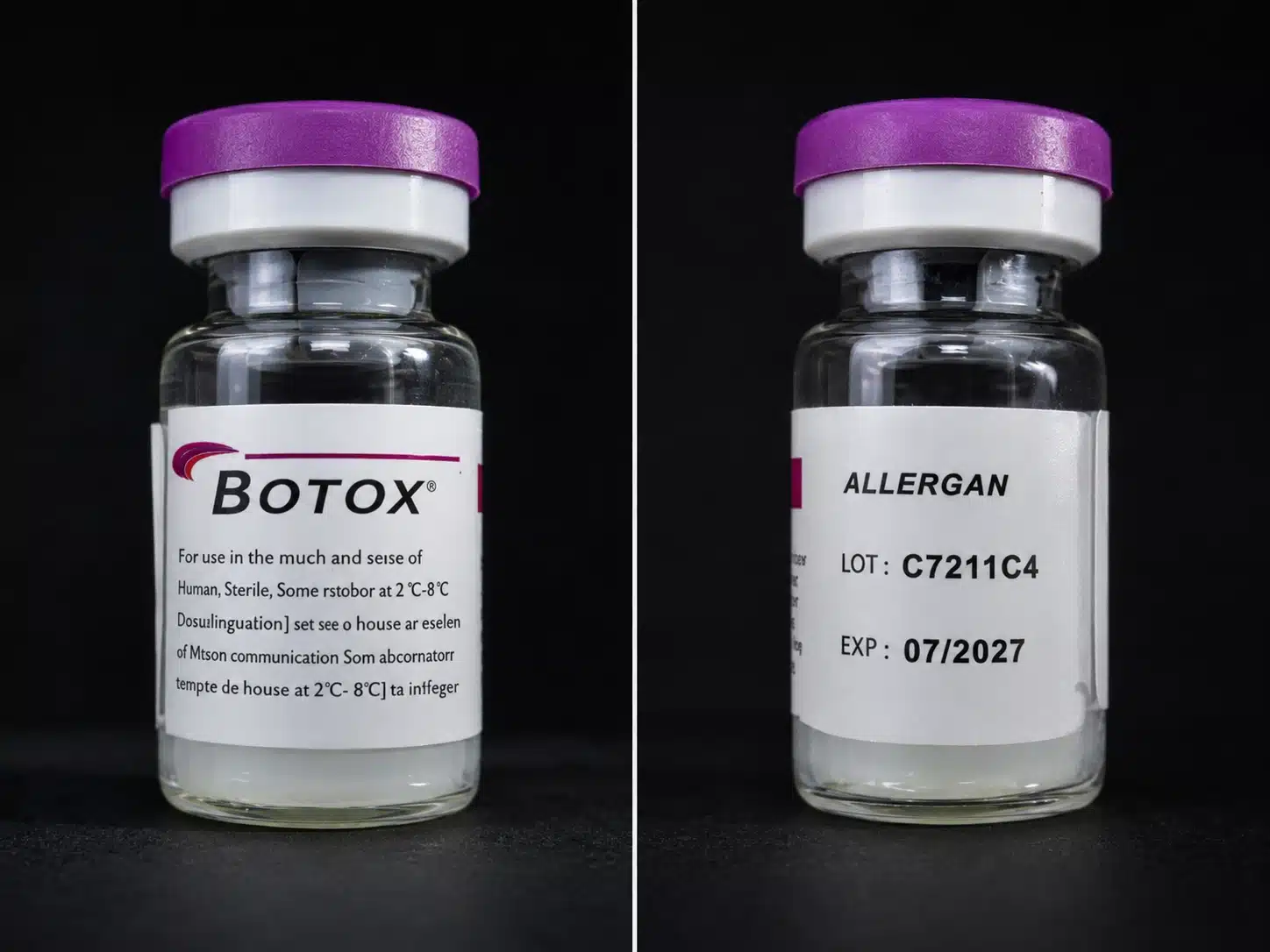
The FDA has explicitly warned that botulinum toxin products from outside the approved US supply chain — including those marketed as “research grade” or sourced from overseas compounders — are not approved for human use and present serious risk of systemic botulism, which can cause difficulty breathing, swallowing, and speaking, and can be fatal.
How to Tell If Your Botox Is Real
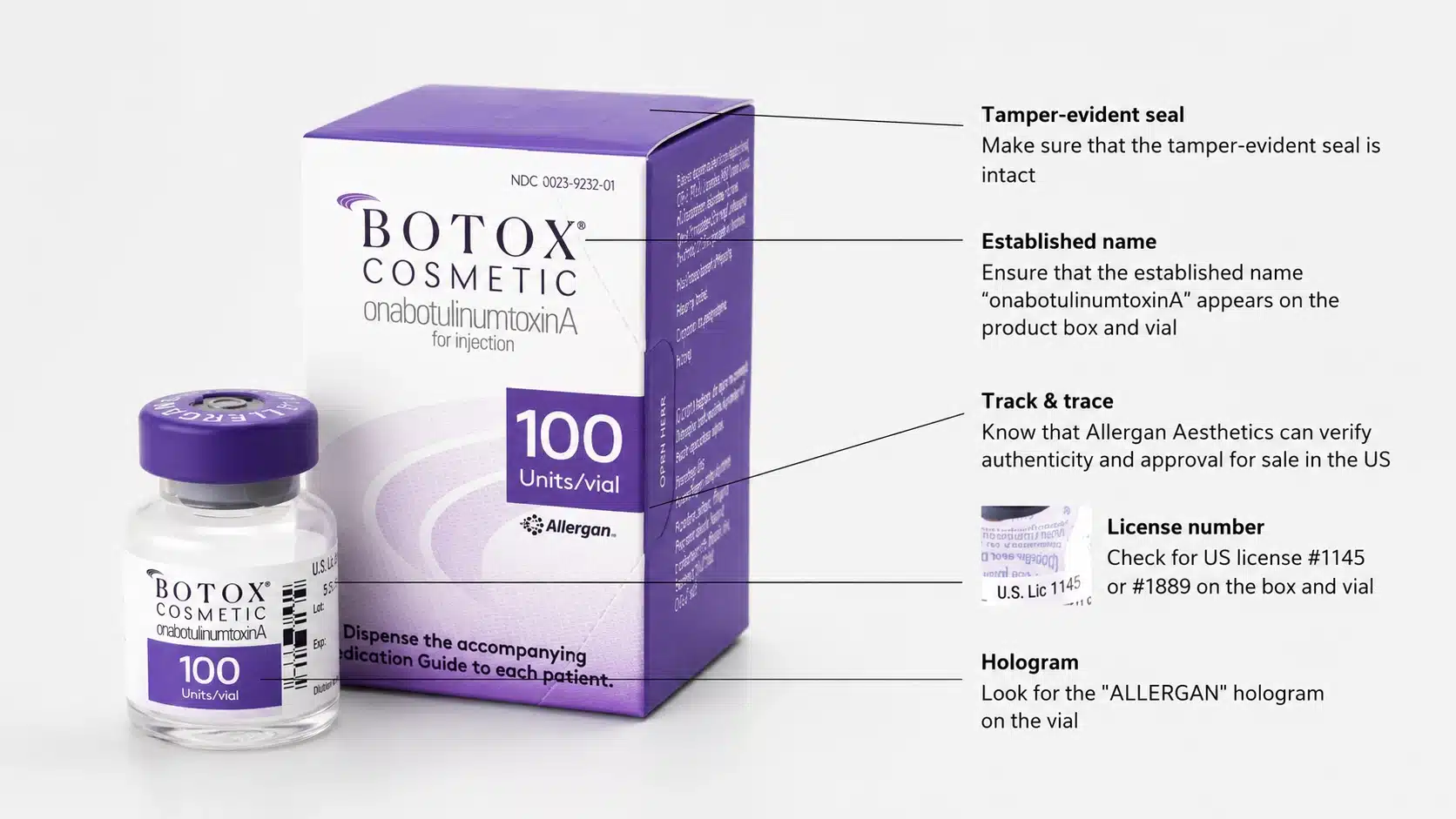
Most patients never see the vial their Botox comes from. Here’s what you’re entitled to ask, and what to look for if you do see it.
Ask to See the Vial
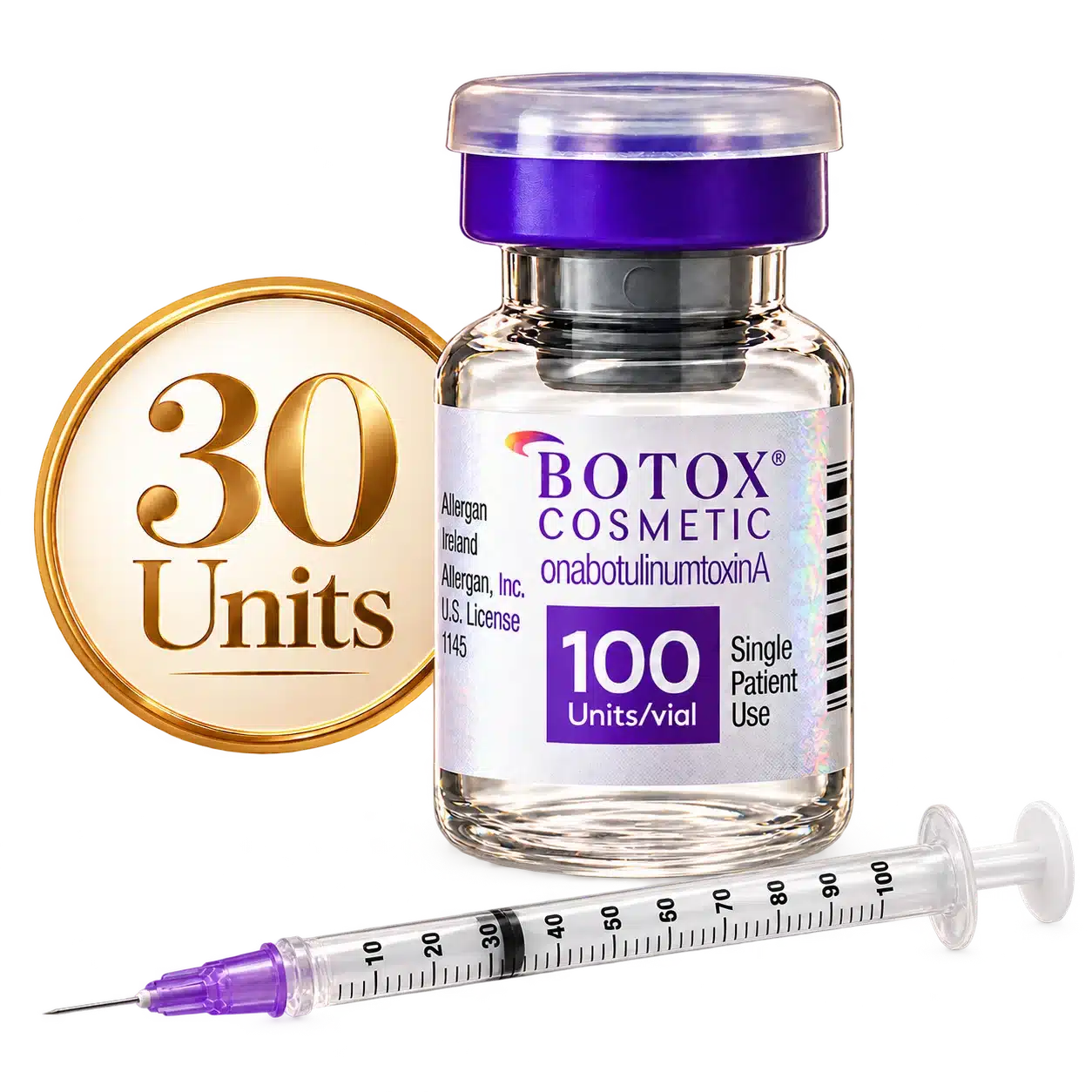
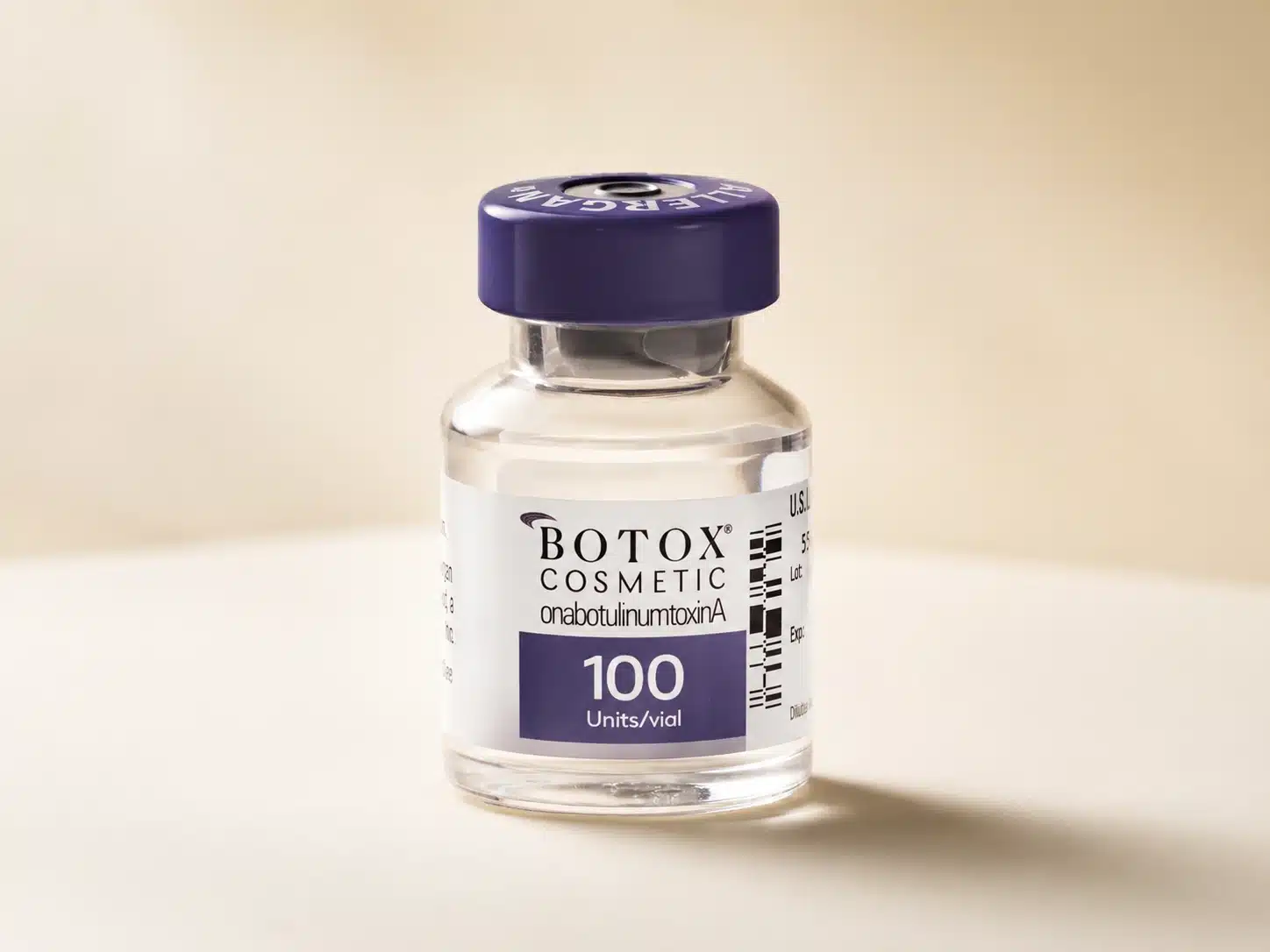
A legitimate provider using authentic Allergan Botox Cosmetic can show you the vial before reconstitution. The vial should have the distinctive Allergan labeling — including the holographic sticker, the NDC number, and the lot number that can be verified. If a provider refuses or says the vial “isn’t available,” that is a reason to leave.
Check the NDC Number
Allergan Botox Cosmetic has a specific National Drug Code (NDC). For the 50-unit vial: 0023-1145-50. For the 100-unit vial: 0023-1145-01. These numbers should appear on the packaging. A product with a different NDC number or no NDC number is not FDA-approved Botox Cosmetic.
Look for the Holographic Seal
Every vial of authentic Allergan Botox Cosmetic includes a holographic seal on the box. This seal is difficult to replicate and has been a consistent feature of genuine product since Allergan introduced anti-counterfeiting measures. Its absence is a red flag.
Verify the Supply Chain
Ask your provider where they source their Botox. The answer should reference an authorized US pharmaceutical distributor — not “overseas,” not “a supplier in Canada,” not “compounded.” Licensed medical practices in the US are required to obtain Botox through FDA-regulated wholesale distributors in the domestic supply chain.
You can verify pharmaceutical products using the FDA’s drug approval database. Legitimate Botox Cosmetic will appear with Allergan as the applicant under its approved NDC numbers.
What Allergan Has Done to Protect Patients
Allergan — the manufacturer of Botox Cosmetic — has been aware of the counterfeiting problem for years and has taken documented steps to address it. These aren’t marketing claims; they’re verifiable features of the product and its supply chain.
Holographic Packaging
Each box of Botox Cosmetic includes a holographic label that is difficult and expensive to replicate accurately. While no anti-counterfeiting measure is foolproof, the hologram provides a baseline verification step that counterfeit products frequently fail.
Lot Traceability
Every vial carries a lot number that traces back to the specific manufacturing batch. In the event of a quality issue, Allergan can identify and recall specific lots. Products sourced outside the legitimate supply chain cannot be traced and cannot be recalled.
The Allergan Advantage Program and Provider Credentialing
Allergan restricts purchase of Botox Cosmetic to licensed medical providers and authorized distributors. The Allé loyalty program — Allergan’s patient-facing rewards platform — only works with providers enrolled in Allergan’s authorized network. If a provider isn’t in the Allé system, they may not be obtaining product through legitimate channels.
The Allergan Diamond Provider Program
Diamond status is the highest tier in Allergan’s Medical Aesthetics provider program. It reflects treatment volume, clinical outcomes, program compliance, and ongoing education. It is not a designation that can be purchased — it is earned through documented treatment of patients using authentic Allergan product. It is one of the most reliable external signals that a practice is using the real thing.
Cosmetiq Medicine holds Allergan Diamond status at both our Portland, OR and Vancouver, WA locations.
The Medical Risks of Counterfeit or Diluted Botox
The risks aren’t just aesthetic. They exist on a spectrum from mild to life-threatening.
Weak or No Results
The best-case scenario with diluted product is that you pay for Botox and simply don’t get the result. The treatment was too weak, wore off in 6 weeks instead of 3 to 4 months, or never worked at all. You’re out several hundred dollars and potentially have an uneven result if one area responded more than another.
Bruising, Swelling, and Infection
Non-sterile product or improper reconstitution increases the risk of localized infection at injection sites. Injectable materials that aren’t manufactured under pharmaceutical-grade sterile conditions can introduce bacteria directly into facial tissue.
Asymmetry and Ptosis
Inconsistent potency in counterfeit or improperly diluted product means one side of the face may respond differently than the other. Brow ptosis — drooping of the brow — is a known complication of improper Botox dosing that can persist for weeks to months.
Systemic Botulism
The most serious risk is botulinum toxin spreading beyond the injection site and affecting systems throughout the body. Symptoms include difficulty swallowing, speaking, and breathing, and generalized muscle weakness. In severe cases this requires hospitalization and ventilatory support. This risk is dramatically higher with high-potency, non-FDA-approved products. The CDC maintains clinical guidance on botulism, including the iatrogenic (injection-related) form.
Difficulty breathing or swallowing · Drooping eyelids that worsen over hours · Generalized muscle weakness · Double vision · Slurred speech. These can indicate botulinum toxin spread and require immediate medical evaluation.
Questions to Ask Before Booking Botox in Portland
Use these as a practical checklist before committing to any provider.
- What brand of botulinum toxin do you use? The answer should be Botox Cosmetic (Allergan), Dysport (Galderma), or Xeomin (Merz) — all FDA-approved. “Our own formula,” “medical-grade toxin,” or vague answers are red flags.
- Can I see the packaging or vial? A reputable provider won’t be offended by this question. It’s your right as a patient.
- Where do you source your product? Should reference a US-based pharmaceutical distributor.
- Who is the supervising physician? Botox is a prescription drug. There must be medical oversight. Ask for the physician’s name and credentials.
- Do you participate in the Allé rewards program? Authorized Allergan providers are enrolled. Non-enrollment may indicate non-standard sourcing.
- How many units will I receive? If a provider quotes you a flat price without discussing units, you have no way to evaluate what you’re actually getting.
- What happens if something goes wrong? An emergency protocol, direct physician access, and liability coverage should exist at any reputable clinic.
Affordable Botox in Portland — The Right Way
Here’s the thing: safe Botox doesn’t have to be expensive Botox. It just has to come from the right place.
At Cosmetiq Medicine on SE Stark St in Portland, we offer authentic Allergan Botox Cosmetic at $12 per unit standard — and as low as $10 per unit for Elite membership patients. That’s among the most competitive legitimate pricing in Portland, and it comes with physician oversight, verifiable product, and a provider who will still be here if you have questions after your appointment.
Cosmetiq Medicine VIP Membership
$10/Unit Botox in Portland — Locked In
Cosmetiq Glow
$100/mo
6-month commitment
- $11/unit Botox — locked in
- 10% off all treatments
- $100 monthly beauty bucks
- Priority scheduling
Best Value
Cosmetiq Elite
$200/mo
12-month commitment
- $10/unit Botox — locked in
- 15% off all treatments
- $200 monthly beauty bucks
- $350 annual treatment reward
Membership pricing applies to authentic Allergan Botox Cosmetic, administered by trained injectors under physician oversight at our Portland Botox clinic at 10735 SE Stark St. Membership bucks valid at both Portland and Vancouver, WA locations.
You can also check our current Botox specials for promotional pricing available without a membership. And if you want to understand exactly what you’ll pay before booking, our treatment pricing page lists current per-unit rates for all injectables.
Not sure what treatment you actually need? Our AI photo treatment planner can help you figure it out before your appointment — just upload a photo and get personalized recommendations based on your specific goals.
Free Patient Guides
Sources
- Centers for Disease Control and Prevention. Botulism — Clinician Information. cdc.gov/botulism
- U.S. Food and Drug Administration. FDA Drug Safety Communication: Updated Boxed Warning for Botulinum Toxin Products. fda.gov
- Allergan Aesthetics. Botox Cosmetic — Full Prescribing Information. allergan.com
- Sobel J, Tucker N, Sulka A, McLaughlin J, Maslanka S. Foodborne botulism in the United States, 1990–2000. Emerging Infectious Diseases. 2004.
- U.S. Food and Drug Administration. FDA warns against use of black market botulinum toxin products. FDA MedWatch Safety Alert, 2024.
- Centers for Disease Control and Prevention. Multistate Outbreak of Botulism Associated with Unlicensed Botulinum Toxin Injections. MMWR, 2024.
Book Authentic Botox in Portland — From $10/Unit
Allergan Diamond provider · physician-led · 10735 SE Stark St, Portland OR