GLP-1 & Weight Loss News
Portland, OR — June 24, 2026 | By Cosmetiq Medicine
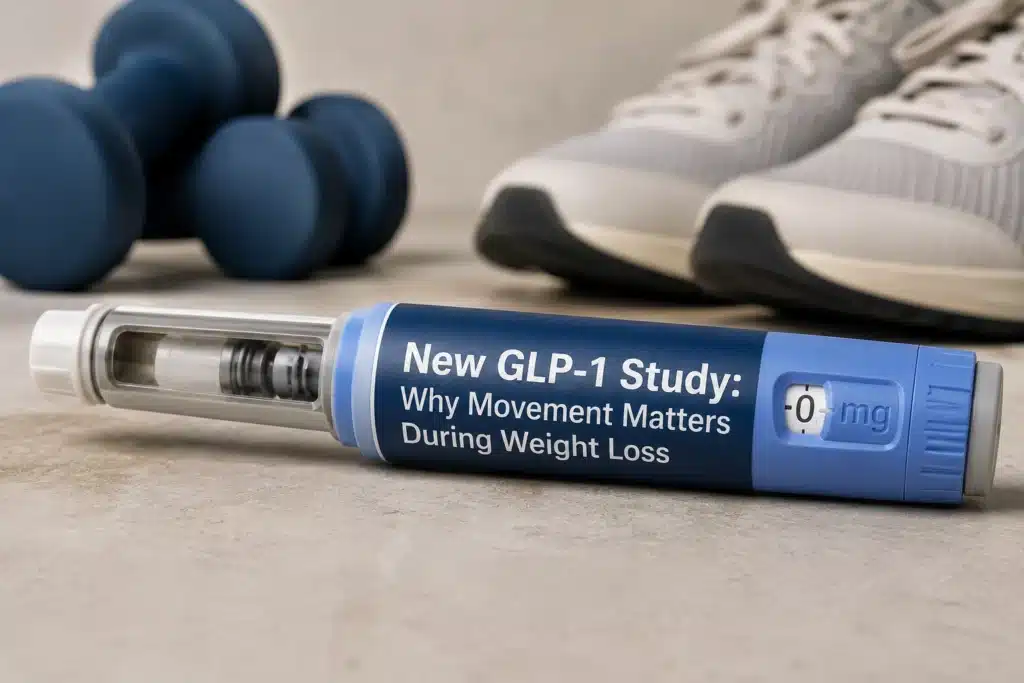
A new study presented at the Endocrine Society’s 2026 annual meeting found that adults losing weight on GLP-1 medications significantly reduced their daily physical activity — the opposite of what many patients expect, and a trend that puts muscle mass at risk during treatment.
What happened
Researchers presenting at ENDO 2026 in Chicago on June 13, 2026 found that adults with obesity who started a GLP-1 receptor agonist — drugs like semaglutide (Ozempic, Wegovy), tirzepatide (Mounjaro, Zepbound), liraglutide, or dulaglutide — became noticeably less physically active after beginning treatment.
The study, led by Sajana Maharjan, M.D. of HSHS St. John’s Hospital in Springfield, Illinois, drew on data from the National Institutes of Health’s All of Us Research Program, which links electronic health records with Fitbit activity data. Of 1,950 adults with obesity who started a GLP-1 medication, 753 had enough wearable-device data to be analyzed. The group was mostly women (78.6%), with an average age of 52.7.
Comparing activity before and after starting treatment, the researchers found average daily steps fell from 5,047 to 4,487, while moderate-to-vigorous physical activity dropped from 28 to 22 minutes per day. The declines were steepest among men and people with joint or muscle pain. Notably, the study found no evidence that losing weight on these drugs led people to move more — even though many assume that getting lighter naturally makes exercise easier.
Why it matters
GLP-1 medications are highly effective at reducing body fat, but they don’t only target fat — they can also reduce lean muscle mass. Muscle doesn’t return as quickly as fat does, and losing it can affect strength, mobility, and long-term metabolic health. If patients are simultaneously becoming less active while on these drugs, as this study suggests, that combination may accelerate muscle loss rather than protect against it.
This is the first large study to use wearable fitness-tracker data, rather than self-reported activity, to examine this pattern in adults taking GLP-1 medications — which makes the findings harder to dismiss as a reporting bias.
What this means for patients in Portland and Vancouver
For anyone starting or currently on a GLP-1 program locally, this study is a reminder that the medication is one part of the plan — not the whole plan. Weight loss alone isn’t a guarantee that the body composition changes underneath it are favorable. A program that pairs GLP-1 treatment with structured strength-focused movement, and that actually checks in on how a patient’s activity and strength are trending over time, is positioned very differently from one that hands over a prescription and little else.
It’s also a useful question to bring to a consultation: ask not just what the medication will do, but what the plan is for protecting muscle and strength while the weight comes off.
“While many assume that weight loss leads naturally to increased physical activity, our study suggests otherwise. The findings in our study reinforce that exercise cannot be optional for people taking these medications.” — Sajana Maharjan, M.D., study lead, Endocrine Society
The bottom line
GLP-1 medications remain a powerful tool for weight loss, but this new research is a clear signal that activity levels don’t take care of themselves once the weight starts coming off — they often move in the opposite direction. As more data like this emerges, the conversation around GLP-1 treatment is shifting from “how much weight can I lose” to “how do I lose weight without losing the muscle and strength that come with it.”
Frequently Asked Questions
What did the new GLP-1 study actually find?
Researchers presenting at ENDO 2026 found that adults with obesity who started a GLP-1 medication became less physically active after beginning treatment. Average daily steps fell from 5,047 to 4,487, and moderate-to-vigorous physical activity dropped from 28 to 22 minutes per day.
Does losing weight on a GLP-1 drug make people more active?
The study found no evidence of that. Even though many assume getting lighter naturally makes movement easier, activity levels declined rather than improved after patients started treatment, regardless of how much weight they lost.
Who was studied, and how reliable is the data?
The study drew on 753 adults from the NIH’s All of Us Research Program who had both GLP-1 prescriptions and Fitbit wearable activity data. Because it used objective device data rather than self-reported activity, it’s considered the first large study of its kind to measure this pattern directly rather than relying on patient recall.
Why does reduced activity matter for someone on a GLP-1 medication?
GLP-1 drugs reduce body fat, but they also reduce lean muscle mass. Muscle is slower to rebuild than fat is to lose, and reduced activity during treatment may accelerate that muscle loss rather than offset it, which can affect strength and mobility over time.
What should someone on a GLP-1 program ask their provider?
Beyond how much weight the medication is expected to help with, it’s worth asking what the plan is for preserving muscle and strength during treatment — including whether structured movement or strength-focused activity is built into the program rather than left up to the patient alone.
Source: Endocrine Society, ENDO 2026 Annual Meeting press release, June 13, 2026.