Aesthetic Medicine News
Portland, OR — June 24, 2026 | By Cosmetiq Medicine
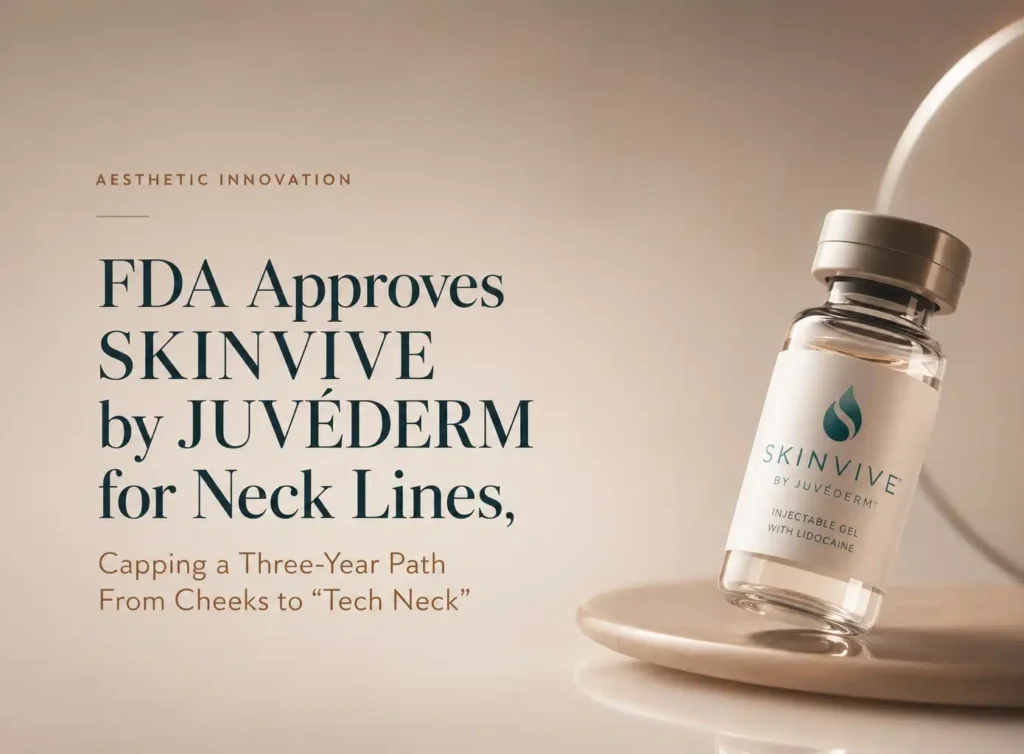
The FDA has approved SKINVIVE by JUVÉDERM for horizontal neck lines — the first hyaluronic acid injectable ever indicated specifically for the neck. The approval landed as a single-day headline for most outlets, but it’s actually the end of a three-year, two-indication regulatory path that started with cheeks in 2023 and only reached the neck after a dedicated Phase 3 trial and a year-long FDA review.
What was approved, exactly
On June 16, 2026, Allergan Aesthetics, an AbbVie company (NYSE: ABBV), announced FDA approval of SKINVIVE by JUVÉDERM to reduce horizontal neck lines and improve neck appearance in adults over 21. It’s the product’s second FDA-cleared use, and the first time any hyaluronic acid injectable has been specifically indicated for this part of the face and neck.
SKINVIVE isn’t a volumizing filler in the traditional sense. It’s a microdroplet HA gel injected just beneath the skin’s surface, designed to improve hydration, smoothness, and texture rather than add structural volume. For the neck specifically, Allergan is positioning it against “tech neck” — the informal term for horizontal neck creasing attributed to years of looking down at phones and screens, alongside the more familiar causes of sun damage, aging, and weight loss.
The three-year road to get here
This wasn’t a fast or simple approval, and the timeline is worth knowing if you’re trying to gauge how seriously to take it:
May 2023 — SKINVIVE by JUVÉDERM receives its original FDA approval, for cheek skin smoothness only. It’s notable at the time as the first HA “skin quality” injectable of its kind in the U.S., distinct from volumizing fillers.
2024–2025 — Allergan runs a dedicated Phase 3 trial (NCT05741034) testing the same formulation specifically for neck lines, enrolling 159 adults in a randomized, evaluator-blinded design with follow-up out to 13 months.
June 30, 2025 — The FDA accepts Allergan’s supplemental premarket approval (sPMA) application for the neck indication for review, based on that trial data.
June 16, 2026 — Nearly a year after accepting the application, the FDA grants approval for the neck indication.
That roughly one-year review window for a supplemental indication on an already-approved device is unremarkable by FDA standards, but it underscores that this wasn’t a quick label tweak — it required new, dedicated trial data specific to the neck, not just an extrapolation from the cheek results.
What the data actually shows
The pivotal trial that supported approval was a randomized, multicenter, evaluator-blinded, controlled study of 105 participants. The primary endpoint was a clinically significant improvement — at least a 1-point gain — on the validated 5-grade Allergan Transverse Neck Lines Scale (ATNLS).
At one month, 74.8% of treated participants hit that benchmark. At six months, 66% had maintained it, and among participants who showed any improvement from baseline, response rates stayed at 78% or higher at every timepoint measured. The earlier sPMA filing had also reported that roughly 80% of patients saw at least a one-grade improvement at one month, with close to 90% reporting visible improvement by a separate clinician-rated scale (GAIS) — slightly different numbers from a related but not identical dataset, which is normal across a multi-study clinical program but worth noting if you see both figures cited.
Side effects were typical for an HA injectable: redness, bruising, tenderness, swelling, firmness, and itching at injection sites, mostly mild and resolving within two weeks. Severe adverse events occurred in fewer than 5% of participants.
The gap nobody’s highlighting: who the trial didn’t include
Here’s the angle that’s gotten almost no attention in coverage so far: Allergan’s own prescribing information states plainly that the safety and effectiveness of the neck treatment has not been studied in patients with darker skin tones. Most outlets reporting this approval have repeated the efficacy numbers without mentioning this limitation at all.
That’s a real and relevant gap, not a footnote to skip past. It doesn’t mean the treatment is unsafe for patients with darker skin tones — it means that specific question simply hasn’t been answered by controlled trial data yet, for either FDA-cleared SKINVIVE indication. If you’re considering treatment and have a deeper skin tone, this is worth raising directly in consultation rather than assuming the published response rates apply equally to you.
When it’s actually available — and what this means locally
Approval doesn’t mean immediate access. The FDA is requiring Allergan to run a mandatory provider training program before any clinician can purchase or administer SKINVIVE for the neck indication, and Allergan says broad commercial availability is expected “later this year” — meaning sometime in the second half of 2026, not necessarily this month.
For patients in the Portland and Vancouver, WA area: if you’re already familiar with JUVÉDERM-family treatments for the face, this is a preview of a complementary option specifically for neck texture and hydration, distinct from neuromodulators or volumizing filler. It’s reasonable to ask about timeline and provider training status at a consultation now, even before it’s commercially available, so you understand where it might fit once it is.
The bottom line
This approval is real and the data behind it is solid — but it’s the product of a multi-year, evidence-driven process, not an overnight innovation, and it comes with a documented evidence gap on darker skin tones that deserves more attention than it’s gotten. Patients curious about it should treat “FDA approved” as the start of an informed conversation with a provider, not the end of one.
Frequently Asked Questions
What is SKINVIVE by JUVÉDERM approved for now?
As of June 16, 2026, the FDA has approved SKINVIVE by JUVÉDERM for two indications: improving skin smoothness of the cheeks (approved May 2023) and reducing horizontal neck lines for improved neck appearance in adults over 21 (approved June 2026). It’s the first hyaluronic acid injectable specifically indicated for the neck.
How long did it take to get SKINVIVE approved for neck lines?
About three years from the original cheek approval. Allergan ran a dedicated Phase 3 trial for the neck indication, the FDA accepted the supplemental premarket approval application for review on June 30, 2025, and granted approval on June 16, 2026 — roughly a one-year review period.
How effective is SKINVIVE for neck lines, according to the clinical trial?
In the pivotal trial of 105 participants, 74.8% achieved a clinically significant improvement on the Allergan Transverse Neck Lines Scale at one month. At six months, 66% maintained that improvement, and response rates among improved patients stayed at 78% or higher at every timepoint measured.
Has SKINVIVE for the neck been studied in all skin tones?
No. Allergan’s own prescribing information states that the safety and effectiveness of SKINVIVE for neck treatment has not been studied in patients with darker skin tones. This applies to both FDA-cleared indications and is worth raising directly with a provider during consultation.
When will SKINVIVE for neck lines be available to patients?
The FDA is requiring a mandatory provider training program before any clinician can purchase or administer SKINVIVE for the neck indication. Allergan anticipates broad commercial availability later in 2026, though an exact date hasn’t been announced.
Sources: Allergan Aesthetics / AbbVie official press release via PR Newswire, June 16, 2026; Managed Healthcare Executive, June 19, 2026; Yahoo Finance / Insider Monkey, June 22, 2026; The Dermatology Digest, June 16, 2026; regulatory timeline per Pharmaceutical Executive, June 30, 2025, and the FDA’s original PMA approval record, May 2023.