Dermal Filler News
Portland, OR — June 24, 2026 | By Cosmetiq Medicine
A new hyaluronic acid filler designed specifically for mid-face volume loss is now under FDA review, after its maker reported trial results that came in stronger than one of the most widely used fillers on the market today. If approved on schedule, Evolysse Sculpt could become commercially available by early 2027 — making it worth knowing about now, even before it’s an option you can book.
What Evolysse Sculpt actually is
Evolysse Sculpt is a hyaluronic acid (HA) gel filler made by Evolus, the company behind the neurotoxin Jeuveau. It’s designed specifically to restore volume in the mid-face — the cheek and upper cheek area that loses structural support as part of natural aging. Sculpt is built using Cold-X technology, developed by the French biomaterials company Symatese, which is intended to better preserve the natural structure of the HA molecule for results that look and move more naturally than some older filler formulations.
It’s the third product in Evolus’s Evolysse collection. The first two, Evolysse Form and Evolysse Smooth, were FDA-approved in February 2025 and are already available in the U.S. Sculpt is positioned as the “flagship” of the line — Evolus describes it as the most structured product in the collection, purpose-built for a higher-volume correction need than Form or Smooth address.
What the trial data actually showed
Evolus ran a U.S. pivotal study comparing Sculpt directly against Restylane-Lyft, one of the most established fillers used for mid-face volume correction. The study enrolled 304 patients in a multicenter, double-blinded, controlled, non-inferiority design, with patients followed for 24 months — a notably long follow-up period for a filler trial.
The primary goal was simply to show Sculpt performed no worse than Restylane-Lyft. It did better than that: Sculpt demonstrated statistical superiority, with a mean mid-face volume deficit severity score difference of -0.26 (p<0.001) in its favor. On the secondary measure, 90.9% of treated cheeks (389 of 428) in the Sculpt group were rated as treatment responders, compared to 83.3% (110 of 132) for Restylane-Lyft — itself a statistically significant difference (p=0.015). Evolus reported that Sculpt’s safety profile was similar to Restylane’s, with no treatment-related serious adverse events in the study.
Evolus has since submitted the final module of its Premarket Approval application to the FDA. The company anticipates a standard PMA review process, with approval expected in the second half of 2026.
“As an investigator in this pivotal study, I was impressed by the durability of results and high levels of patient satisfaction achieved with Evolysse Sculpt. The product handled exceptionally well during injection, delivering the lift and contouring in the mid-face we seek in daily practice.” — Dr. Gilly Munavalli, MD, MHS, study investigator
The angle worth paying attention to: why a head-to-head win against an established filler matters
Most new filler approvals are measured against placebo or judged only on their own merits. This trial did something more useful for patients trying to decide what’s actually worth waiting for: it ran Sculpt directly against a filler many people have already had injected, in a real comparative head-to-head, not just a “does this work at all” study. A 7.6 percentage point gap in responder rate, with statistical superiority rather than just non-inferiority, is a meaningfully different result than “comparable to existing options” — it’s evidence the new formulation may genuinely outperform one of the category leaders, not just match it.
That’s the detail most coverage of this story has buried under the financial and regulatory framing. For a patient who’s already considered or had Restylane-Lyft for cheek volume, that comparison is the single most relevant piece of information in this entire announcement.
What this means if you’re considering filler for volume loss
Nothing changes for treatment available today — Sculpt isn’t approved yet, and even on an optimistic timeline it likely wouldn’t be commercially available until sometime in 2027. If you’re dealing with mid-face volume loss now, today’s dermal filler options, including Restylane-family products, remain well-studied, effective choices with a long safety track record.
Where this is genuinely useful to know now: if you’re the type of patient who likes to understand what’s coming before deciding when to treat, Sculpt is one to keep an eye on through 2026 and into 2027. It’s also a good reason to bring up timing directly at a consultation — your provider can help you weigh whether to treat now with an established option or whether your specific situation makes sense to revisit once newer formulations reach the market.
Frequently Asked Questions
What is Evolysse Sculpt used for?
Evolysse Sculpt is a hyaluronic acid filler designed to restore volume in the mid-face, addressing the cheek and upper cheek volume loss that comes with natural aging. It is currently under FDA review and is not yet commercially available.
How did Evolysse Sculpt perform compared to Restylane?
In a 304-patient U.S. pivotal trial against Restylane-Lyft, Sculpt showed statistical superiority on the primary efficacy measure (p<0.001) and achieved a 90.9% responder rate compared to 83.3% for Restylane-Lyft, with a similar safety profile and no treatment-related serious adverse events.
When will Evolysse Sculpt be available?
Evolus has submitted its Premarket Approval application to the FDA and anticipates approval in the second half of 2026. Commercial availability would likely follow in early 2027, pending approval and standard launch timelines.
Should I wait for Evolysse Sculpt instead of getting filler now?
Not necessarily. Current FDA-approved fillers for mid-face volume remain well-studied and effective. Whether to treat now or wait depends on your individual goals and timeline, which is best discussed directly with your provider.
Sources: AInvest, August 25, 2025; primary data via Evolus, Inc. press release via StockTitan.
Medicare & Weight Loss Access
Portland, OR — July 3, 2026 | By Cosmetiq Medicine
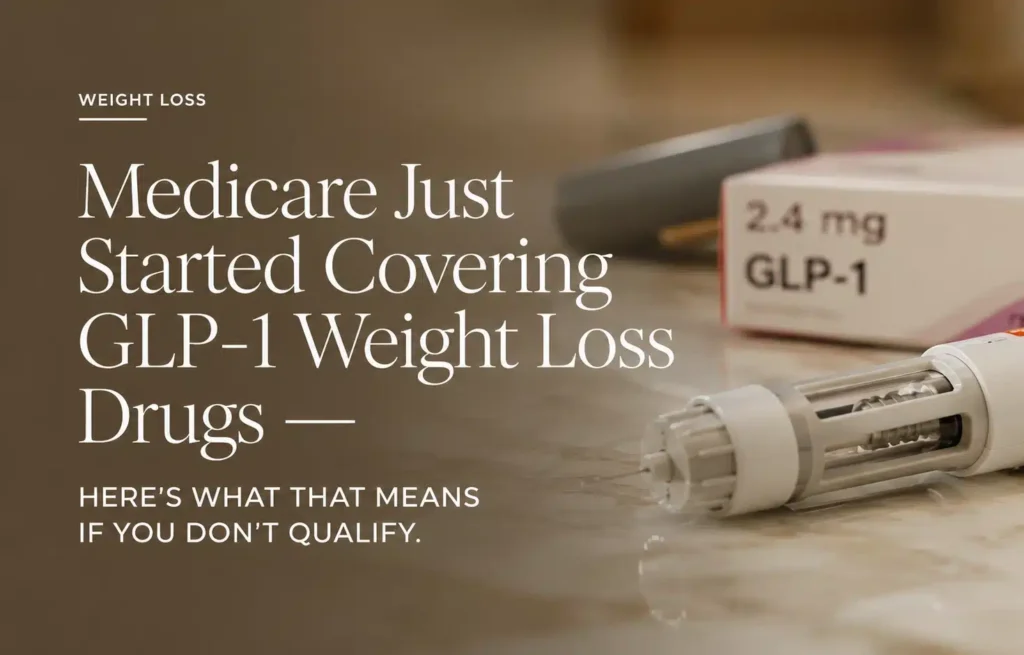
Starting this week, Medicare is covering GLP-1 weight-loss medications for the first time in the program’s history. The new Medicare GLP-1 Bridge took effect July 1, 2026, letting eligible beneficiaries access drugs like Wegovy, Zepbound, and Foundayo for a flat $50 monthly copay — a fraction of the roughly $350 many patients pay out of pocket today. It’s a genuine access breakthrough. But it’s a narrow one, and understanding exactly who it helps, and who it leaves out, matters just as much as the headline.
What Happened: Medicare Opens the Door to GLP-1 Coverage
The Centers for Medicare & Medicaid Services (CMS) launched the Medicare GLP-1 Bridge on July 1, marking the first time federal law has allowed Medicare Part D to help pay for a medication prescribed solely for weight loss. For more than two decades, a federal exclusion blocked Part D plans from covering weight-loss drugs at all, no matter a patient’s health risks.
CMS Administrator Dr. Mehmet Oz pointed to cost as the barrier the program is meant to solve, noting that “too many seniors are currently unable to access them due to high cost.” The Bridge is a temporary fix, not a permanent law change: it runs through December 31, 2027, under a section of federal authority that lets CMS test new approaches to care delivery before Congress acts.
Three medications are covered under the program: Novo Nordisk’s Wegovy, available as both an injection and a pill, and two products from Eli Lilly — the Zepbound KwikPen injection and the Foundayo daily pill. Single-dose Zepbound pens and vials are not included, only the multi-dose KwikPen. Notably absent is Ozempic, the drug that made GLP-1 medications a household name. Ozempic remains FDA-approved for type 2 diabetes rather than weight loss, so it falls outside this program’s scope even though it shares the same active ingredient as Wegovy.
Who Qualifies — and How the Bridge Program Works
Coverage isn’t automatic. A patient has to be enrolled in a participating Medicare Part D plan, and their provider must submit a prior authorization request establishing medical necessity. Beneficiaries need to meet at least one of the following, based on their BMI and health history when they first started GLP-1 therapy:
- A BMI of 35 or higher
- A BMI of 30 or higher, with a history of heart failure, uncontrolled hypertension, or chronic kidney disease
- A BMI of 27 or higher, with prediabetes, a previous heart attack or stroke, or symptomatic peripheral artery disease
Beneficiaries who already have GLP-1 coverage under Part D for a separate condition, such as type 2 diabetes or sleep apnea, aren’t eligible for the Bridge; they stay on their existing coverage. And because the program runs outside standard Part D benefit design, the $50 copay doesn’t count toward a patient’s deductible or their annual out-of-pocket cap, and it can’t be stacked with manufacturer coupons or other discounts.
What the Price Drop Actually Looks Like
Numbers make this easier to grasp than percentages do. Without insurance, Wegovy carries a list price around $1,350 a month, according to GoodRx pricing data. Even through manufacturer self-pay programs, most eligible Medicare-age patients not on the Bridge are still looking at $149 to $449 a month, depending on the drug and dose, per CNN’s reporting on the launch. The $50 flat copay is a genuinely different tier of pricing, not just a modest discount.
Sources: GoodRx and CNN. Figures are representative list and self-pay prices; actual cost varies by drug, dose, pharmacy, and any manufacturer program a patient already qualifies for.
Why This Is Being Called a Turning Point
The Kaiser Family Foundation (KFF), a nonpartisan health policy research organization, estimates that about 3.8 million Medicare beneficiaries currently meet the Bridge’s eligibility criteria. That’s out of roughly 69 million people enrolled in Medicare nationwide, meaning even at launch, only around one in eighteen beneficiaries qualifies.
Juliette Cubanski, KFF’s director of Medicare policy, has been clear that the program doesn’t change federal law permanently; it relies on a temporary demonstration authority instead, and its future past 2027 is genuinely uncertain. Her advice for anyone wondering if they qualify is simple: “a good first step is to talk to their clinician.”
The Angle Most Coverage Is Missing
Nearly every story covering this launch, from CBS to NPR to ABC, frames it purely as a Medicare story. That’s accurate, but it leaves out the bigger picture: this program does nothing for the tens of millions of American adults under 65 who are also managing weight and metabolic health, and who have no path to $50-a-month GLP-1 coverage through this Bridge.
It also, quietly, does very little for most people already on Medicare. KFF’s own numbers show that even among Medicare’s roughly 69 million beneficiaries, only about one in eighteen currently meets the Bridge’s BMI and health-history requirements. For everyone else — under 65, over 65 but ineligible, or simply not interested in navigating a federal prior-authorization process — the real question this news raises isn’t “does Medicare cover this now?” It’s “where can I get affordable, medically supervised GLP-1 care regardless of my age or insurance status?”
How Cosmetiq Medicine Keeps GLP-1 Weight Loss Accessible in Portland & Vancouver
That’s a question we hear often at Cosmetiq Medicine, and it’s one our GLP-1 weight loss program was built to answer directly. You don’t need to be on Medicare, and you don’t need to hit a specific age, to start GLP-1 weight loss treatment with our medical team at either our Portland, OR or Vancouver, WA clinic.
Every patient begins with a full medical consultation and evaluation, not a quick screening questionnaire. From there, our clinical team builds a personalized GLP-1 weight loss treatment plan around your health history, goals, and starting point, with ongoing monitoring and adjustments so your plan keeps working as your body changes. It’s the same structured, medically supervised approach the Medicare Bridge was designed to fund for a narrow slice of seniors, available now to any qualified adult, regardless of age or insurance status.
Cost is the real barrier behind this whole news cycle, which is exactly why CMS built a temporary $50 bridge in the first place. It’s also why we offer payment plans to help make GLP-1 weight loss and our other treatments easier to fit into a monthly budget, so affordable access to GLP-1 weight loss isn’t limited to Medicare beneficiaries or a two-year federal pilot program.
What This Means for Patients Here at Home
For our patients in Portland and Vancouver, this news is genuinely good, even if it doesn’t apply to most of them directly. It signals that federal regulators increasingly view GLP-1 therapy as legitimate, evidence-based medicine worth covering, not a lifestyle drug. That shift in tone tends to ripple outward over time, even for patients whose coverage doesn’t come from Medicare.
In the meantime, our GLP-1 weight loss program remains open at both locations, with the same medical oversight, upfront evaluation, and ongoing monitoring that any responsible GLP-1 program should include, Medicare Bridge or not. If you’ve been priced out, waitlisted, or simply unsure where to start, our team can walk you through eligibility, planning, and the full range of injectable, laser, and wellness treatments that pair well with a weight-management plan.
Bottom Line
Medicare covering GLP-1 medications for weight loss, even temporarily, is a real milestone, the kind of policy shift that’s been debated in Washington for years. But “Medicare now covers it” isn’t the same as “it’s now accessible.” For the vast majority of people asking about GLP-1 weight loss this week, age and insurance status still won’t be the deciding factor at Cosmetiq Medicine.
Frequently Asked Questions
What is the Medicare GLP-1 Bridge program?
It’s a temporary CMS demonstration that lets eligible Medicare Part D beneficiaries access GLP-1 medications prescribed solely for weight loss at a $50 monthly copay. It began July 1, 2026, and is scheduled to run through December 31, 2027.
Which medications does the Bridge program cover?
Wegovy (injection and pill), the Zepbound KwikPen injection, and the Foundayo pill. Ozempic is not included, since it’s approved for diabetes rather than weight loss.
Who qualifies for the $50 copay?
Medicare Part D beneficiaries with a BMI of 35 or higher, a BMI of 30 or higher with heart failure, uncontrolled hypertension, or chronic kidney disease, or a BMI of 27 or higher with prediabetes, a prior heart attack or stroke, or symptomatic peripheral artery disease.
How many people actually qualify?
KFF estimates about 3.8 million of Medicare’s roughly 69 million beneficiaries meet the criteria, a small share of the overall Medicare population.
Do I need Medicare or a certain age to start GLP-1 weight loss treatment at Cosmetiq Medicine?
No. Cosmetiq Medicine’s GLP-1 weight loss program at our Portland, OR and Vancouver, WA locations is open to qualified adults regardless of age or Medicare status, with payment plans available to help manage cost.
Sources: U.S. Centers for Medicare & Medicaid Services · CBS News · CNN · KFF (Kaiser Family Foundation) · GoodRx · Wegovy (Novo Nordisk) · Zepbound (Eli Lilly) · Foundayo (Eli Lilly)